
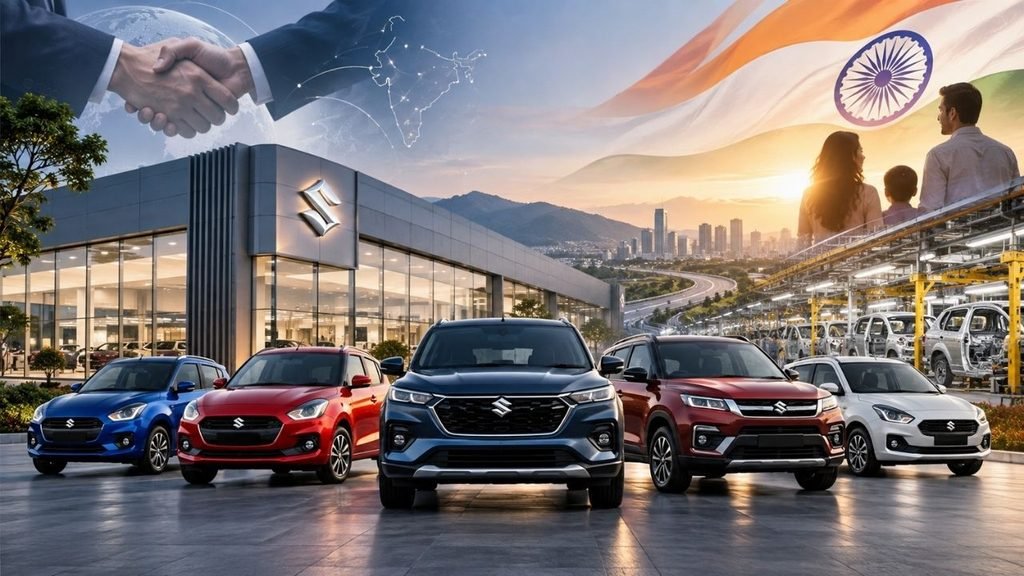
Maruti Suzuki is one of the most important names in the Indian automobile industry. From the iconic Maruti 800 to modern SUVs, CNG cars and the electric e VITARA, the company has built a large presence across India’s passenger-vehicle market.
Maruti Suzuki India Limited is a subsidiary of Suzuki Motor Corporation, Japan. The company was incorporated in 1981 as a joint venture between the Government of India and Suzuki Motor Corporation and began manufacturing cars in India in 1983. Its first major product was the Maruti 800.
Today, Maruti Suzuki operates through multiple retail channels, including ARENA, NEXA and Maruti Suzuki Commercial, while its wider ecosystem also includes True Value, Maruti Suzuki Driving School, genuine parts, accessories and service facilities.
This detailed guide covers Maruti Suzuki history, ownership, manufacturing plants, current car lineup, ARENA, NEXA, CNG, hybrid technology, electric vehicles, service network, exports, sales, production, safety, maintenance and frequently asked questions.
⭐ What Is Maruti Suzuki?
Maruti Suzuki India Limited, commonly known simply as Maruti Suzuki, is an automobile manufacturer operating in India.
The company manufactures and sells passenger vehicles and also has businesses connected with pre-owned cars, fleet management and vehicle financing. Its parent company is Suzuki Motor Corporation of Japan.
The company has grown from a manufacturer associated primarily with small cars into a much broader automobile company with hatchbacks, sedans, SUVs, MPVs, vans, commercial vehicles and electric vehicles.
Maruti Suzuki at a Glance
| Particular | Details |
|---|---|
| Company | Maruti Suzuki India Limited |
| Parent Company | Suzuki Motor Corporation, Japan |
| Incorporated | February 1981 |
| First Major Car | Maruti 800 |
| Manufacturing Started | 1983 |
| Headquarters | New Delhi |
| Major Manufacturing Locations | Haryana and Gujarat |
| Retail Channels | ARENA, NEXA and Commercial |
| Main Business | Passenger vehicles and related automobile services |
| Electric Vehicle | e VITARA |
| Export Reach | More than 100 countries |
| Stock Exchanges | NSE and BSE |
⭐ History of Maruti Suzuki
The history of Maruti Suzuki is closely connected with the development of India’s modern automobile industry.
1981: Formation of the Company
Maruti Udyog Limited was incorporated in February 1981 as a joint venture between the Government of India and Suzuki Motor Corporation, Japan.
The partnership brought Suzuki’s automobile technology and manufacturing experience to India.
1983: Maruti 800
In 1983, Maruti Suzuki introduced the Maruti 800, which became one of the most recognisable cars in India’s automotive history.
The small car played a major role in making personal car ownership more accessible to Indian families.
1987: Exports Begin
Maruti Suzuki began exporting vehicles from India in 1987. The company’s first major export shipment went to Hungary.
Over the following decades, exports became an increasingly important part of the company’s business.
1990s: Expansion of the Product Range
The company expanded its portfolio with models such as:
- Zen
- Esteem
- WagonR
- Alto
These models helped Maruti Suzuki build a presence across different parts of the passenger-car market.
2005: Swift Era
The launch of the Swift created another important chapter for Maruti Suzuki. The model became one of the company’s best-known hatchbacks and has remained an important name in its portfolio.
2015: NEXA
Maruti Suzuki launched NEXA in 2015 as a separate premium retail channel. The objective was to provide a different and more premium vehicle-buying experience.
2016: Compact SUV Expansion
The Vitara Brezza marked an important expansion into the compact SUV segment.
2024: 3 Crore Production Milestone
In 2024, Maruti Suzuki announced that cumulative production had crossed 3 crore vehicles.
2025–26: Electric Vehicle Era
Maruti Suzuki entered the battery-electric vehicle segment with the e VITARA. The company unveiled the model in 2025 and subsequently began exporting it from India.
⭐ Who Owns Maruti Suzuki?
Maruti Suzuki India Limited is a subsidiary of Suzuki Motor Corporation, Japan.
According to the company’s business information, Suzuki Motor Corporation held 56.2% equity at the time of the company’s stated corporate information. The company is publicly listed and its shares trade on both the National Stock Exchange (NSE) and the Bombay Stock Exchange (BSE).
Therefore, Maruti Suzuki is not simply a Japanese company operating independently in India. It is an Indian listed company with Suzuki Motor Corporation as its controlling shareholder.
⭐ Does the Government of India Still Own Maruti Suzuki?
Maruti Suzuki has an important connection with the Government of India because the company was originally established in 1981 as a joint venture between the Government of India and Suzuki Motor Corporation, Japan. At that time, the Government of India had an equity stake in the company.
However, Maruti Suzuki is not a government-owned company today, and the Government of India does not currently hold an equity stake in Maruti Suzuki India Limited.
Over the years, the ownership structure changed, and Suzuki Motor Corporation became the controlling shareholder. According to Maruti Suzuki’s current corporate information, Suzuki Motor Corporation owns 56.2% equity in Maruti Suzuki India Limited. The remaining shares are held by other shareholders, including public investors. The company is listed on both the National Stock Exchange (NSE) and the Bombay Stock Exchange (BSE).
Maruti Suzuki Ownership: Then vs Now
| Period | Ownership Position |
|---|---|
| 1981 | Joint venture between Government of India and Suzuki Motor Corporation |
| Earlier years | Government of India held an equity stake |
| Current position | Government of India has no equity stake |
| Current major shareholder | Suzuki Motor Corporation, Japan |
| Suzuki’s current equity | 56.2% |
| Company status | Publicly listed company |
So, saying “Maruti Suzuki was started by the Government of India” is historically correct in the context of its original joint-venture structure. However, saying “Maruti Suzuki is a government company” would be incorrect for its current ownership structure.
Today, Maruti Suzuki India Limited is a publicly listed company and a subsidiary of Suzuki Motor Corporation, Japan.
⭐ Where Are Maruti Suzuki Cars Manufactured?
Maruti Suzuki has developed a large manufacturing footprint in India.
As of FY 2025–26, the company stated that it operated four manufacturing facilities:
- Gurugram, Haryana
- Manesar, Haryana
- Kharkhoda, Haryana
- Hansalpur, Gujarat
Together, these facilities had an installed annual capacity of approximately 24 lakh vehicles.
The company has also identified land for another manufacturing facility at Khoraj Industrial Estate in Sanand, Gujarat. The proposed facility is planned with an annual capacity of 10 lakh units once fully operational.
⭐ Maruti Suzuki Production Capacity
Maruti Suzuki has reached very large production volumes in India.
In FY 2025–26, the company reported its highest-ever annual production of more than 23.4 lakh vehicles. The company identified Dzire, Fronx, Swift, Ertiga and Baleno as the five highest-produced models during that year, with each crossing the two-lakh-unit mark.
This large manufacturing scale is supported by an extensive supplier and dealer ecosystem.
⭐ Maruti Suzuki Sales in FY 2025–26
Maruti Suzuki reported total sales of 24,22,713 vehicles in FY 2025–26.
This included:
- Domestic sales including LCV: 18,61,704
- Sales to other OEMs: 1,13,235
- Exports: 4,47,774
- Total sales: 24,22,713
The company said all three major figures—total sales, domestic sales and exports—were record highs for the company.
FY 2025–26 Sales Snapshot
| Category | Units |
|---|---|
| Domestic sales including LCV | 18,61,704 |
| Sales to other OEMs | 1,13,235 |
| Exports | 4,47,774 |
| Total sales | 24,22,713 |
⭐ Maruti Suzuki Car Models
Maruti Suzuki’s current portfolio covers several categories.
The company’s retail channels list models including:
ARENA Cars
The ARENA portfolio includes models such as:
- Alto K10
- S-Presso
- Celerio
- WagonR
- Swift
- Dzire
- Brezza
- Ertiga
- Eeco
- Victoris
The exact portfolio can change as new models are introduced or existing models are updated.
NEXA Cars
NEXA currently includes models such as:
- Baleno
- Fronx
- Grand Vitara
- XL6
- Jimny
- Invicto
- e VITARA
Commercial Vehicle
Maruti Suzuki also sells commercial vehicles, including the Super Carry light commercial vehicle.
⭐ Maruti Suzuki ARENA
ARENA is Maruti Suzuki’s mainstream retail channel.
It focuses on a wide range of customers and includes several of the company’s popular mass-market models.
The company describes ARENA as its legacy-oriented retail channel focused on accessibility and performance.
ARENA is particularly important for customers looking for models such as:
- Alto K10
- WagonR
- Swift
- Dzire
- Brezza
- Ertiga
- Eeco
⭐ What Is Maruti Suzuki NEXA?
NEXA is Maruti Suzuki’s premium retail channel.
It was launched in July 2015 to create a different vehicle-buying experience and attract customers looking for a more premium retail environment.
NEXA sells models such as:
- Baleno
- Fronx
- Grand Vitara
- XL6
- Jimny
- Invicto
- e VITARA
In February 2026, Maruti Suzuki announced the opening of its 200th NEXA Studio and said its NEXA network had more than 740 outlets across more than 530 cities.
⭐ Maruti Suzuki True Value
Maruti Suzuki True Value is the company’s pre-owned vehicle business.
It provides a network for buying and selling used cars.
The company positions True Value around:
- Pre-owned vehicle sales
- Vehicle evaluation
- Assured value
- Transparency
- Used-car buying and selling
True Value is part of Maruti Suzuki’s wider automobile ecosystem.
⭐ Maruti Suzuki CNG Cars
CNG has become an important powertrain option in Maruti Suzuki’s Indian portfolio.
The company offers CNG versions across selected models, allowing customers to choose a factory-fitted CNG vehicle instead of converting a petrol car through an aftermarket kit.
Depending on the model, customers can find CNG options in parts of the Maruti Suzuki range.
Advantages of Factory-Fitted CNG
- Designed and integrated by the manufacturer
- Dedicated CNG system
- Petrol and CNG fuel options on applicable models
- Suitable for customers with high daily running
- Can reduce fuel expenditure depending on fuel prices and driving conditions
Actual fuel economy depends on driving style, traffic, load, road conditions and vehicle maintenance.
⭐ Maruti Suzuki Hybrid Technology
Maruti Suzuki also offers vehicles using hybrid technology.
The company’s hybrid portfolio is particularly associated with models such as the Grand Vitara, where hybrid technology is offered alongside other powertrain choices.
Hybrid vehicles use an internal combustion engine together with an electric motor and battery system.
This technology can help improve fuel efficiency under suitable driving conditions.
However, buyers should distinguish between:
- Mild hybrid
- Strong hybrid
- Plug-in hybrid
- Battery electric vehicle
These technologies work differently and should not be treated as the same thing.
⭐ Maruti Suzuki Electric Cars
Maruti Suzuki has entered the battery-electric vehicle market with the e VITARA.
The company describes e VITARA as its first electric SUV. It was unveiled in 2025, and Maruti Suzuki subsequently began exporting it from its Hansalpur facility.
The Hansalpur facility in Gujarat serves as the global production hub for e VITARA, according to the company.
This marks an important change in Maruti Suzuki’s product strategy, which has historically included petrol, CNG and hybrid technologies.
⭐ Maruti Suzuki Export Business
Exports have become a major part of Maruti Suzuki’s operations.
In FY 2025–26, the company exported 4,47,774 vehicles, its highest-ever annual export volume. The company reported exports to more than 100 countries.
The export portfolio includes different types of vehicles, including SUVs, hatchbacks, sedans and electric vehicles.
In calendar year 2025, Maruti Suzuki said it exported 3.95 lakh vehicles, with exports increasing by more than 21% compared with 2024.
⭐ Maruti Suzuki Service Network
After-sales service is an important part of the company’s business model.
Maruti Suzuki has built an extensive service network across India, allowing customers to access:
- Periodic maintenance
- Repairs
- Genuine spare parts
- Accessories
- Vehicle inspection
- Warranty-related services
- Breakdown assistance
- Service booking
The company announced its 5,000th service touchpoint in 2024.
Customers should use authorised service facilities for scheduled maintenance and warranty-related work.
⭐ Maruti Suzuki Genuine Parts
Maruti Suzuki provides genuine replacement parts through its authorised ecosystem.
Using genuine parts can be important because vehicle components are designed according to the manufacturer’s specifications.
When replacing an important component, customers should verify:
- Part compatibility
- Part number
- Vehicle model
- Manufacturing year
- Authorised source
The company also promotes its genuine parts and accessories ecosystem.
⭐ Maruti Suzuki Driving School
Maruti Suzuki also operates Maruti Suzuki Driving School, which is part of the company’s wider mobility ecosystem.
The service is intended to help people learn driving through structured training rather than simply learning informally.
Availability and course offerings can vary by location.
⭐ Maruti Suzuki Safety
Safety is an important consideration when choosing any car.
Modern Maruti Suzuki vehicles come with various safety technologies depending on the model and variant.
These may include features such as:
- Airbags
- ABS with EBD
- Electronic stability-related systems on applicable models
- Reverse parking assistance
- Electronic safety systems
- Seat-belt reminders
- ISOFIX child-seat mounts on applicable models
- Cameras and sensors on selected variants
However, safety features differ significantly between models and variants.
Therefore, buyers should check the exact variant’s official specifications rather than assuming that a feature available on one Maruti Suzuki model is available on every model.
⭐ Maruti Suzuki Maintenance
Regular maintenance is necessary for any vehicle.
Typical maintenance can include:
- Engine oil replacement
- Oil filter replacement
- Air filter inspection/replacement
- Brake inspection
- Tyre inspection
- Battery inspection
- Coolant inspection
- AC system checks
- Wheel alignment and balancing when required
- Periodic service according to the manufacturer’s schedule
For CNG vehicles, additional attention should be given to the CNG system and related components.
For hybrid and electric vehicles, specialised high-voltage systems require appropriate service procedures.
⭐ Maruti Suzuki After-Sales Services
Maruti Suzuki’s wider service ecosystem includes:
- Vehicle servicing
- Genuine parts
- Genuine accessories
- Service booking
- Roadside assistance
- Customer support
- Driving school
- Used-car services
The company’s official business channels also provide access to service and genuine-parts information.
⭐ Why Is Maruti Suzuki So Widely Used in India?
Maruti Suzuki has built its position over several decades through a combination of factors.
Some of the important elements of its business model include:
Large Product Portfolio
Customers can choose between small hatchbacks, sedans, SUVs, MPVs, vans, commercial vehicles, CNG models, hybrids and EVs.
Extensive Retail Network
ARENA and NEXA allow the company to serve different customer segments.
Large Service Ecosystem
A broad service network makes routine maintenance and repairs easier to access in many parts of India.
Manufacturing Scale
The company’s large manufacturing capacity allows it to produce vehicles in significant volumes.
Export Infrastructure
India is increasingly being used as an export base for Suzuki vehicles, with Maruti Suzuki shipping vehicles to more than 100 countries.
⭐ Maruti Suzuki’s Future Plans
Maruti Suzuki is expanding its production capacity and product portfolio.
The company has stated that it aims to increase annual production capacity to around 40 lakh units by FY 2030–31. It is also expanding its manufacturing footprint and working on new products and powertrain technologies.
The company has already entered the electric vehicle market with e VITARA, while continuing with multiple powertrain technologies.
Its future strategy therefore involves more than one technology rather than depending exclusively on petrol, CNG, hybrid or electric vehicles.
⭐ Maruti Suzuki Company Leadership
Maruti Suzuki’s current corporate leadership includes R.C. Bhargava as Chairman and Hisashi Takeuchi as Managing Director & CEO, according to the company’s official corporate information.
The company has a board and management team responsible for areas including production, sustainability, corporate planning and other functions.
⭐ Maruti Suzuki: Important Milestones
| Year | Major Development |
|---|---|
| 1981 | Maruti Udyog Limited incorporated |
| 1983 | Maruti 800 introduced |
| 1987 | Major export shipment to Hungary |
| 1990s | Zen, Esteem, WagonR and Alto expanded the portfolio |
| 2015 | NEXA launched |
| 2016 | Vitara Brezza launched |
| 2022 | Major solar-energy milestone at Manesar |
| 2024 | 3 crore cumulative production milestone |
| 2024 | 5,000th service touchpoint |
| 2025 | e VITARA unveiled |
| 2025 | e VITARA exports started |
| 2026 | Record FY 2025–26 sales of 24.22 lakh vehicles |
⭐ Conclusion
Maruti Suzuki has evolved considerably since the launch of the Maruti 800 in 1983. From small hatchbacks, the company has expanded into SUVs, sedans, MPVs, CNG vehicles, hybrid technology and now battery-electric vehicles.
Its business today includes manufacturing, domestic sales, exports, ARENA and NEXA retail channels, True Value pre-owned cars, servicing, genuine parts and driving schools. In FY 2025–26, the company recorded its highest-ever total sales of 24.22 lakh vehicles and exports of 4.47 lakh vehicles.
The company’s expansion of manufacturing capacity and entry into electric vehicles indicate that its product strategy is continuing to evolve alongside India’s changing automobile market.
For more detailed information about cars, banking, government services, technology and other useful topics, visit Sarkari Bakery.
⭐ Frequently Asked Questions About Maruti Suzuki
Based on Google's Helpful Content System, this article emphasizes user value, transparency, and accuracy. It incorporates principles of E-E-A-T (Experience, Expertise, Authoritativeness, Trustworthiness).
Why Choose Sarkari Bakery?
Official Information
Government schemes & banking information based on official sources.
Step-by-Step Guides
Simple application process explained for every service.
Regular Updates
Content updated whenever official rules or services change.
People-First Content
Helpful, transparent and user-focused content.