
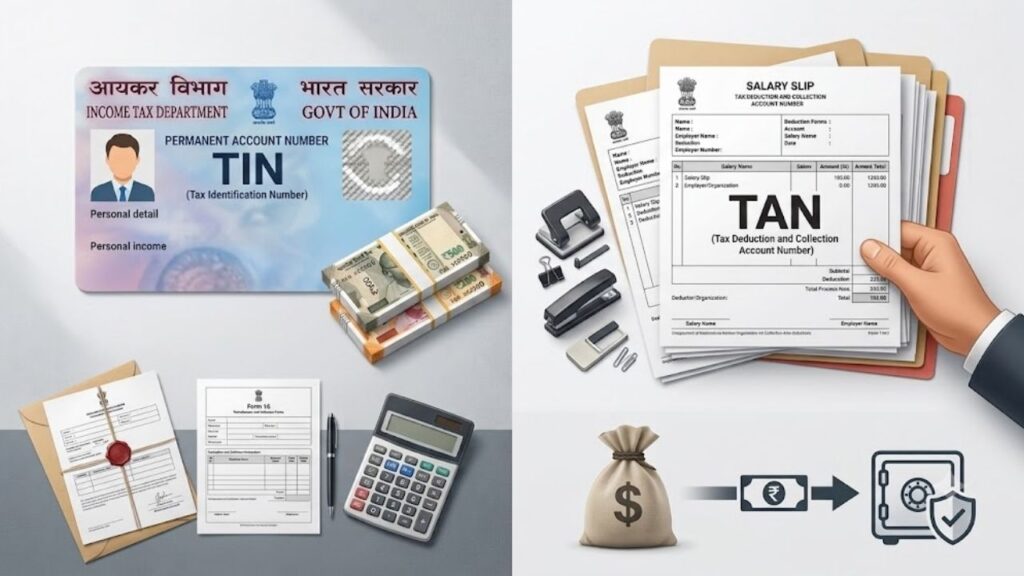
Many taxpayers and business owners often confuse TIN and TAN, but these two numbers serve completely different purposes. While TIN (Taxpayer Identification Number) was primarily used for VAT-related transactions, TAN (Tax Deduction and Collection Account Number) is mandatory for deducting or collecting tax at source under the Income Tax Act.
If you’re wondering “What is the difference between TIN and TAN?”, this guide explains everything in simple language.
What is TIN?
TIN (Taxpayer Identification Number) is an identification number that was issued to businesses registered under the Value Added Tax (VAT) system.
Earlier, TIN was mainly used for:
- VAT registration
- Sale and purchase of goods
- Interstate trade
- Tax identification of dealers
After the introduction of GST (Goods and Services Tax) in July 2017, TIN has largely been replaced by GSTIN for indirect tax purposes.
Key Features of TIN
- Full Form: Taxpayer Identification Number
- Usually an 11-digit number
- Issued by State Commercial Tax Department
- Used under the VAT system
- Mostly replaced by GSTIN
Form 49B: What It Is, How to Fill It & Download TAN Application Form
What is TAN?
TAN (Tax Deduction and Collection Account Number) is a unique 10-character alphanumeric number issued by the Income Tax Department.
It is mandatory for every person or entity responsible for:
- Deducting TDS (Tax Deducted at Source)
- Collecting TCS (Tax Collected at Source)
Without TAN, a deductor generally cannot file TDS returns or deposit TDS correctly.
Example of TAN
DELD12345A
Key Features of TAN
- Full Form: Tax Deduction and Collection Account Number
- 10-character alphanumeric number
- Issued by the Income Tax Department
- Mandatory for TDS and TCS compliance
- Used while filing TDS returns
TIN vs TAN: Difference Table
| Basis | TIN | TAN |
|---|---|---|
| Full Form | Taxpayer Identification Number | Tax Deduction and Collection Account Number |
| Issued By | State Commercial Tax Department | Income Tax Department |
| Purpose | VAT identification | TDS and TCS compliance |
| Number Format | Usually 11 digits | 10-character alphanumeric |
| Applicable Law | VAT Act | Income Tax Act |
| Used For | Sale and purchase of goods | Tax deduction and collection |
| Mandatory For | VAT dealers (before GST) | Every TDS deductor |
| Current Status | Mostly replaced by GSTIN | Still mandatory |
TIN vs GSTIN
Many people confuse TIN with GSTIN.
| TIN | GSTIN |
|---|---|
| Used before GST | Used after GST implementation |
| VAT registration number | GST registration number |
| State-specific | Nationwide GST system |
| Mostly discontinued | Currently active |
Who Needs TAN?
You generally need TAN if you:
- Deduct employee salary TDS
- Deduct contractor payments
- Deduct rent TDS
- Deduct professional fees TDS
- Collect TCS
- File quarterly TDS returns
What is MMID? Meaning, Full Form, Importance & How to Generate an MMID Code
Who Needed TIN?
TIN was mainly required by:
- Traders
- Manufacturers
- Wholesalers
- Retailers
- Businesses registered under VAT
Today, these businesses usually require GSTIN instead of TIN.
Format of TAN
A TAN consists of 10 characters.
Example:
ABCD12345E
Structure:
- First 4 letters → Jurisdiction and deductor
- Next 5 digits → Unique number
- Last letter → Alphabetic check digit
Can a Business Have Both TAN and GSTIN?
Yes.
A business may have:
- GSTIN for GST compliance
- TAN for TDS deduction
- PAN for Income Tax purposes
Photo With Name and Date – Meaning, Importance, and Where It Is Required
All three numbers serve different purposes.
Is TIN Still Valid?
Since GST replaced VAT in most cases:
- New businesses generally receive GSTIN.
- Old TIN numbers are no longer used for GST compliance.
- However, historical records may still contain TIN.
Is TAN Mandatory?
Yes.
If you’re liable to deduct TDS or collect TCS, obtaining TAN is mandatory under the Income Tax Act.
Failure to obtain or quote TAN where required may result in penalties.
How to Apply for TAN?
You can apply for TAN by:
- Filling Form 49B
- Applying online through the NSDL/Protean portal
- Applying through authorized TIN Facilitation Centers
After verification, the TAN is allotted by the Income Tax Department.
Common Mistakes People Make
Avoid these common mistakes:
- Confusing TAN with PAN.
- Assuming GSTIN replaces TAN.
- Using PAN instead of TAN while filing TDS returns.
- Thinking TIN and GSTIN are the same.
- Applying for TAN when only GST registration is required.
How to Compare Two Mutual Funds: Importance, Key Factors, and Smart Decision Tips
Conclusion
TIN and TAN are two completely different identification numbers used for different tax purposes. TIN was mainly associated with the old VAT system and has largely been replaced by GSTIN. TAN, however, continues to be an essential requirement for businesses and employers responsible for deducting or collecting tax at source. Understanding the difference helps ensure proper tax compliance and avoids unnecessary penalties.
For more easy-to-understand tax guides and government-related updates, visit Sarkari Bakery.
Frequently Asked Questions (FAQs)
Based on Google's Helpful Content System, this article emphasizes user value, transparency, and accuracy. It incorporates principles of E-E-A-T (Experience, Expertise, Authoritativeness, Trustworthiness).
Why Choose Sarkari Bakery?
Reliable guidance to help you understand government schemes, online applications and essential digital services.
Official Information
Information presented with relevant official sources wherever available.
Step-by-Step Guides
Clear instructions to understand application procedures and requirements.
Regular Updates
Helpful updates and guidance when information changes or becomes available.
People-First Content
Practical explanations designed around the questions citizens commonly ask.
GOOGLE BUSINESS PROFILE
Explore Our Profile
Visit our Google Business Profile to check the latest available business information and customer reviews.
View Google ReviewsPlease check Google for the current rating and available reviews.
Pingback: Compare Two Mutual Funds: Registration, Status & Benefits