
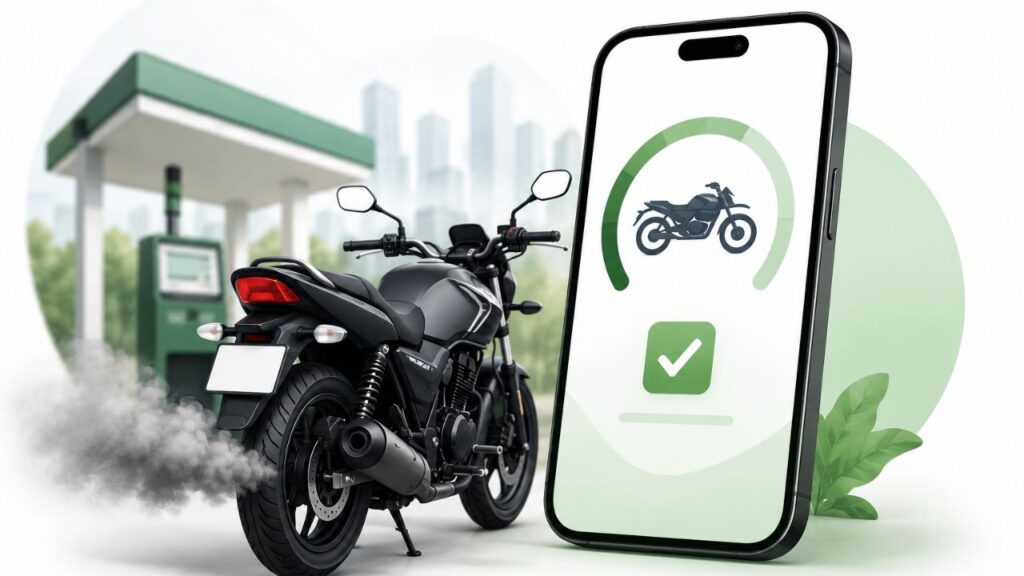
Owning a bike in India comes with several legal responsibilities, and one of the most important is maintaining a valid Pollution Under Control (PUC) Certificate. Many riders only remember the pollution check when they are stopped by traffic police or receive an e-challan.
However, a pollution certificate is not just another document to avoid fines. It helps ensure that your motorcycle meets the pollution standards set by the government and contributes to cleaner air. Riding without a valid PUC certificate can lead to heavy penalties under the Motor Vehicles Act and may also create issues during vehicle inspections or insurance claims.
This guide explains everything you need to know about bike pollution checks, including how the test is conducted, where to get a PUC certificate, validity, fees, penalties, and common mistakes to avoid.
What is a Bike Pollution Check?
A bike pollution check is a test conducted to measure the amount of harmful gases emitted from your motorcycle’s exhaust.
After successfully passing the emission test, the vehicle owner receives a Pollution Under Control (PUC) Certificate, which confirms that the bike complies with the emission standards prescribed by the government.
This certificate acts as proof that your vehicle is not causing excessive air pollution.
Why is a Pollution Certificate Important?
Many riders believe the certificate is only required to avoid traffic fines, but it serves several important purposes.
Benefits of a Bike Pollution Certificate
- Helps reduce air pollution.
- Ensures the engine is functioning efficiently.
- Required during traffic inspections.
- Mandatory under the Motor Vehicles Act.
- Helps identify engine problems early.
- Supports environmental protection efforts.
Keeping your PUC certificate updated also demonstrates responsible vehicle ownership.
Is a Pollution Certificate Mandatory?
Yes. Every petrol and diesel motorcycle running on public roads must have a valid Pollution Under Control Certificate unless exempted under applicable rules.
Driving without a valid PUC certificate may attract penalties during traffic inspections.
When Should You Get a Bike Pollution Check?
The timing depends on whether your motorcycle is new or already in use.
| Vehicle Type | PUC Requirement |
|---|---|
| New Bike | Usually receives an initial certificate from the dealer (valid for a limited period). |
| Existing Bike | Must renew the PUC certificate before its expiry date. |
Always check the expiry date printed on your certificate and renew it before it expires.
How Does a Bike Pollution Test Work?
The process usually takes only a few minutes.
Step 1
Visit an authorised PUC testing centre.
Step 2
Provide your bike registration number.
Step 3
The operator inserts an emission-testing probe into the bike’s exhaust pipe.
Step 4
The engine is tested at different RPM levels.
Step 5
The machine measures emission levels and compares them with government limits.
Step 6
If the vehicle passes the test, a Pollution Under Control Certificate is issued immediately.
Documents Required for Bike Pollution Check
Generally, very few documents are needed.
| Document | Purpose |
|---|---|
| Vehicle Registration Certificate (RC) | Vehicle identification |
| Previous PUC Certificate (if available) | Renewal reference |
Some centres can also generate the certificate using only the vehicle registration number.
Where Can You Get a Bike Pollution Certificate?
You can obtain a PUC certificate from:
- Government-authorised PUC centres
- Petrol pumps with emission testing facilities
- Vehicle testing centres approved by the transport department
Always choose an authorised testing centre to ensure the certificate is valid.
Bonafide Certificate – Meaning, Importance, Application Process, Format & Complete Guide
Bike Pollution Certificate Charges
The pollution check fee depends on the type of vehicle and state government regulations.
For most motorcycles, the testing charges are generally affordable and may vary from one state to another.
Before making the payment, ask for the official receipt and verify that the certificate contains the correct vehicle details.
How to Check Bike PUC Certificate Online?
If you have misplaced your certificate or want to verify its validity, you can check it online.
Steps
- Visit the official PUC portal.
- Enter your vehicle registration number.
- Enter the last five digits of the chassis number (if required).
- View the status of your Pollution Under Control Certificate.
This helps you confirm whether your certificate is still valid.
What Happens If Your Bike Fails the Pollution Test?
Sometimes, motorcycles fail the emission test because of poor maintenance or engine issues.
Common reasons include:
- Dirty air filter
- Engine tuning problems
- Old engine oil
- Damaged silencer
- Fuel system issues
How to Get SDM Order for Birth Certificate: A Complete Step-by-Step Guide
After repairing the problem, you can visit the testing centre again for a fresh pollution check.
Common Mistakes That Lead to PUC Failure
Many bike owners unknowingly make mistakes that increase emissions.
Avoid These Mistakes
❌ Skipping regular servicing
❌ Ignoring engine warning signs
❌ Using poor-quality fuel
❌ Riding with damaged exhaust systems
❌ Delaying engine maintenance
Regular servicing can improve both fuel efficiency and emission performance.
Penalty for Riding Without a Valid Pollution Certificate
Driving without a valid Pollution Under Control Certificate may attract penalties under the Motor Vehicles Act.
Depending on the applicable rules and the nature of the violation, traffic authorities may impose fines or take further action against repeat offenders.
It is advisable to renew the certificate before expiry instead of waiting until enforcement action is taken.
Tips to Keep Your Bike Pollution-Free
- Get your bike serviced on time.
- Use quality fuel from authorised fuel stations.
- Replace air filters regularly.
- Avoid unnecessary engine idling.
- Check engine oil periodically.
- Renew your PUC certificate before it expires.
Marriage Certificate MP: Online Registration, Documents, Fees, Status & Complete Guide
These simple habits not only reduce pollution but also improve engine performance and fuel economy.
Conclusion
A valid Pollution Under Control (PUC) Certificate is an essential document for every motorcycle owner. It ensures compliance with pollution norms, helps avoid traffic penalties, and contributes to a cleaner environment.
Instead of waiting for a traffic inspection or challan, bike owners should monitor the certificate’s validity and complete the pollution check before the expiry date. Regular maintenance and timely emission testing can also improve the life of the engine and reduce long-term repair costs.
For more practical guides related to traffic rules, vehicle documents, bike challans, driving licences, and government services, keep visiting Sarkari Bakery, where every article is written to help readers make informed decisions with accurate and easy-to-understand information.
FAQs
Based on Google's Helpful Content System, this article emphasizes user value, transparency, and accuracy. It incorporates principles of E-E-A-T (Experience, Expertise, Authoritativeness, Trustworthiness).
Why Choose Sarkari Bakery?
Reliable guidance to help you understand government schemes, online applications and essential digital services.
Official Information
Information presented with relevant official sources wherever available.
Step-by-Step Guides
Clear instructions to understand application procedures and requirements.
Regular Updates
Helpful updates and guidance when information changes or becomes available.
People-First Content
Practical explanations designed around the questions citizens commonly ask.
GOOGLE BUSINESS PROFILE
Explore Our Profile
Visit our Google Business Profile to check the latest available business information and customer reviews.
View Google ReviewsPlease check Google for the current rating and available reviews.