
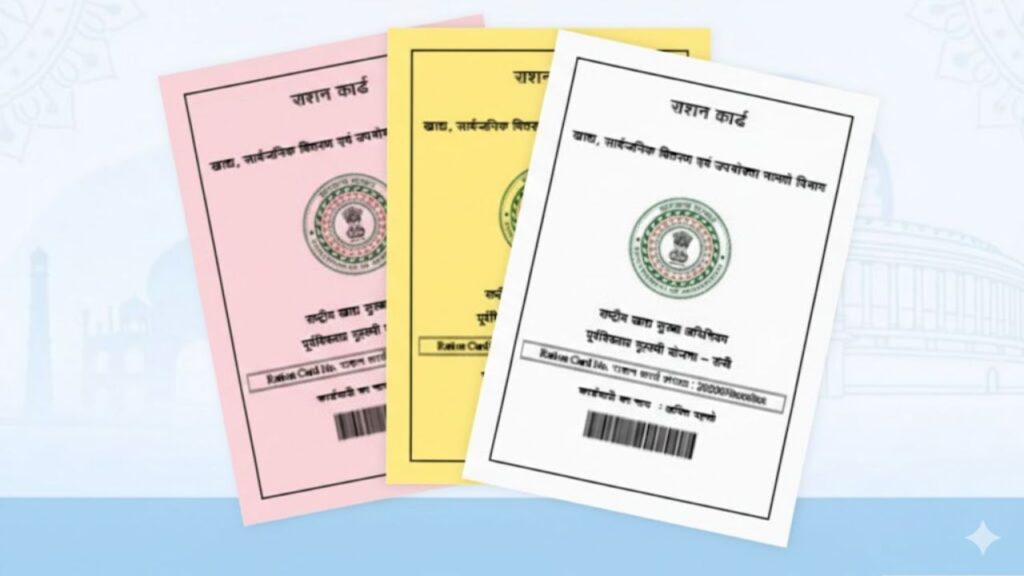
Ration cards play a crucial role in India’s public welfare system. For millions of families, they are not just a way to access subsidised food grains but also an important government-recognised document used in daily life. People often search about different types of ration cards because rules have changed over the years, older categories still exist in some states, and eligibility differs based on income, occupation, and household conditions.
This guide explains every type of ration card used in India today, how they work under the National Food Security Act (NFSA) and the Targeted Public Distribution System (TPDS), who is eligible, and what benefits each card offers.
⭐ What Is a Ration Card?
A ration card is an official document issued by state governments through their Food and Civil Supplies departments. It allows eligible households to purchase essential food items such as rice, wheat, and coarse grains at subsidised prices from Fair Price Shops (FPS).
Earlier, ration cards were issued mainly under the Targeted Public Distribution System. After the introduction of the National Food Security Act, 2013, the system became more structured, with fixed entitlements and clear eligibility rules. Today, ration cards also function as a family identity document and are widely accepted as proof of address.
⭐ Why Ration Cards Are Important for Households
Ration cards are important because they:
- Ensure food security for economically weaker families
- Help control household food expenses
- Act as proof of residence for many government and private services
- Enable access to welfare schemes and subsidies
- Help maintain official family records at the state level
Keeping the ration card updated is essential to avoid disruptions in benefits.
⭐ Main Types of Ration Cards in India
India currently follows two systems for ration cards:
- NFSA-based ration cards (used by most states)
- TPDS-based ration cards (still used in a few states)
Together, these systems cover five major ration card categories.
⭐ Ration Cards Under the National Food Security Act (NFSA)
Under NFSA, states mainly issue three types of ration cards.
⭐ Antyodaya Anna Yojana (AAY) Ration Card
This ration card is meant for the poorest and most vulnerable families.
Who gets it?
- Families without a stable income
- Daily wage labourers, rickshaw pullers, and similar workers
- Destitute persons, elderly without support, widows
- Households identified by state governments as Antyodaya families
Food entitlement:
- 35 kg of food grains per family per month
- Usually includes 20 kg rice and 15 kg wheat
Subsidised prices:
- Rice: ₹3 per kg
- Wheat: ₹2 per kg
This card provides the highest level of food support under the public distribution system.
⭐ Priority Household (PHH) Ration Card
Families not covered under AAY but still eligible for food support fall under this category.
Food entitlement:
- 5 kg of food grains per person per month
Subsidised prices:
- Rice: ₹3 per kg
- Wheat: ₹2 per kg
- Coarse grains: ₹1 per kg
Inclusion guidelines generally cover:
- Persons with more than 40% disability
- Transgender persons
- Primitive tribal group households
- Destitute families and widow pension households
- Families without proper shelter
Exclusion guidelines usually include households that:
- Pay income tax
- Have government or PSU employees
- Own large houses or multiple vehicles
- Use high electricity loads regularly
- Own mechanised agricultural equipment
State governments finalise eligibility based on local criteria.
⭐ Non-Priority Household (NPHH) Ration Card
This ration card is issued to families that do not qualify under PHH criteria.
Key points:
- No entitlement to subsidised food grains
- Acts mainly as identity and address proof
- Useful for documentation and household records
Many middle-income households fall under this category.
⭐ Ration Cards Under the Targeted Public Distribution System (TPDS)
Some states still follow older TPDS categories, especially where NFSA implementation is partial.
⭐ Below Poverty Line (BPL) Ration Card
Issued to families living below the poverty line as defined by the state.
Benefits:
- 10 to 20 kg of food grains per family per month
- Subsidised prices (usually around 50% of economic cost)
Rates and quantities vary across states.
⭐ Above Poverty Line (APL) Ration Card
Issued to families living above the poverty line.
Benefits:
- Limited food grains at market or near-market prices
- Subsidies depend on state policy
APL cards are slowly being phased out in NFSA states.
⭐ Annapurna Yojana (AY) Ration Card
This card is meant for elderly citizens.
Who gets it?
- Poor individuals aged 65 years and above
- Those not receiving regular pension benefits
Entitlement:
- 10 kg of food grains per month
This scheme provides basic food security to senior citizens without family support.
⭐ Colour-Based Ration Cards (State-Specific)
Earlier, ration cards were colour-coded to show income status. Some states still follow this system alongside NFSA cards.
Common colour codes include:
- Yellow or Saffron Card – Below Poverty Line families
- Green Card – Above Poverty Line families
- White Card – Higher-income households
States like Tamil Nadu, Maharashtra, and Gujarat continue using colour-coded ration cards in different formats.
⭐ How to Renew a Ration Card
Ration cards must be renewed or updated periodically to keep benefits active.
General process:
- Visit the nearest ration card service centre
- Complete Aadhaar-based biometric verification
- Add or update family members if required
- Pay the applicable service fee
For children below five years, biometric authentication is not mandatory, but Aadhaar details are still required.
⭐ Benefits and Uses of a Ration Card
Apart from food subsidies, ration cards are widely used for:
- Proof of identity and address
- Opening bank accounts
- Applying for PAN card and passport
- Getting LPG gas connections and subsidies
- Accessing state and central welfare schemes
- Acting as a family composition record
Because of these uses, keeping ration card details accurate is very important.
⭐ Checking Ration Card Status and e-Ration Card
Most states now provide online facilities to:
- Check application status
- Download e-ration cards
- Update mobile numbers
- Complete e-KYC
If you want to track your application, you can follow the steps explained in ration card status guides available state-wise.
⭐ Common Mistakes to Avoid With Ration Cards
- Not updating family member details after marriage or death
- Using incorrect income information
- Skipping Aadhaar linking where mandatory
- Ignoring renewal or verification notices
- Holding multiple ration cards within one family
These mistakes can lead to cancellation or suspension of benefits.
⭐ Conclusion
Ration cards remain one of the most important welfare tools in India. Whether it is Antyodaya support for the poorest families or Priority Household benefits under NFSA, each ration card type serves a specific purpose. Understanding which category you fall under helps you access food security, government schemes, and essential services without interruption.
For clear, practical guides on ration cards, government schemes, and official documents, visit Sarkari Bakery.
❓ Frequently Asked Questions
Based on Google's Helpful Content System, this article emphasizes user value, transparency, and accuracy. It incorporates principles of E-E-A-T (Experience, Expertise, Authoritativeness, Trustworthiness).
Why Choose Sarkari Bakery?
Official Information
Government schemes & banking information based on official sources.
Step-by-Step Guides
Simple application process explained for every service.
Regular Updates
Content updated whenever official rules or services change.
People-First Content
Helpful, transparent and user-focused content.