
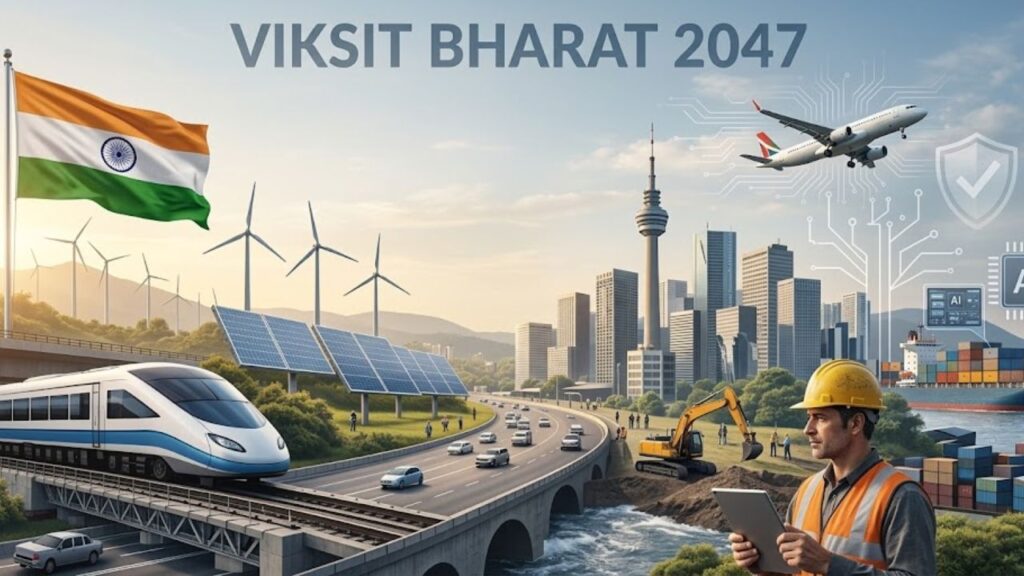
What will India look like when it celebrates 100 years of independence in 2047? This is the defining question behind Viksit Bharat 2047, the Government of India’s official, long-term roadmap to transform the country from a developing economy into a completely developed nation.
It is a vision that aims to lift millions out of poverty, scale the economy to monumental heights, and position India as a global superpower in technology, services, and sustainability.
This comprehensive guide breaks down the core meaning, core pillars, sector-wise objectives, and how you can actively contribute your ideas to this historic national mission.
What is Viksit Bharat 2047?
“Viksit Bharat” translates literally to “Developed India.” It represents an exhaustive, multi-sector national strategy targeting 2047—the centenary year of India’s independence.
Rather than focusing entirely on top-down macroeconomic statistics, this mission is built around four structural pillars representing the segments of society that will drive and sustain this transformation:
- Yuva (Youth): The powerhouse of skill, innovation, and technological adaptation.
- Garib (The Poor): Ensuring zero poverty and absolute financial inclusion through direct welfare and economic opportunities.
- Mahilayen (Women): Promoting women-led development, leadership, and financial security.
- Annadata (Farmers): Ensuring a prosperous, self-reliant, and sustainable agricultural sector.
Key Core Targets and Objectives
To transition into a developed superpower, the government has established concrete milestones spanning financial, infrastructure, and socio-economic frameworks:
The Economic Roadmap
- $30 Trillion Economy: Propelling India’s Gross Domestic Product (GDP) to an estimated $30 trillion over the next two decades.
- Global Services Hub: Following the formation of the “Education to Employment and Enterprise” Standing Committee, India targets a 10% global share in the services sector by 2047.
- Logistics Revolution: Broadening dedicated freight corridors and national waterways to dramatically lower internal supply chain and logistics expenses.
Key Policies and Reforms
- Tax Structural Reforms: Spurring internal market demand by raising personal income tax exemption thresholds to ₹12 lakh, directly boosting middle-class consumption power.
- Financial & Banking Realignment: Introducing a High-Level Committee on Banking alongside public sector NBFC restructurings (such as PFC and REC) to optimize credit delivery to MSMEs and startups.
Sector-Wise Transformation Strategies
Achieving a developed nation status requires structural overhauls across every facet of governance and enterprise:
1. Agriculture and Farmer Welfare
Through a ₹1 lakh crore agricultural infrastructure funding facility, the initiative shifts focus from survival to surplus. High-yield crop initiatives aim to support over 17 million farmers, while programs like PM-PRANAM and the SVAMITVA scheme empower rural landowners with clear property titles and organic, sustainable farming resources.
2. Women Empowerment and Leadership
True development is impossible without gender parity. Legal mandates like the Nari Shakti Vandan Adhiniyam guarantee a 33% reservation for women in the Lok Sabha and state assemblies. Financial inclusion is reinforced with over 28 crore women-owned Jan Dhan bank accounts, driving the entrepreneurship pipelines of PM Mudra Yojana and Stand Up India.
3. Education, Training, and Innovation
India is bridging the gap between classrooms and industry requirements. Thousands of PM SHRI schools focus on foundational learning, while 10,000+ Atal Tinkering Labs cultivate a scientific temperament early on. Higher education is also going global, highlighted by IIT campuses opening branches internationally in places like Zanzibar and Abu Dhabi.
4. Sustainable Energy and Green Technology
India ranks as the 4th largest country globally in installed renewable energy capacity. Programs like the GOBARdhan scheme turn organic agricultural waste into biogas, while the PM-KUSUM scheme solarizes water pumps across agricultural fields, paving a path toward carbon neutrality.
Core Operational Framework
                       ┌───────────────────────────┐
                       │    VIKSIT BHARAT 2047     │
                       └─────────────┬─────────────┘
                                     │
             ┌───────────────┬───────┴───────┬───────────────┐
             ▼               ▼               ▼               ▼
         ┌───────┐       ┌───────┐       ┌───────┐       ┌───────┐
         │ YUVA  │       │ GARIB │       │MAHILA │       │ANNA-  │
         │(Youth)│       │(Poor) │       │(Women)│       │ DATA  │
         └───────┘       └───────┘       └───────┘       │(Farmer)
                                                         └───────┘
Step-by-Step: How to Register & Share Your Ideas on MyGov
Viksit Bharat 2047 relies heavily on crowdsourced, citizen-led innovation. The government invites students, professionals, and innovators to submit actionable insights directly on the MyGov digital portal.
Follow these steps to submit your ideas:
Step 1: Open the Portal
Navigate to the official MyGov web portal and locate the button titled ‘Share Your Ideas for Viksit Bharat’.
Step 2: User Authentication
Provide your name alongside your registered mobile number or email ID. Click ‘Log In with OTP’, input the received verification code, and press ‘Submit’.
Step 3: Profile Classification
Select your participant status as either ‘Student’ or ‘Non Student’. Fill in your core demographic details—including age, gender, occupation, and complete address—then click ‘Confirm and Proceed’.
Step 4: Submit Your Vision
Select one or multiple development themes that align with your proposal. Enter your structured suggestion detailing how India can resolve systemic bottlenecks to achieve its 2047 goals, and click ‘Submit’.
Note on Youth Initiatives: Events like the Viksit Bharat Young Leaders Dialogue serve as continuous, specialized avenues for young professionals to pitch policy feedback directly to administrators.
Conclusion
Viksit Bharat 2047 represents an ambitious blueprint for national modernization. By anchoring growth across infrastructure development, gender inclusion, clean energy transition, and digitized governance, it sets a clear track to reclaim India’s prominent position on the global economic stage. Achieving this goal requires proactive civic engagement alongside robust governance frameworks.
To keep tabs on the latest updates regarding welfare programs, national reforms, and infrastructure rollouts, check out Sarkari Bakery for clear, simplified breakdowns of critical national policies.