
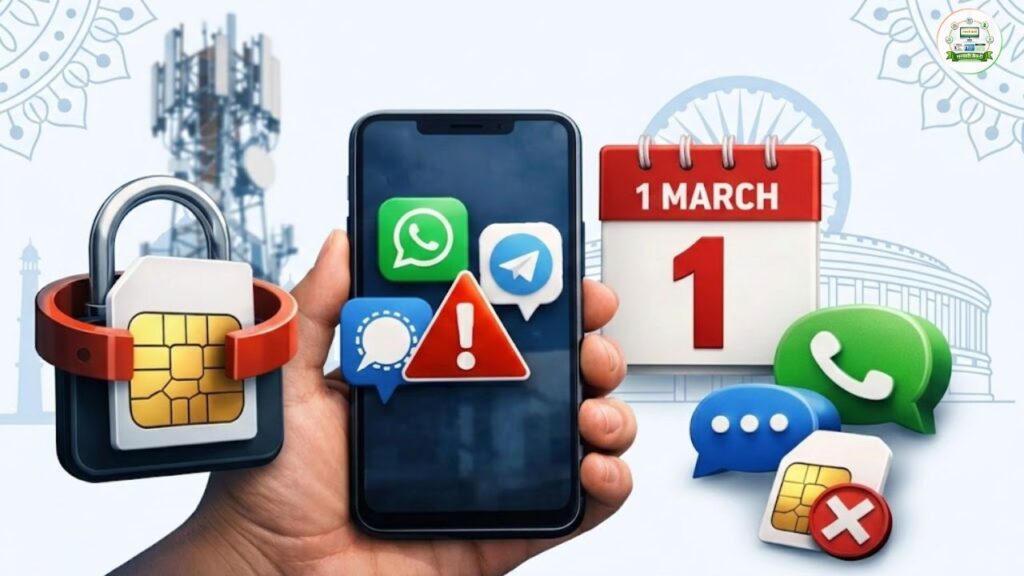
From March 1, a new SIM-binding rule issued by the Department of Telecommunications (DoT) will change how messaging apps like WhatsApp, Telegram, and other OTP-based platforms function in India. This move is aimed at reducing online fraud, SIM swap scams, and misuse of mobile numbers.
If you use your mobile number to log in to apps, verify OTPs, or access banking services, this update directly affects you.
📌 What Is SIM-Binding?
SIM-binding is a security rule that ensures messaging apps work only when the registered SIM card is physically present in the user’s primary device.
Until now, most apps verified users through a one-time password (OTP) sent to their mobile number during registration. Once verified, the app could continue working even if:
- The SIM was removed
- The SIM was deactivated
- The SIM was inserted into another phone
Under the new rule, that flexibility changes.
Now, the app must remain actively linked to the same SIM card in the primary device for continued usage.
🔐 Why Has This Rule Been Introduced?
The main reason is rising digital fraud.
In recent years, India has seen a sharp increase in:
- SIM swap fraud
- OTP interception scams
- Banking fraud via duplicate SIM activation
- Identity theft using stolen mobile numbers
- WhatsApp account hijacking
Fraudsters often exploit the gap between OTP verification and actual SIM ownership.
The new SIM-binding rule aims to close this gap.
⚙️ How SIM-Binding Will Work
Here’s how the system is expected to function:
- You register on WhatsApp or Telegram using your mobile number.
- OTP verification is completed.
- The app checks whether the registered SIM is present in the primary device.
- If the SIM is removed or replaced, the app may stop functioning.
This ensures that:
✔ The verified user still controls the SIM
✔ Fraudsters cannot use cloned SIMs easily
✔ Stolen numbers cannot be misused
📱 What Changes for WhatsApp Users?
WhatsApp currently:
- Sends OTP during registration
- Allows web login via QR code
- Continues functioning even if SIM is removed
Under SIM-binding:
- WhatsApp may require SIM to remain in device
- Removing SIM could log you out
- Account access may stop until SIM is reinserted
- Web access may depend on active SIM presence
This adds an extra security layer.
📲 What About Telegram and Other Apps?
Apps that use mobile numbers for login — including:
- Telegram
- Signal
- Certain banking apps
- OTP-based services
May also need to comply.
Any app relying on mobile number authentication will need to ensure the SIM remains bound to the active device.
🚨 What Happens If You Change SIM?
If you:
- Replace SIM
- Upgrade to eSIM
- Change mobile number
- Lose SIM
You may need to:
✔ Re-verify your number
✔ Complete fresh authentication
✔ Re-link your account
Temporary disruption may occur.
🔁 What About Dual SIM Users?
If you use dual SIM phones:
- The registered SIM must remain active
- Removing the primary SIM may interrupt service
- Swapping SIM slots could require verification
Exact implementation details may vary by app.
🛑 Does This Affect SIM Swap Fraud?
Yes — directly.
In SIM swap fraud:
- Fraudster gets duplicate SIM issued.
- OTPs start going to fraudster.
- Bank accounts are accessed.
With SIM-binding:
- App checks for active SIM in primary device.
- Duplicate SIM usage becomes harder.
- Account takeover risk reduces.
It makes fraud more difficult.
💳 Impact on Banking & Digital Payments
Your mobile number is linked to:
- UPI
- Net banking
- Debit/credit card OTP
- Government portals
- Social media accounts
SIM-binding strengthens protection by ensuring:
✔ Only genuine SIM holder accesses OTP-based services
✔ Unauthorized number duplication is blocked
It enhances digital trust.
📊 Who Will Be Most Affected?
This rule may affect:
- Users frequently changing SIMs
- Users using SIM in secondary phone
- Users who register and remove SIM
- Users relying only on Wi-Fi without SIM inserted
Regular users keeping SIM active will likely see minimal disruption.
⚠️ Possible Challenges
While security improves, some challenges may arise:
- Inconvenience during SIM replacement
- Temporary service interruption
- Issues for international travelers
- Users with damaged SIM cards
However, the focus remains fraud prevention.
🧠 Practical Example
Before SIM-binding:
You register WhatsApp.
Remove SIM.
App still works via Wi-Fi.
After SIM-binding:
You remove SIM.
App detects SIM missing.
Access restricted until SIM reinserted.
Security increases — flexibility reduces.
📌 What Should Users Do Now?
✔ Keep registered SIM active in primary device
✔ Update KYC details with telecom provider
✔ Avoid sharing OTP
✔ Immediately report lost SIM
✔ Be careful during SIM replacement
Staying proactive prevents disruption.
🛡️ How This Rule Improves Digital Security
The government’s broader goal includes:
- Reducing online fraud
- Protecting banking users
- Preventing identity theft
- Improving telecom compliance
- Strengthening cybersecurity laws
SIM-binding is part of a wider digital safety strategy.
🔚 Conclusion
The new SIM-binding rule coming into effect from March 1 marks a significant shift in how mobile-based authentication works in India. Messaging apps like WhatsApp and Telegram will need to ensure that the registered SIM card remains present in the primary device.
While this may slightly reduce flexibility, it significantly strengthens protection against SIM swap fraud, OTP scams, and digital identity misuse.
In today’s digital economy, your mobile number is your identity key. Securing that link is essential.
For more easy-to-understand guides on telecom rules, digital safety, and government updates, visit Sarkari Bakery.
❓ Frequently Asked Questions
Based on Google's Helpful Content System, this article emphasizes user value, transparency, and accuracy. It incorporates principles of E-E-A-T (Experience, Expertise, Authoritativeness, Trustworthiness).
Why Choose Sarkari Bakery?
Official Information
Government schemes & banking information based on official sources.
Step-by-Step Guides
Simple application process explained for every service.
Regular Updates
Content updated whenever official rules or services change.
People-First Content
Helpful, transparent and user-focused content.