
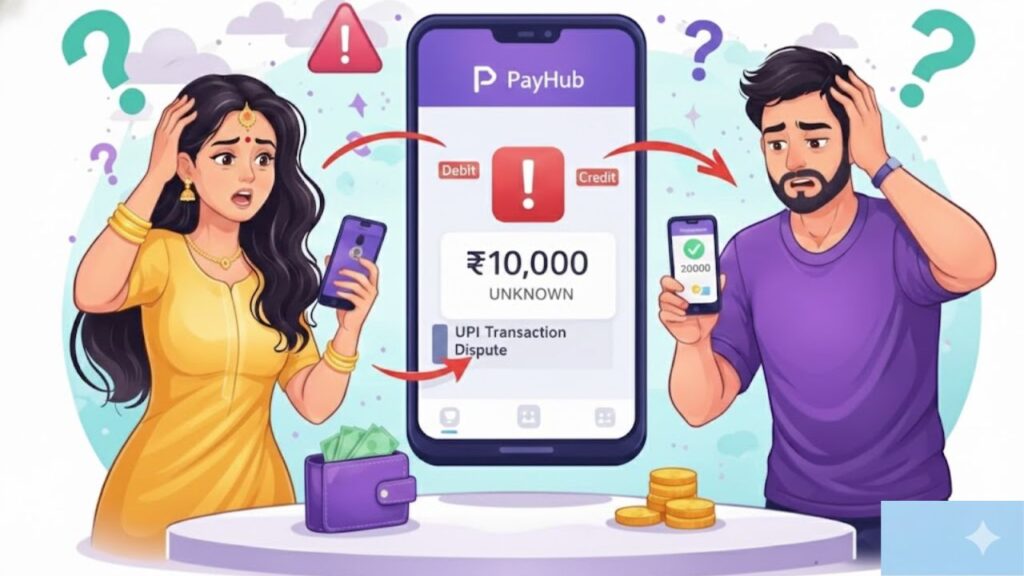
Sending money through UPI is fast and convenient, but that speed can turn stressful when funds are transferred to the wrong person. This usually happens due to a typing mistake, selecting the wrong contact, or reacting too quickly to a payment request. Many users panic because UPI payments feel “instant and final”, but Indian banking rules do provide ways to report and possibly recover such transactions—if you act correctly and on time.
This guide explains, in clear and practical terms, how to reverse a wrong UPI transaction in India, what usually works, what does not, and what to do if the money is not returned.
⭐ What Is a Wrong UPI Transaction?
A wrong UPI transaction happens when money is transferred to an unintended UPI ID, mobile number, or bank account. Once the payment is completed, UPI does not automatically reverse it like a failed transaction.
Common causes include:
- Entering the wrong mobile number or UPI ID
- Choosing the wrong contact with a similar name
- Approving a “collect request” without verifying details
- Falling for fraud or social engineering scams
Under RBI guidelines, the responsibility to verify details before sending money lies with the sender. However, banks and UPI platforms are required to offer grievance redressal mechanisms.
⭐ What to Do Immediately After a Wrong UPI Transfer
Time matters more than anything else. The first 24–48 hours are critical.
Act fast and collect details
Keep these ready:
- UPI transaction ID
- Date and time of transaction
- Amount sent
- UPI app used (Google Pay, PhonePe, Paytm, BHIM, etc.)
The sooner you report the issue, the higher the chance of recovery—especially if the recipient has not yet withdrawn or used the money.
⭐ Raise a Complaint Through Your UPI App
Most UPI apps have an in-app dispute option. This should always be your first step.
How it usually works
- Open your UPI app
- Go to Transaction History
- Select the incorrect transaction
- Choose Report a problem / Raise dispute
- Select Wrong transfer / Sent to wrong UPI ID
- Submit the complaint
Once submitted, the app forwards the issue to your bank. The bank then contacts the recipient’s bank to request consent for reversal.
Important reality check: banks cannot debit the recipient’s account without consent unless fraud is legally proven.
⭐ Contact Your Bank Directly
If the app response is slow, contact your bank’s customer care or visit the branch.
Provide:
- Transaction ID
- Beneficiary details (if visible)
- Proof of transaction
Banks log the complaint internally and coordinate with the receiving bank. This step is essential if the amount is large.
⭐ Call the NPCI UPI Helpline
NPCI operates the UPI system in India.
UPI Wrong Transaction Complaint Number:
1800-120-1740
This helpline can:
- Guide you to the correct complaint channel
- Track whether the issue is already logged
- Advise escalation steps
It does not directly reverse money but ensures your complaint reaches the right system.
⭐ Use the NPCI Online Grievance Portal
If your issue remains unresolved for up to 30 days, escalate it online.
You will need:
- Transaction ID
- Bank name
- Mobile number linked to UPI
Always save the complaint reference number. This becomes important if further escalation is required.
⭐ Escalate to RBI Ombudsman (Last Formal Step)
If neither the bank nor NPCI resolves the issue within 30 days, you can file a complaint with the RBI Banking Ombudsman through the RBI CMS portal.
This is useful when:
- The bank fails to respond
- The bank rejects your complaint without proper reasoning
RBI intervention often speeds up stalled cases, especially when procedural lapses are involved.
⭐ Real-Life Situations Where Reversal Becomes Difficult
Understanding these scenarios helps set realistic expectations.
Mistyped number
If the recipient is genuine but refuses to return the money, banks have limited authority unless fraud is involved.
Fraud or scam
In cases of impersonation or fake requests, recovery is harder. Filing a police complaint strengthens your case.
Technical glitch
Sometimes money is credited to the wrong account due to system errors. These cases have a higher chance of reversal if reported early.
⭐ When Legal Action Is an Option
If the amount is significant and the recipient refuses to cooperate:
- File a local police complaint
- Share the FIR copy with the bank
This is usually effective when there is clear evidence of fraud or intentional misuse.
⭐ Common Mistakes That Reduce Recovery Chances
Avoid these errors:
- Waiting too long to report
- Deleting transaction details
- Assuming the app will auto-reverse the payment
- Not escalating after bank silence
Many users lose recovery chances simply because they stop after the first complaint.
⭐ How to Prevent Wrong UPI Transactions in the Future
UPI is safe—but only when used carefully.
Practical safety habits
- Double-check recipient name before confirming
- Never approve unknown collect requests
- Do not share UPI PIN, even with “bank officials”
- Avoid rushing payments
If you frequently use UPI, it also helps to understand daily limits and safeguards explained in UPI limits.
Fraud awareness is equally important. Knowing how fake requests work can save you from losses, as explained in fake UPI payments.
⭐ What If the Money Is Not Recovered?
Sometimes, despite all efforts, recovery may not be possible. This usually happens when:
- The recipient withdraws funds immediately
- The transfer was authorised and non-fraudulent
- There is no legal ground to force reversal
In such cases, prevention and awareness become the only long-term solutions.
⭐ Final Thoughts
A wrong UPI transaction is stressful, but it does not always mean your money is lost forever. Quick action, proper escalation, and correct documentation significantly improve recovery chances. Always start with the UPI app, involve your bank, use NPCI support, and escalate to RBI if required. At the same time, building careful payment habits is the strongest defence against such errors.
For more clear, practical guides on banking, digital payments, and government processes, visit Sarkari Bakery.
Frequently Asked Questions
Based on Google's Helpful Content System, this article emphasizes user value, transparency, and accuracy. It incorporates principles of E-E-A-T (Experience, Expertise, Authoritativeness, Trustworthiness).
Why Choose Sarkari Bakery?
Official Information
Government schemes & banking information based on official sources.
Step-by-Step Guides
Simple application process explained for every service.
Regular Updates
Content updated whenever official rules or services change.
People-First Content
Helpful, transparent and user-focused content.