
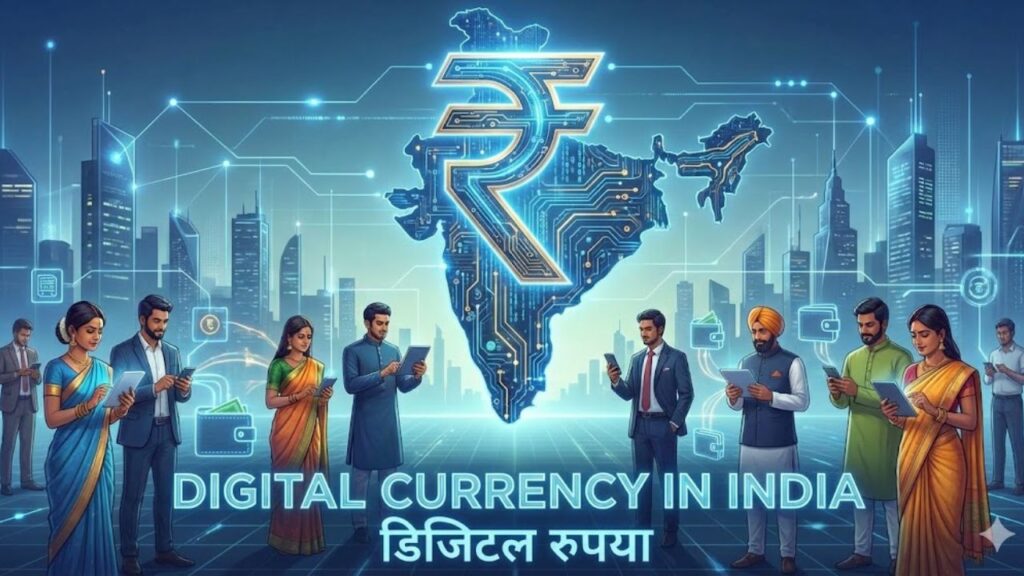
India has seen a massive shift from cash-based transactions to digital payments over the last decade. UPI, mobile banking, and online wallets have already changed how people pay. To take this transformation one step further, the Government of India and the Reserve Bank of India (RBI) introduced digital currency, officially known as the Digital Rupee.
Many people search for this topic because they are confused about what digital currency actually is, how it is different from UPI or cryptocurrency, and whether it is safe to use. This guide explains everything in a clear, practical way without technical jargon.
⭐ What Is Digital Currency?
Digital currency is money issued by a central bank in electronic form. In India, this currency is called the Digital Rupee and is officially known as Central Bank Digital Currency (CBDC).
Unlike private digital wallets or payment apps, the Digital Rupee is:
- Issued by the Reserve Bank of India
- Fully backed by the Government of India
- Equal in value to physical cash
In simple terms, ₹1 Digital Rupee = ₹1 paper rupee. It is not an investment product and does not fluctuate like crypto assets.
⭐ Name of Digital Currency in India
The official name is:
- Digital Rupee
- Also referred to as e₹ (e-Rupee)
RBI has introduced two versions:
- Retail Digital Rupee (e₹-R) for public use
- Wholesale Digital Rupee (e₹-W) for banks and financial institutions
⭐ How Digital Currency Works in Real Life
The Digital Rupee works through a wallet-based system provided by RBI-authorised banks.
Here’s how a typical transaction happens:
- You load Digital Rupees into a CBDC wallet.
- You scan a QR code or enter the receiver’s details.
- The amount is transferred instantly.
- Settlement happens directly, without intermediaries.
Unlike UPI, transactions do not always require a bank account for settlement, which makes it closer to digital cash than online banking.
⭐ Key Features of Digital Rupee
🔐 Sovereign-Backed Currency
The Digital Rupee is issued and regulated by RBI, making it fully legal tender.
⚡ Instant Settlement
Transactions settle immediately without clearing delays or interbank dependency.
🧾 Cash-Like Privacy (With Control)
It offers controlled traceability, helping prevent illegal activities while maintaining user trust.
🌐 Offline Potential
RBI is testing offline usage for areas with weak internet connectivity.
🏦 No Dependency on Wallet Balance
Unlike prepaid wallets, CBDC represents actual money, not stored value.
⭐ Advantages of Digital Currency in India
✅ Safer Than Physical Cash
No risk of theft, damage, or loss like paper notes.
✅ Lower Cost for Government
Reduces printing, storage, transportation, and replacement costs of currency.
✅ Faster Payments
Useful for peer-to-peer, business, and government transactions.
✅ Better Transparency
Helps reduce black money, fake currency, and tax leakage.
✅ Financial Inclusion
People without full banking access can still participate in digital transactions.
CBDC usage also complements existing banking KYC systems and digital identity frameworks already used across India.
⭐ Digital Currency vs Cryptocurrency
Many people wrongly assume Digital Rupee is similar to Bitcoin. It is not.
| Aspect | Digital Currency | Cryptocurrency |
|---|---|---|
| Issuer | RBI | Private networks |
| Regulation | Fully regulated | Largely unregulated |
| Value Stability | Stable | Highly volatile |
| Legal Status | Legal tender | Not legal tender |
| Risk Level | Low | High |
Digital Rupee focuses on payments, not speculation.
⭐ Digital Rupee Launch in India
- Retail pilot launched: 1 November 2022
- Wholesale pilot launched: 2 November 2022
The rollout started with selected banks and cities and is being expanded gradually based on user feedback and system readiness.
⭐ Is Digital Rupee Based on Blockchain?
RBI has not confirmed a public blockchain structure like cryptocurrencies.
Instead, the system may use controlled ledger technology, allowing RBI to maintain security, efficiency, and scalability without decentralised risk.
⭐ Common Misunderstandings About Digital Currency
- ❌ It is not a cryptocurrency
- ❌ It does not offer returns or interest
- ❌ It is not a replacement for UPI
- ❌ It is not anonymous money
Most confusion arises when people mix payment apps with currency issuance.
⭐ Who Should Use Digital Rupee?
- People looking for safe digital cash alternatives
- Small businesses needing instant settlement
- Users in areas with limited banking access
- Anyone wanting government-backed digital payments
🔚 Conclusion
Digital currency in India is a major step toward a more transparent, efficient, and inclusive financial system. The Digital Rupee combines the trust of physical cash with the convenience of digital payments, without the risks associated with private cryptocurrencies. As adoption grows, it is expected to strengthen India’s digital economy while keeping monetary control firmly with the RBI.
For clear, reliable explanations on government-backed financial systems and digital services, visit Sarkari Bakery.
❓ Frequently Asked Questions
Based on Google's Helpful Content System, this article emphasizes user value, transparency, and accuracy. It incorporates principles of E-E-A-T (Experience, Expertise, Authoritativeness, Trustworthiness).
Why Choose Sarkari Bakery?
Official Information
Government schemes & banking information based on official sources.
Step-by-Step Guides
Simple application process explained for every service.
Regular Updates
Content updated whenever official rules or services change.
People-First Content
Helpful, transparent and user-focused content.