
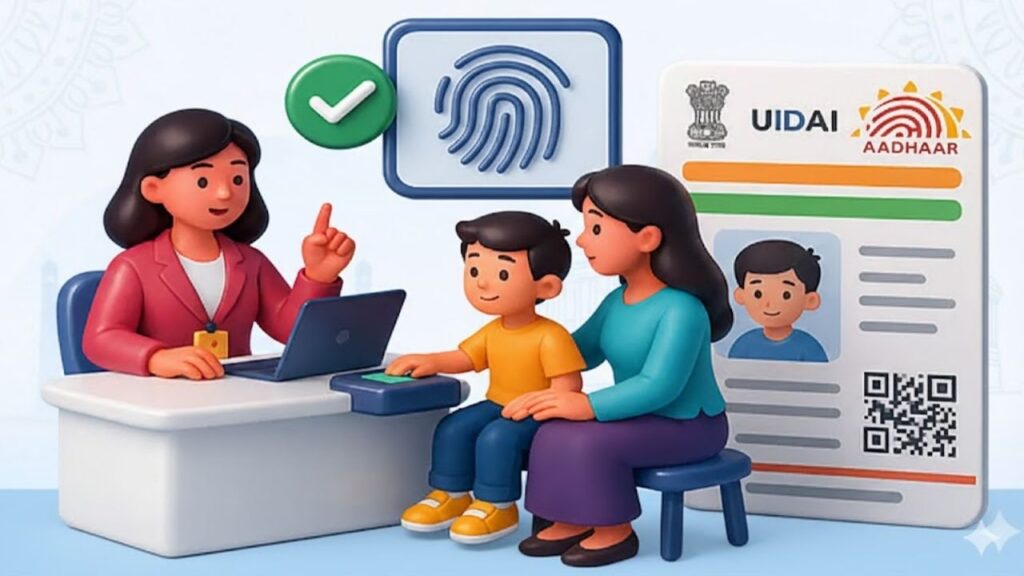
Many people worry about Aadhaar updates because banks, government offices, and service providers often ask for “updated Aadhaar.” However, not every Aadhaar holder is required to update their details every time. Knowing exactly when Aadhaar update is mandatory and when it is optional can save you from unnecessary visits, rejections, and confusion.
This guide explains real-life situations where Aadhaar updates are compulsory, cases where they are not required, and how ignoring mandatory updates can cause serious problems.
⭐ Why Aadhaar Updates Matter in Real Life
Aadhaar is used for banking, subsidies, SIM verification, tax filing, and many government services. If your Aadhaar details are outdated or incorrect, it can lead to:
- Failed KYC verification
- Bank account restrictions
- Rejection of government benefits
- Delays in certificates, pensions, or subsidies
That’s why UIDAI has clearly defined mandatory and non-mandatory Aadhaar update rules.
⭐ When Aadhaar Update Is Mandatory
📌 Change in Name
If your name has changed due to:
- Marriage
- Divorce
- Legal name correction
Updating Aadhaar is mandatory, especially for banking, passport, PAN, and government records.
📌 Change in Address
You must update Aadhaar if:
- You have shifted permanently
- Your address does not match bank or official records
Address mismatch is one of the most common reasons for Aadhaar-based service rejection.
📌 Biometric Update (Age-Based Rule)
Biometric updates are compulsory at specific ages:
- At age 5 – Fingerprints and iris update
- At age 15 – Mandatory biometric update
Without these updates, Aadhaar may fail authentication in the future.
📌 Photo Mismatch
If your Aadhaar photo:
- Is very old
- Does not resemble your current appearance
Many banks and offices may reject Aadhaar verification, making photo update practically mandatory.
📌 Mobile Number Change (Practical Mandatory)
While UIDAI does not legally force mobile updates, it becomes mandatory if:
- You cannot receive OTPs
- You want to access online Aadhaar services
- You need bank or KYC verification
Without a linked mobile number, Aadhaar services become nearly unusable.
📌 Errors in Date of Birth or Gender
If DOB or gender is incorrect:
- Government forms may get rejected
- Exams, pensions, and benefits may be blocked
Correction becomes mandatory in such cases.
⭐ When Aadhaar Update Is NOT Mandatory
✅ No Change in Personal Details
If your:
- Name
- Address
- DOB
- Gender
are correct and unchanged, no update is required, even if Aadhaar is several years old.
✅ Aadhaar Validity Has No Expiry
Aadhaar never expires. There is no rule that Aadhaar must be updated every 5 or 10 years unless details have changed.
✅ Old Aadhaar Still Works
Even older Aadhaar cards:
- Are valid
- Can be used for KYC
- Work for government schemes
As long as details are accurate and biometrics are updated (where required).
✅ Optional Photo Update
If your photo is old but still recognizable, updating it is optional, not compulsory.
⭐ What Happens If You Skip Mandatory Aadhaar Updates
Failing to update Aadhaar when required can lead to:
- Bank account freeze or limited services
- Failed OTP or biometric authentication
- Rejection of subsidy or pension
- PAN–Aadhaar linking issues
- Delays in certificates and applications
Checking your Aadhaar update history helps confirm whether all required updates are already completed.
⭐ How to Know If Your Aadhaar Needs an Update
You should review your Aadhaar details if:
- Bank KYC fails
- OTP is not received
- Address proof is rejected
- Aadhaar authentication fails frequently
In such cases, booking an Aadhaar appointment ensures faster and correct updates.
⭐ Common Mistakes People Make
- Assuming Aadhaar must be updated regularly
- Ignoring biometric updates at age milestones
- Not updating mobile number and losing OTP access
- Using Aadhaar with incorrect DOB or address
Avoiding these mistakes prevents long-term issues.
🔚 Conclusion
Aadhaar update is mandatory only in specific situations, not for everyone. If your details are correct and biometrics are updated as required, there is no need for unnecessary changes. However, ignoring mandatory updates can block essential services and benefits. Understanding these rules helps you stay compliant without wasting time.
For clear, practical guidance on Aadhaar, banking, and government documentation, visit Sarkari Bakery.