
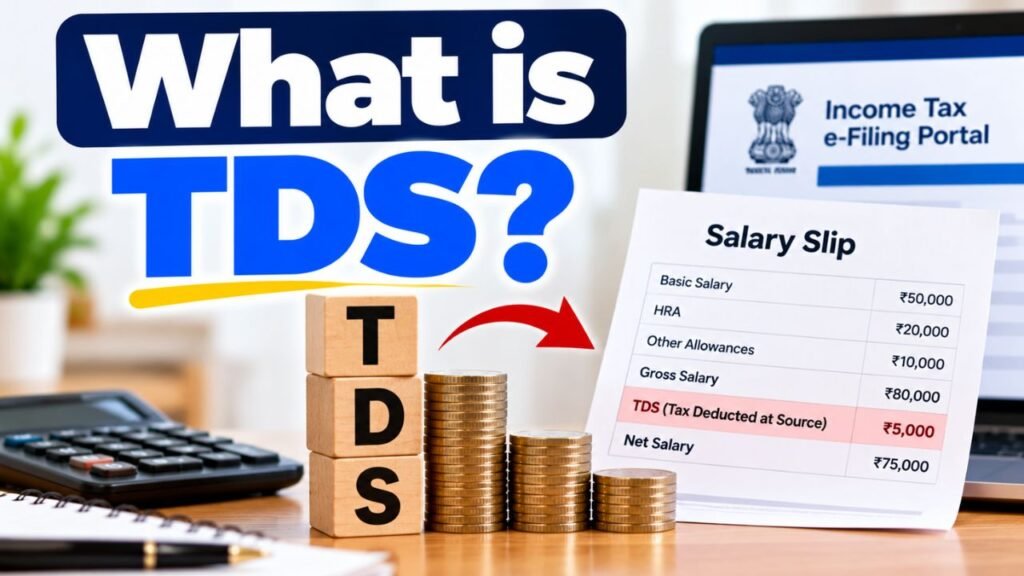
TDS, or Tax Deducted at Source, is a system under which tax is deducted from certain payments at the time of payment or credit, as applicable, and deposited with the Income Tax Department.
Instead of the recipient receiving the entire amount first and paying tax later, the person or organisation making the specified payment deducts the applicable amount of tax and deposits it with the government.
For example, if an employer calculates TDS on an employee’s taxable salary, the employer deducts the applicable tax before paying the salary. Similarly, TDS may apply to certain interest, professional fees, contractual payments, rent and other specified payments when the relevant conditions and thresholds are satisfied.
The amount of TDS deducted on your behalf is not automatically an additional tax that you pay twice. It is generally available as tax credit, subject to the applicable rules and its reflection in the tax records used while filing your ITR.
The Income Tax Department provides taxpayers with records such as Form 26AS and AIS through the e-Filing portal, while Form 16 and Form 16A provide TDS certificate details for specified types of income.
What Does TDS Mean?
TDS stands for Tax Deducted at Source.
The basic idea is:
Payment → TDS deducted → TDS deposited with government → TDS credit available to taxpayer
There are generally two parties involved:
Deductor
The person or organisation responsible for deducting TDS.
Examples may include:
- Employer
- Bank
- Company
- Business
- Tenant
- Certain persons making specified professional or contractual payments
Deductee
The person whose income or payment is subject to TDS.
For example, an employee is generally the deductee when an employer deducts TDS from salary.
How Does TDS Work?
Consider a simple example.
Suppose a payment of ₹50,000 is subject to TDS at an applicable rate of 10%.
The payer may deduct:
₹5,000 TDS
and pay the recipient:
₹45,000
The ₹5,000 deducted is deposited with the Income Tax Department according to the applicable TDS provisions.
The recipient can then claim eligible credit for the TDS while filing the Income Tax Return, subject to the amount being properly reported and available in the tax records.
The actual TDS rate and threshold depend on the nature of payment, applicable provision, taxpayer status and other conditions. Therefore, the simple example above should not be treated as a universal TDS rate.
Why Is TDS Deducted?
TDS is designed to collect tax at the point where certain income is paid or credited.
It helps the tax system by:
- Collecting tax throughout the year
- Reducing the possibility of tax evasion
- Creating a reporting trail for specified transactions
- Helping taxpayers meet their tax liability gradually
- Providing the government with information about certain payments
For taxpayers, TDS can also reduce the amount of tax that needs to be paid later as self-assessment tax, depending on the total tax liability.
Where Is TDS Applicable?
TDS can apply to several categories of payments when the applicable legal conditions are satisfied.
Common examples include:
- Salary
- Bank interest
- Professional fees
- Commission
- Contractual payments
- Rent
- Certain payments for purchase of property
- Certain payments to residents and non-residents
- Other specified payments
The exact section, threshold and rate depend on the nature of the transaction.
Therefore, you should not assume that every payment is subject to TDS or that the same TDS rate applies to every transaction.
TDS on Salary
Salary TDS is one of the most common forms of TDS.
An employer calculates the employee’s estimated taxable salary and applicable tax based on the relevant provisions and information provided by the employee.
The employer then deducts TDS from salary during the financial year.
The Income Tax Department identifies Form 16 as the certificate of TDS on salary. It contains information relating to the employee’s income, applicable deductions/exemptions and TDS for the purpose of computing tax payable or refundable.
Before filing your ITR, compare:
Salary slips → Form 16 → Form 26AS → AIS → ITR
If the figures do not match, investigate the reason before submitting your return.
TDS on Bank Interest
Banks and other financial institutions may deduct TDS on certain interest payments when the applicable conditions are satisfied.
This can include interest relating to certain:
- Fixed deposits
- Recurring deposits
- Other specified interest payments
The actual TDS depends on the applicable provisions and taxpayer circumstances.
One important point is that TDS and final tax liability are not necessarily the same thing.
For example, a bank may deduct TDS from interest, but your final tax liability depends on your total income and applicable tax provisions.
Therefore, you still need to report the relevant interest income while filing your ITR.
TDS on Professional Fees
Certain professional payments can attract TDS when the applicable conditions are satisfied.
Examples may include payments to professionals such as:
- Chartered accountants
- Lawyers
- Doctors
- Consultants
- Technical professionals
- Other specified professionals
The applicable TDS provision depends on the nature of the payment and the parties involved.
A freelancer or professional receiving payments should therefore maintain:
- Invoices
- Payment records
- Bank statements
- TDS certificates
- Form 26AS
- AIS
These records help reconcile gross income with TDS received.
TDS on Contract Payments
Certain payments made under contracts can also attract TDS.
This may be relevant to businesses making specified payments to contractors or other eligible recipients.
The applicable section, threshold and rate depend on the nature of the contract and the status of the parties.
Businesses should maintain proper:
- Invoices
- Agreements
- Payment records
- TDS records
- TDS certificates
TDS on Rent
Certain rent payments can attract TDS when the applicable conditions are satisfied.
The rules can differ depending on:
- Type of property
- Nature of payment
- Status of payer and recipient
- Applicable threshold
- Applicable TDS provision
Therefore, taxpayers should not assume that every rent payment automatically requires TDS.
If TDS is applicable, the payer should follow the relevant deduction, deposit, reporting and certificate requirements.
What Is Form 16?
Form 16 is the TDS certificate for salary.
The employer provides Form 16 to the employee after the financial year.
The Income Tax Department states that Form 16 contains information such as:
- Employee income
- Deductions/exemptions
- TDS deducted
It is used while determining the employee’s tax payable or refundable.
For salaried taxpayers, Form 16 is one of the most important documents to check before filing an ITR.
What Is Form 16A?
Form 16A is a TDS certificate for income other than salary.
The Income Tax Department describes Form 16A as a certificate issued quarterly by the deductor to the deductee. It captures information such as the amount credited, amount of TDS, nature of payment and TDS deposited with the Income Tax Department.
For example, Form 16A may be relevant where TDS is deducted from certain non-salary income.
You should preserve Form 16A and compare its information with Form 26AS and AIS.
Difference Between Form 16 and Form 16A
| Form 16 | Form 16A |
|---|---|
| TDS on salary | TDS on income other than salary |
| Generally issued by employer | Issued by deductor |
| Related to salary income | Related to specified non-salary payments |
| Issued for the financial year | Generally issued quarterly |
| Important for salaried ITR filing | Important for non-salary TDS reconciliation |
The Income Tax Department specifically identifies Form 16 as the salary TDS certificate and Form 16A as the certificate for TDS on income other than salary.
What Is Form 26AS?
Form 26AS is an important tax-credit statement available through the Income Tax e-Filing portal.
The current Income Tax Department guidance identifies Form 26AS as containing TDS/TCS-related information. It also explains that other information that was historically available in 26AS is now available in AIS.
The current route provided by the department is:
Login → e-File → Income Tax Return → View Form 26AS
Taxpayers should check the available tax-credit information before filing the ITR.
You can also read the detailed guide on Form 26AS.
What Is AIS and How Is It Related to TDS?
AIS stands for Annual Information Statement.
AIS provides broader information than the current TDS/TCS-focused Form 26AS.
The Income Tax Department lists information such as:
- TDS/TCS
- SFT information
- Tax payments
- Demand/refund
- Other reported information
in AIS.
Therefore, taxpayers should not check only Form 26AS while preparing their ITR.
A better approach is:
Form 16/16A + Form 26AS + AIS + Bank Statements + Other Income Records
Then reconcile the information before filing.
You can learn more through AIS Income Tax.
Is TDS the Same as Income Tax?
No.
TDS is a method of collecting tax at source.
Your final income tax liability is calculated based on your total taxable income and the applicable tax provisions.
For example, suppose:
- Final tax liability = ₹60,000
- TDS already deducted = ₹45,000
Subject to the applicable calculation, you may have to pay the remaining tax.
On the other hand, if:
- Final tax liability = ₹30,000
- TDS already deducted = ₹45,000
you may be eligible for a refund of the excess tax, subject to processing and other applicable conditions.
Therefore:
TDS deducted ≠ Final tax liability
Is TDS a Separate Tax?
No.
TDS is generally a mechanism for collecting income tax at source.
If TDS is deducted from your income, the deducted amount can generally be claimed as tax credit in your ITR, subject to applicable rules and availability of the credit in the tax records.
You do not normally pay the same TDS amount again merely because it was deducted.
However, your final tax calculation can result in:
- Additional tax payable
- Nil additional tax
- Refund
depending on your total income, deductions, tax regime and tax already paid.
How to Check TDS Online
Taxpayers can check TDS-related information through their tax records.
Important sources include:
Form 26AS
Form 26AS provides relevant TDS/TCS information.
AIS
AIS provides TDS/TCS along with broader reported information.
Form 16
Salaried taxpayers can check TDS deducted from salary.
Form 16A
Non-salary TDS recipients can check the relevant TDS certificate.
The Income Tax Department recommends checking these records and reconciling discrepancies before filing the return.
What If TDS Is Not Showing in Form 26AS?
Sometimes a taxpayer may find that TDS deducted by the employer, bank or another deductor is not showing correctly.
Do not immediately claim an unsupported amount in your ITR.
First compare:
TDS Certificate → Form 26AS → AIS → ITR
If there is a mismatch, contact the relevant deductor and ask them to verify their TDS statement.
The Income Tax Department also provides a tax-credit mismatch facility for identifying differences in TDS/TCS and other tax-credit information.
For a detailed guide, see TDS Credit Not Showing.
What If TDS Is Deducted but Not Deposited?
A taxpayer may sometimes see a difference between the amount shown in their records and the tax credit available with the department.
If your employer or deductor has deducted TDS but the credit is not properly reflected, first contact the deductor.
The deductor is responsible for fulfilling the applicable TDS compliance requirements.
You should keep:
- Salary slip
- Form 16/16A
- Bank statement
- TDS communication
- Relevant tax records
as supporting evidence.
Do not assume that simply having a salary slip means the TDS credit will automatically appear in your tax records.
Can You Get a TDS Refund?
Yes, a taxpayer can receive a refund where the total eligible taxes paid, including TDS, exceed the final tax liability.
For example:
Total tax liability = ₹25,000
TDS already deducted = ₹40,000
The excess amount may become refundable, subject to the final processing of the ITR.
This is why TDS should always be reconciled before filing.
If your return has already been filed and you are waiting for the refund, you can check the Income Tax Refund Status.
What Is TDS Credit?
TDS credit refers to the eligible amount of tax already deducted and deposited on your behalf.
While filing your ITR, the TDS amount is considered along with other taxes already paid.
The final calculation may result in:
Tax liability > TDS → Additional tax may be payable
Tax liability = TDS → No further tax may be payable
Tax liability < TDS → Refund may be due
The actual result depends on the complete return calculation.
TDS and ITR Filing
TDS is directly relevant to ITR filing.
Before filing, compare:
- Form 16
- Form 16A, where applicable
- Form 26AS
- AIS
- Bank statements
- Salary or payment records
- Your own income calculations
Do not simply copy the TDS amount from one document without reconciliation.
For example, if Form 16 shows ₹50,000 TDS but Form 26AS shows ₹45,000, investigate the difference before submitting your return.
Common TDS Mistakes
1. Not Checking Form 26AS
Taxpayers sometimes file their ITR using only Form 16.
This can be risky when there are other sources of income or TDS.
2. Ignoring AIS
AIS may contain relevant TDS/TCS and other information that should be reconciled before filing.
3. Claiming Incorrect TDS
Do not claim a TDS amount simply because you believe it was deducted.
Check the available tax records.
4. Forgetting Non-Salary TDS
If you earn interest, professional income or other income subject to TDS, do not forget to check Form 16A and related records.
5. Not Reporting the Related Income
TDS deduction does not mean the related income can be omitted from the ITR.
If TDS was deducted from interest income, for example, the relevant interest income should also be considered while preparing the return.
6. Not Reporting Bank Interest
A taxpayer may see TDS from a bank and report only the TDS amount while forgetting to include the underlying interest income.
7. Ignoring TDS Mismatch
If the TDS certificate and tax portal information differ, investigate the issue rather than ignoring it.
How to Reconcile TDS Before Filing ITR
A simple reconciliation process can prevent many problems.
Step 1: Collect TDS Certificates
Keep:
- Form 16
- Form 16A
- Other applicable TDS certificates
Step 2: Check Form 26AS
Compare the TDS information with your certificates.
Step 3: Check AIS
Review TDS/TCS and other relevant information in AIS.
Step 4: Check Bank Statements
For bank-related TDS, compare the TDS with the actual interest received.
Step 5: Check Your ITR
Enter the correct income and eligible TDS credit.
Step 6: Resolve Mismatches
If something does not match, contact the relevant deductor before finalising the return where possible.
TDS vs TCS
TDS and TCS are different concepts.
TDS — Tax Deducted at Source
Tax is deducted by the payer from specified payments.
TCS — Tax Collected at Source
Tax is collected by the seller or specified collector on specified transactions.
Both can appear in tax records and may be relevant while preparing your ITR.
The Income Tax Department’s Form 26AS guidance identifies both TDS and TCS as tax-related information.
What Is TAN in TDS?
TAN stands for Tax Deduction and Collection Account Number.
It is a number associated with persons responsible for deducting or collecting tax at source, where applicable.
The Income Tax Department advises taxpayers to verify the TAN of a person who deducts tax on their behalf and notes that TDS details can be checked through Form 16, Form 16A and Form 26AS.
TAN is different from PAN.
PAN identifies the taxpayer.
TAN is associated with TDS/TCS compliance for the deductor/collector where required.
TDS Certificate: Form 16 and Form 16A
TDS certificates are important documents because they help the taxpayer verify how much tax was deducted.
For salary:
Form 16
For specified non-salary income:
Form 16A
The Income Tax Department identifies Form 16A as a quarterly TDS certificate for non-salary income and Form 16 as the salary TDS certificate.
You can also read TDS Certificate for the detailed process.
What Should You Do If TDS Details Are Wrong?
If your TDS details are incorrect:
- Identify the exact difference.
- Compare Form 16/16A with Form 26AS.
- Check AIS.
- Contact the employer or deductor.
- Ask them to verify the TDS statement.
- Keep evidence of the communication.
- Recheck the tax records after correction.
- File the ITR using accurate information based on the applicable rules.
Do not assume that the Income Tax Department will automatically correct a deductor’s reporting error.
TDS Checklist Before Filing ITR
Use this checklist before filing:
- Collect Form 16
- Collect Form 16A where applicable
- Download/check Form 26AS
- Check AIS
- Compare TDS amounts
- Check bank interest
- Check salary income
- Check professional/freelance income
- Check other TDS-covered income
- Identify mismatches
- Contact the deductor where necessary
- Report the underlying income
- Claim eligible TDS credit
- Keep TDS certificates safely
Frequently Asked Questions About TDS
[su_accordion]

[su_spoiler title="What is TDS?"]

TDS stands for Tax Deducted at Source. It is a system under which tax is deducted from certain specified payments at the time of payment or credit, as applicable, and deposited with the Income Tax Department.

[/su_spoiler]

[su_spoiler title="Is TDS the same as income tax?"]

No. TDS is a mechanism for collecting tax at source. Your final income tax liability is calculated based on your total taxable income and applicable tax provisions.

[/su_spoiler]

[su_spoiler title="Who deducts TDS?"]

The person or organisation responsible for making a payment covered by the applicable TDS provisions is generally responsible for deducting TDS. Depending on the transaction, this can include employers, banks, businesses or other specified deductors.

[/su_spoiler]

[su_spoiler title="What is Form 16?"]

Form 16 is the TDS certificate issued by an employer to an employee for salary income. It contains information relating to salary income, applicable deductions/exemptions and TDS.

[/su_spoiler]

[su_spoiler title="What is Form 16A?"]

Form 16A is a TDS certificate for income other than salary. It is generally issued quarterly by the deductor to the deductee for applicable non-salary TDS.

[/su_spoiler]

[su_spoiler title="What is the difference between Form 16 and Form 16A?"]

Form 16 relates to TDS on salary, while Form 16A relates to TDS on specified income other than salary.

[/su_spoiler]

[su_spoiler title="How can I check my TDS?"]

You can check TDS-related information through Form 16 or Form 16A and by reviewing Form 26AS and AIS on the Income Tax e-Filing portal.

[/su_spoiler]

[su_spoiler title="What should I do if TDS is not showing in Form 26AS?"]

Compare your TDS certificate with Form 26AS and AIS. If the credit is missing or incorrect, contact the employer or deductor and ask them to verify and correct the relevant TDS statement.

[/su_spoiler]

[su_spoiler title="Can I claim TDS while filing ITR?"]

Eligible TDS can generally be claimed as tax credit while filing your ITR, subject to applicable rules and the availability of the relevant credit in the tax records.

[/su_spoiler]

[su_spoiler title="Can TDS result in an income tax refund?"]

Yes. If the eligible TDS and other taxes already paid are greater than your final tax liability, you may become eligible for a refund after the return is processed.

[/su_spoiler]

[su_spoiler title="What is TAN in TDS?"]

TAN stands for Tax Deduction and Collection Account Number. It is associated with persons responsible for deducting or collecting tax at source where TAN is required.

[/su_spoiler]

[su_spoiler title="Should I report income if TDS has already been deducted?"]

Yes. TDS deduction does not mean that the underlying income can be omitted from your ITR. The relevant income should be reported according to the applicable tax provisions, and eligible TDS can then be considered as tax credit.

[/su_spoiler]

[/su_accordion]
Conclusion
TDS, or Tax Deducted at Source, is a mechanism through which tax is collected from certain specified payments at the source itself. For taxpayers, the most important point is that TDS should be properly reconciled with the underlying income and tax records before filing an ITR.
Before submitting your return, check Form 16 or Form 16A, Form 26AS, AIS and your own financial records. If the TDS amount does not match, identify the reason and contact the relevant deductor where necessary. The Income Tax Department provides Form 26AS and AIS through the e-Filing portal to help taxpayers review tax-related information.
For related information, you can read TDS Credit Not Showing, TDS Certificate and Form 26AS.
For more practical Income Tax and government-service guides, visit Sarkari Bakery.
Based on Google's Helpful Content System, this article emphasizes user value, transparency, and accuracy. It incorporates principles of E-E-A-T (Experience, Expertise, Authoritativeness, Trustworthiness).
Why Choose Sarkari Bakery?
Official Information
Government schemes & banking information based on official sources.
Step-by-Step Guides
Simple application process explained for every service.
Regular Updates
Content updated whenever official rules or services change.
People-First Content
Helpful, transparent and user-focused content.
Pingback: TDS Certificate: What Is It, Form 16A, Download Process & Uses - Sarkari Bakery