
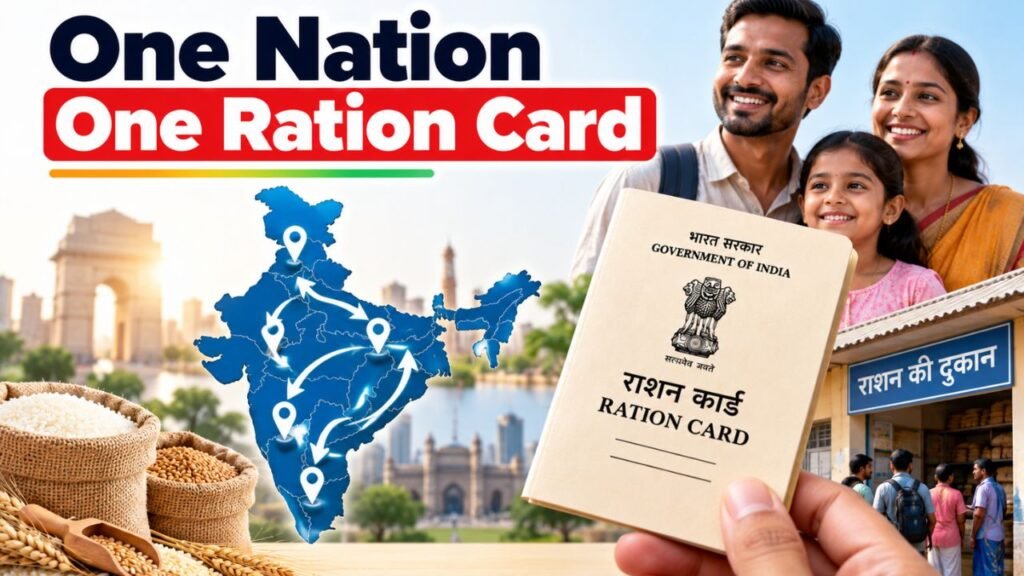
One Nation One Ration Card (ONORC) is a nationwide ration-card portability system that allows eligible beneficiaries under the National Food Security Act (NFSA) to collect their entitled foodgrains from an eligible Fair Price Shop (FPS) even when they are away from the location where their ration card was originally issued.
This facility is particularly useful for migrant workers, daily-wage workers, employees who move between States, and families whose members live or work in different locations.
Under ONORC, eligible NFSA beneficiaries can use their existing ration card rather than applying for a new ration card every time they move to another State or Union Territory. The system uses electronic Point of Sale (ePoS) technology and authentication to identify the beneficiary and record the transaction.
The Department of Food & Public Distribution states that ONORC has been enabled in all 36 States/UTs, covering around 80 crore NFSA beneficiaries.
What Is One Nation One Ration Card?
One Nation One Ration Card is a technology-driven portability system under India’s Targeted Public Distribution System (TPDS).
The basic idea is simple:
Your ration card is issued by your home State/UT, but eligible NFSA foodgrain entitlements can be accessed from an ePoS-enabled Fair Price Shop in another part of the country.
For example, suppose a worker has an NFSA ration card issued in Bihar but moves to Delhi for employment. Under ONORC, the eligible beneficiary can access the applicable foodgrain entitlement in Delhi without first surrendering the Bihar ration card and obtaining a new Delhi ration card.
The official Department of Food & Public Distribution describes ONORC as a plan for nationwide portability of ration cards and NFSA beneficiaries.
When Was One Nation One Ration Card Started?
ONORC was initially launched as a pilot in August 2019 with inter-State portability involving Andhra Pradesh, Gujarat, Maharashtra and Telangana.
The system was subsequently expanded to additional States and UTs in phases.
Delhi joined the portability system in July 2021, and the national rollout reached all 36 States/UTs in June 2022, when Assam was integrated.
The nationwide rollout means that eligible beneficiaries covered by the NFSA can use the portability system across the country, subject to the applicable authentication and operational requirements.
Who Can Use One Nation One Ration Card?
ONORC is primarily designed for beneficiaries covered under the National Food Security Act (NFSA).
The Department of Food & Public Distribution states that ONORC enables NFSA beneficiaries to lift their entitled foodgrains from an ePoS-enabled Fair Price Shop anywhere in the country using their existing NFSA ration card after the required biometric/Aadhaar authentication.
This makes the facility particularly useful for:
- Migrant workers
- Daily-wage workers
- Construction workers
- Factory workers
- Domestic workers
- Employees transferred to another State
- Students or workers living away from their home State
- Families whose members live in different States
- Other eligible NFSA beneficiaries who temporarily or permanently move
However, simply possessing any type of ration card does not automatically mean that a person receives an NFSA entitlement under ONORC. The beneficiary must be covered under the applicable NFSA category and State/UT records.
How Does One Nation One Ration Card Work?
ONORC connects ration-card and beneficiary information through a technology-based system.
A simplified process looks like this:
Existing NFSA Ration Card → Beneficiary Authentication → ePoS Device → Central Portability System → Entitlement Verification → Foodgrain Distribution
When the beneficiary visits an ePoS-enabled Fair Price Shop:
- The beneficiary provides the required identification.
- The FPS dealer identifies the beneficiary through the ePoS system.
- Biometric/Aadhaar authentication or another supported authentication process is completed.
- The system checks the beneficiary’s entitlement.
- The eligible foodgrain quantity is calculated.
- The transaction is recorded electronically.
- The beneficiary receives the applicable entitlement.
The Department’s official information states that beneficiaries can use the same/existing NFSA ration card and obtain their entitled foodgrains after biometric/Aadhaar authentication on an ePoS device.
Do You Need a New Ration Card in Another State?
No, not for using ONORC portability.
One of the major advantages of ONORC is that an eligible beneficiary does not have to surrender the existing NFSA ration card and obtain a new ration card merely because they have moved to another State or UT.
The Department’s official FAQ states that beneficiaries can use their existing AAY/PHH ration card issued by their home State/UT to access their entitled NFSA foodgrains under ONORC in another State/UT.
This is especially useful for people who move frequently for employment.
Can Migrant Workers Use ONORC?
Yes. Migrant workers are one of the major groups that ONORC is intended to benefit.
Consider this example:
A family has an eligible ration card in Uttar Pradesh. One member moves to Delhi for work while the rest of the family remains in Uttar Pradesh.
The migrant worker can potentially obtain the applicable entitlement from an ePoS-enabled FPS in Delhi, while the remaining family members can continue to access their entitlement at the appropriate FPS in their home location.
The Department’s official annual report specifically notes that ONORC has enabled migrant labourers to collect ration at their workplace while the rest of the family can obtain ration at the home State.
Can Family Members Take Ration Separately?
The portability system is particularly useful for households in which members are living in different places.
For example:
- Husband works in Delhi.
- Wife and children remain in Bihar.
- The household has an eligible NFSA ration card.
The eligible member in Delhi can use portability at an enabled FPS, while other household members can access their eligible entitlement at their usual location.
The exact quantity available to each member will depend on the household’s applicable NFSA entitlement and the amount already drawn.
What Is ePoS in ONORC?
ePoS means electronic Point of Sale.
It is the electronic device used at Fair Price Shops for authentication, transaction recording and distribution-related activities.
Under ONORC, ePoS technology helps the system identify beneficiaries and record foodgrain transactions electronically.
This reduces dependence on a physical register and allows portability transactions to be recorded within the connected PDS system.
The Department has described ePoS-enabled FPSs as an important part of the national portability system.
Is Aadhaar Required for ONORC?
Aadhaar-based authentication is an important part of the ONORC system, although the precise authentication options available can depend on the system and circumstances.
The Department states that eligible beneficiaries can use their existing NFSA ration card after biometric/Aadhaar authentication on an ePoS device at the Fair Price Shop.
The official ONORC FAQ also explains that a migrant beneficiary can use a ration card or Aadhaar-related identification for portability at an ePoS-enabled FPS, subject to the applicable authentication process.
Therefore, beneficiaries should ensure that their Aadhaar and ration-card information is correctly seeded/updated where required.
Can ONORC Be Used Without the Physical Ration Card?
The physical card is not necessarily the only way to identify an eligible beneficiary.
The official ONORC FAQ states that a migrant NFSA beneficiary who does not have the physical ration card with them may use a copy of the ration card or Aadhaar-related identification and complete the required authentication at an ePoS-enabled FPS.
The exact procedure can depend on the authentication system available at the FPS.
It is therefore useful to keep your ration-card number and relevant identification details accessible when travelling or working outside your home State.
Does ONORC Require Registration?
A major advantage of the system is that beneficiaries generally do not have to go through a separate process of obtaining a new ration card in the destination State simply to use portability.
The Department’s official FAQ states that beneficiaries can use ONORC without additional cost or additional paperwork/registration and do not need to surrender the home-State ration card or apply for a new ration card in the destination State merely to use portability.
However, the underlying ration-card record and required authentication must be in place.
What Foodgrains Can Be Received Under ONORC?
The quantity and type of foodgrains depend on the beneficiary’s applicable NFSA entitlement.
The official FAQ states that the existing NFSA scale and Central Issue Price provisions apply when portability is used. It gives the NFSA entitlement scale of:
- AAY: 35 kg per family per month
- PHH: 5 kg per person per month
The applicable rules, prices and foodgrain details should always be checked against current government provisions because food-security policies and distribution arrangements can change.
What Is AAY?
Antyodaya Anna Yojana (AAY) is an NFSA-related category intended for the poorest households identified under the applicable government criteria.
The NFSA system provides a monthly household entitlement under AAY.
Under the current official ONORC FAQ, the stated NFSA entitlement scale is 35 kg per AAY family per month.
The identification of eligible households is handled by the respective State/UT government.
What Is PHH?
Priority Household (PHH) is another beneficiary category under the National Food Security Act.
For PHH beneficiaries, the official ONORC FAQ states an entitlement of 5 kg of foodgrains per person per month under the applicable NFSA framework.
The exact beneficiary identification and ration-card issuance process is handled by the relevant State/UT.
Benefits of One Nation One Ration Card
ONORC provides several practical benefits.
1. Nationwide Portability
Eligible beneficiaries can access their entitled foodgrains outside their home State.
2. Useful for Migrant Workers
A worker does not necessarily have to travel back home simply to access the eligible ration entitlement.
3. Existing Ration Card Can Be Used
There is generally no need to obtain a new ration card in the destination State just to use portability.
4. Family Members Can Benefit From Different Locations
The system can be useful when household members are temporarily living in different locations.
5. Electronic Transaction Records
ePoS technology records transactions electronically, helping create a more connected PDS system.
6. Better Access During Migration
People who move for temporary employment can maintain access to eligible food-security benefits.
7. Find Nearby FPS
The Mera Ration application provides a feature for locating nearby Fair Price Shops using GPS-based functionality.
What Is Mera Ration 2.0?
Mera Ration 2.0 is a government mobile application designed to help citizens access information related to their ration-card system and NFSA entitlements.
According to the official NFSA FAQ, the app can provide facilities such as:
- Ration card details
- Foodgrain entitlement information
- Transaction history
- Nearby Fair Price Shop information
- Grievance submission and status monitoring
The Department of Food & Public Distribution also provides a Mera Ration app link through its official website.
How to Use Mera Ration for ONORC-Related Information
The app can be useful when you are living away from your home location.
A general process is:
- Install the official Mera Ration application.
- Enter or authenticate the required beneficiary information.
- View your ration-card details.
- Check your entitlement.
- Review recent transactions.
- Locate a nearby FPS.
- Use the information to visit an appropriate Fair Price Shop.
The app’s official FAQ confirms that it provides ration-card details, entitlement information, transaction history and nearby FPS information.
How to Find a Fair Price Shop Under ONORC
Beneficiaries can use the Mera Ration application to find nearby Fair Price Shops.
The official Department information states that the application includes a GPS-based facility for locating nearby FPSs and following the map to the closest shop.
When you are in a new city, this can be more convenient than trying to locate a suitable FPS manually.
Is There Any Extra Fee for ONORC?
According to the official ONORC FAQ, beneficiaries do not have to bear an additional financial burden for using the portability facility. The FAQ states that portability can be used without additional cost or additional paperwork/registration.
However, the applicable entitlement and issue-price rules remain relevant to the foodgrains being distributed.
Is a New Ration Card Required After Moving to Another State?
No, not merely for using ONORC portability.
For example, if an eligible NFSA beneficiary moves from Bihar to Delhi for employment, the beneficiary does not have to surrender the Bihar ration card and obtain a Delhi ration card simply to use ONORC portability.
The existing eligible NFSA ration card can be used through the national portability system.
This is different from permanently changing the household’s ration-card registration or applying for a different State-specific ration-card service.
ONORC vs New Ration Card
These two concepts should not be confused.
| ONORC | New Ration Card |
|---|---|
| Provides portability | Creates/updates a State/UT ration-card record |
| Mainly useful when beneficiaries move | Used when a new eligible household needs a card |
| Existing eligible NFSA card can be used | New application is required |
| No new destination-State card needed merely for portability | Eligibility is assessed under State/UT rules |
| Works through the national portability system | Managed by the concerned State/UT |
| Particularly useful for migrants | Used for establishing a household’s ration-card entitlement |
The NFSA confirms that new ration-card issuance is handled by the respective State Government/UT Administration.
ONORC vs Ration Card Address Change
An address change and ONORC serve different purposes.
Suppose you temporarily move from Uttar Pradesh to Delhi for six months for work.
You may use ONORC portability to access your eligible ration entitlement in Delhi without immediately changing your home ration-card registration.
If you permanently relocate and need to update the official household record, a separate ration-card address-change or transfer procedure may be relevant.
For a detailed guide, see Ration Card Address Change.
Does ONORC Change Your Ration Card?
No.
ONORC is primarily a portability facility. It does not mean that your original ration card is automatically transferred to the destination State.
The Department describes the system as allowing beneficiaries to use the same/existing NFSA ration card for portability.
What If the FPS Dealer Refuses to Give Ration?
If an eligible beneficiary faces a problem at an FPS, first check:
- Whether the FPS is ePoS-enabled.
- Whether authentication has been completed.
- Whether sufficient entitlement remains.
- Whether the ration-card record is active.
- Whether there is a technical issue.
- Whether the transaction has already been recorded.
If the problem continues, use the applicable State/UT grievance mechanism or the NFSA grievance facility.
The Mera Ration 2.0 app also supports grievance submission and status monitoring according to the official NFSA FAQ.
Common Problems With ONORC
Aadhaar Authentication Failure
Biometric authentication may fail because of authentication or device-related issues.
Aadhaar Not Properly Seeded
If the relevant beneficiary record is not properly linked or updated, authentication may create problems.
FPS Not Operational
Not every problem is necessarily related to your ration card. An FPS can experience connectivity, device or operational issues.
Insufficient Remaining Entitlement
If part of the month’s entitlement has already been collected, the remaining quantity may be lower.
Incorrect Beneficiary Details
Differences in beneficiary information can create authentication or record-matching issues.
Transaction Already Recorded
If the system shows that the month’s entitlement has already been collected, the beneficiary should check the transaction details before attempting another withdrawal.
How to Check Ration Card Details Before Using ONORC
Before travelling or moving to another State, it is useful to verify your ration-card information.
You can check:
- Ration Card Number
- Head of Family
- Family members
- Beneficiary category
- Aadhaar seeding/authentication status, where available
- Previous transactions
- Foodgrain entitlement
The Mera Ration application provides facilities for viewing ration-card details, entitlements and transaction history.
You can also read e Ration Card Download if you need to access the digital ration-card facility.
Important Points to Remember
Before using ONORC, remember:
- ONORC is primarily for eligible NFSA beneficiaries.
- You generally do not need a new ration card in the destination State merely to use portability.
- The existing eligible NFSA ration card remains associated with the issuing State/UT.
- Foodgrain entitlement depends on the applicable NFSA category.
- Authentication is performed through the ePoS system.
- Aadhaar/biometric authentication is an important part of the system.
- Mera Ration can help check entitlements and locate FPSs.
- Keep your ration-card number and relevant identification details available.
- Do not share OTPs or sensitive authentication information with strangers.
- For disputes, use official grievance channels.
One Nation One Ration Card: Quick Example
Imagine a family from Bihar has an eligible PHH ration card.
The father moves to Delhi for construction work.
Instead of applying for a separate Delhi ration card merely because he has moved for work, he can use the ONORC portability facility at an eligible ePoS-enabled FPS in Delhi.
Meanwhile, the rest of the family remains in Bihar and can access its applicable entitlement there.
The national portability system is designed to make this type of access possible for eligible NFSA beneficiaries.
Frequently Asked Questions
Conclusion
One Nation One Ration Card has made ration portability much easier for eligible NFSA beneficiaries, particularly people who move between States for employment. Instead of obtaining a new ration card simply because they have moved, eligible beneficiaries can use their existing NFSA ration-card record to access their entitled foodgrains through an ePoS-enabled Fair Price Shop.
The system is now enabled across all 36 States/UTs, and the Department of Food & Public Distribution reports coverage of around 80 crore NFSA beneficiaries.
For people who frequently migrate for work, understanding ONORC can help avoid unnecessary applications, paperwork and travel back to the home State. Before using the facility, check your ration-card details, entitlement and authentication status through the official system or Mera Ration application.
For more practical guides on ration cards and Indian government services, visit Sarkari Bakery.
Based on Google's Helpful Content System, this article emphasizes user value, transparency, and accuracy. It incorporates principles of E-E-A-T (Experience, Expertise, Authoritativeness, Trustworthiness).
Why Choose Sarkari Bakery?
Official Information
Government schemes & banking information based on official sources.
Step-by-Step Guides
Simple application process explained for every service.
Regular Updates
Content updated whenever official rules or services change.
People-First Content
Helpful, transparent and user-focused content.