
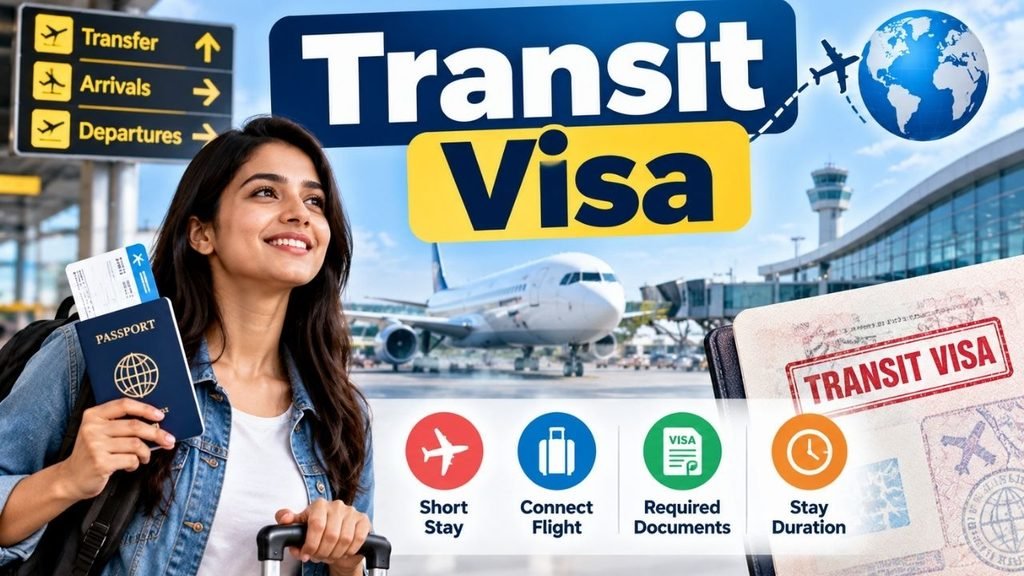
A Transit Visa is a type of short-term visa that allows a foreign traveller to pass through a country while travelling to another country. It is mainly used when a traveller has to travel through a third country before reaching the final destination.
For example, suppose a person is travelling from Country A to Country C, but the journey requires a stop in Country B. Country B is the transit country. Depending on the traveller’s nationality, airport, itinerary and immigration rules, the traveller may need a transit visa to pass through Country B.
A transit visa is different from a tourist visa because the primary purpose is not to visit the transit country. Instead, it is intended to allow the traveller to continue the journey to another destination.
The rules for transit visas are not the same everywhere. Some travellers may be able to remain inside an airport’s international transit area without a visa, while others may need a visa even for a short connection. Therefore, understanding what a transit visa is, when it is required, how long it is valid, what documents are needed and how the application process works is important before booking or starting an international journey.
⭐ What Is a Transit Visa?
A Transit Visa is a temporary visa issued to a foreign traveller who needs to pass through a country while travelling to another destination.
The main purpose of this visa is to facilitate the traveller’s onward journey.
A transit visa generally allows a person to remain in the transit country for a limited period and under specific conditions. The traveller is expected to continue the journey to the final destination rather than use the transit visa for an ordinary visit.
For example:
Starting Country → Transit Country → Final Destination
If the traveller needs to enter the transit country during this journey, immigration authorities may require a transit visa.
The exact requirement depends on the laws of the transit country and the circumstances of the journey.
⭐ Why Is a Transit Visa Required?
Countries have immigration controls that determine who can enter their territory and under what conditions.
Even if a traveller is not planning to stay for a long time, they may sometimes need to pass through immigration during a connecting journey.
A transit visa can provide limited permission for this type of travel.
It may be required when:
- A traveller needs to enter the transit country.
- The traveller needs to leave the airport.
- The traveller has to change airports.
- The traveller needs to collect and re-check baggage.
- The connecting journey requires immigration clearance.
- The traveller’s nationality is subject to transit visa requirements.
- The traveller needs to stay overnight outside the permitted transit area.
- The traveller’s itinerary involves a type of transit for which an airport transit exemption does not apply.
However, simply having a connecting flight does not automatically mean that a transit visa is required.
⭐ How Does a Transit Visa Work?
The easiest way to understand a transit visa is through an example.
Suppose a traveller has the following journey:
India → Country B → United Kingdom
Here, Country B is the transit country.
If the traveller arrives at Country B and remains within the permitted international transit area before boarding the next flight, a transit visa may not always be necessary.
But suppose the traveller has to leave the airport, collect baggage, change airports or pass through immigration.
In that situation, the traveller may need permission to enter Country B.
Depending on the country’s rules and the traveller’s nationality, this could mean obtaining a transit visa before travelling.
The important point is that the entire itinerary matters, not just the fact that the traveller has a connecting flight.
⭐ Do You Always Need a Transit Visa?
No, a transit visa is not required in every international connection.
Whether you need one depends on several factors.
Nationality
Your passport nationality can determine whether you need a transit visa.
Some countries have visa exemptions for citizens of certain countries, while additional requirements may apply to citizens of others.
Transit Country
Every country has its own immigration and transit rules.
A connection through one country may be treated differently from a connection through another country.
Airport
The airport you use can also matter.
Some airports have international transit facilities that allow eligible passengers to remain airside without entering the country.
Connecting Flight
The type of connection can affect the visa requirement.
For example, a passenger travelling on a single booking may have a different transit arrangement from someone travelling on separate tickets.
Baggage
If the traveller needs to collect checked baggage and check in again, they may need to pass through immigration.
Final Destination
The country where the traveller ultimately intends to travel can also be relevant to the transit process.
⭐ What Is an Airport Transit Visa?
An Airport Transit Visa is a specific type of transit permission associated with passing through an airport without entering the country beyond the permitted international transit area.
It is generally intended for passengers who:
- Arrive at an airport,
- Remain within the permitted transit zone,
- Wait for their connecting flight, and
- Continue to another country.
An airport transit visa is different from a normal entry visa.
In many situations, an airport transit visa does not give the traveller general permission to enter the country.
This distinction is important because a traveller may be allowed to remain in an international transit area but may not be allowed to pass through immigration and enter the country.
⭐ Airport Transit Without a Transit Visa
Some travellers can transit through an airport without obtaining a transit visa.
This can happen when the traveller is permitted to remain in the designated international transit area and does not need to enter the country.
For example:
Flight 1 → International Transit Area → Flight 2
If the passenger does not need to pass through immigration and is eligible for visa-free airside transit, a transit visa may not be required.
However, this is not a universal rule.
Some nationalities can be subject to special airport transit requirements even when they do not plan to leave the airport.
Therefore, travellers should check the exact requirements applicable to their nationality and journey.
⭐ When Do You Need a Transit Visa?
A transit visa may be required in several situations.
Changing Airports
If your connecting flight departs from another airport in the same country, you may need to enter the country to travel between the airports.
In such cases, airport transit rules may not be sufficient.
Leaving the Airport
If you want or need to leave the airport during your connection, you may need permission to enter the country.
Collecting Baggage
When baggage is not automatically transferred to the next flight, you may need to collect it and check in again.
This can require you to pass through immigration.
Separate Flight Tickets
Travelling on separate tickets can sometimes create additional requirements.
For example, if the first airline does not transfer your baggage to the second airline, you may have to enter the country to collect the baggage.
Overnight Stay
A long connection that requires you to stay outside the airport can create different visa requirements.
Immigration Clearance
If the itinerary requires immigration clearance before the connecting flight, the traveller may need an appropriate visa or entry permission.
⭐ What Is the Difference Between Transit Visa and Tourist Visa?
A transit visa and a tourist visa are designed for different purposes.
| Feature | Transit Visa | Tourist Visa |
|---|---|---|
| Main purpose | Passing through a country | Visiting a country |
| Typical stay | Short | Usually longer |
| Main journey | Continuing to another destination | Staying in the destination country |
| Tourism | Usually not the purpose | Main purpose |
| Onward journey | Generally important | Not necessarily required |
| Entry conditions | Usually limited | Depends on tourist visa |
| Duration | Depends on issuing country | Depends on visa category |
A traveller should not use a transit visa for a purpose that requires another type of visa.
For example, if someone plans to spend several weeks sightseeing in the transit country, a tourist visa or another appropriate visa may be required instead.
⭐ What Is the Difference Between Transit Visa and Airport Transit Visa?
These two terms are closely related but can have different meanings.
A Transit Visa can provide limited permission to pass through or enter a country during an onward journey.
An Airport Transit Visa is generally associated with remaining in the airport’s international transit area.
| Transit Visa | Airport Transit Visa |
|---|---|
| May allow limited entry depending on country rules | Generally connected with airside transit |
| Used for passing through a country | Used for transit through an airport |
| Conditions vary by country | Conditions can be more restrictive |
| May involve immigration clearance | Generally intended to avoid entry into the country |
The exact definitions vary between immigration systems, so travellers should always check the terminology used by the relevant country’s authorities.
⭐ How Long Is a Transit Visa Valid?
There is no single validity period for all transit visas.
The validity is decided by the country issuing the visa and depends on the particular visa category.
A transit visa may have a relatively short validity period because its purpose is only to facilitate an onward journey.
The visa document may specify:
- Date of issue
- Start date
- Expiry date
- Number of entries
- Maximum permitted stay
- Other conditions
It is important to understand the difference between visa validity and permitted stay.
A visa may remain valid for a certain number of days, but the traveller may only be allowed to stay in the country for a much shorter period.
⭐ How Long Can You Stay on a Transit Visa?
A transit visa generally permits only a limited stay.
The permitted period depends on the issuing country’s rules.
Some transit visas may allow only a very short stay, while others may provide a slightly longer period for completing the journey.
The traveller must follow the stay limit written on the visa.
A transit visa should not be considered an alternative to a tourist, business, employment or student visa.
If you need to stay in the country beyond the permitted transit period, you may need another type of visa.
⭐ Single-Entry Transit Visa
A Single-Entry Transit Visa generally allows one entry into the transit country.
It is suitable for a traveller who needs to pass through the country once before continuing to the final destination.
For example:
Country A → Transit Country → Country C
If the traveller does not need to return to the transit country during the same journey, a single-entry transit visa may be appropriate where such a visa is available.
⭐ Double-Entry Transit Visa
A Double-Entry Transit Visa can allow two entries into the transit country when the traveller’s journey requires it.
For example:
Country A → Transit Country → Country C → Transit Country → Country A
If the relevant immigration system provides a double-entry transit visa and the traveller meets the conditions, this type of visa may be used for two permitted transit entries.
Not every country offers the same entry options.
⭐ What Documents Are Required for a Transit Visa?
The documents required depend on the country and the applicant’s circumstances.
However, a transit visa application may commonly require documents such as:
- Valid passport
- Completed visa application form
- Recent photograph
- Confirmed onward travel ticket
- Travel itinerary
- Proof of final destination
- Valid visa for the final destination, where required
- Supporting documents relating to the journey
- Additional documents requested by the immigration authority
The purpose of these documents is generally to establish the traveller’s identity, travel plans and onward journey.
⭐ Why Is an Onward Ticket Important?
An onward ticket can be an important document for a transit visa because it demonstrates that the traveller intends to continue the journey.
For example:
Country A → Transit Country → Country C
The ticket from the transit country to Country C provides evidence of the onward journey.
Depending on the circumstances, authorities may also ask for other evidence of the final destination.
Travellers should therefore keep their complete itinerary available when applying for a transit visa.
⭐ Do You Need a Visa for the Final Destination?
In some situations, a transit visa application may require proof that the traveller is legally permitted to enter the final destination.
This can include:
- A valid visa
- Residence permit
- Entry authorization
- Other applicable travel permission
For example, if a traveller is passing through a country to reach a destination that requires a visa, the transit authority may require evidence that the traveller has the necessary permission for that final destination.
The exact requirement depends on the countries involved.
⭐ How to Apply for a Transit Visa?
Although the procedure varies by country, the general application process can be understood through the following steps.
Step 1: Check Whether You Need a Transit Visa
Before applying, determine whether your nationality and itinerary require transit permission.
Do not apply based only on the fact that you have a connecting flight.
Step 2: Check the Transit Rules
Check the immigration requirements of the country where you will transit.
Pay attention to:
- Airport
- Nationality
- Connection time
- Terminal
- Baggage arrangements
- Airport change
- Entry requirements
Step 3: Complete the Application Form
If a transit visa is required, complete the relevant application form.
Make sure all information matches your passport and travel documents.
Step 4: Prepare Supporting Documents
Collect the required documents, such as:
- Passport
- Photograph
- Flight tickets
- Travel itinerary
- Final destination visa, where applicable
- Other supporting documents
Step 5: Pay the Visa Fee
If a fee applies, pay it according to the instructions of the relevant immigration authority.
Step 6: Submit the Application
Depending on the country, applications may be submitted:
- Online
- At an embassy
- At a consulate
- Through a visa application centre
- Through another authorized channel
Step 7: Provide Biometrics if Required
Some visa applications require biometric information such as fingerprints or a photograph.
Step 8: Wait for the Decision
After submission, the application is processed.
If approved, check the visa carefully before travelling.
⭐ Transit Visa Application Process at a Glance
| Step | Process |
|---|---|
| 1 | Check whether a transit visa is required |
| 2 | Check nationality-specific requirements |
| 3 | Confirm the complete itinerary |
| 4 | Complete the application |
| 5 | Prepare supporting documents |
| 6 | Pay the applicable fee |
| 7 | Submit the application |
| 8 | Provide biometrics if required |
| 9 | Wait for processing |
| 10 | Check the visa conditions before travelling |
⭐ How Much Does a Transit Visa Cost?
There is no universal transit visa fee.
The cost depends on factors such as:
- Transit country
- Applicant’s nationality
- Visa category
- Number of entries
- Processing method
- Urgent processing, where available
Some countries may also have different fee arrangements for nationals of specific countries.
Therefore, travellers should check the current fee published by the relevant embassy, consulate or immigration authority.
⭐ Can You Leave the Airport on a Transit Visa?
This depends on the type of visa issued.
An airport transit visa may only allow the traveller to remain in the international transit area.
Another type of transit visa may permit limited entry into the country.
Therefore, having a transit visa does not automatically mean that you can freely travel around the country.
Always check the conditions written on the visa.
⭐ Can You Stay in a Hotel During Transit?
Whether you can stay in a hotel depends on whether your visa permits you to leave the airport and enter the country.
If your permission is limited to airside transit, you may not be allowed to leave the airport.
If you have an appropriate visa allowing entry, accommodation outside the airport may be possible within the permitted stay.
Travellers should not assume that an overnight connection automatically gives them permission to leave the airport.
⭐ What Happens If You Have a Long Layover?
A long layover does not automatically mean that you need a transit visa.
The important question is what you need to do during the layover.
For example:
Short Airside Connection
If you remain in the international transit area and your nationality is exempt from transit visa requirements, you may be able to continue without a transit visa.
Long Connection Inside the Airport
Even a long connection may be possible without entering the country if the airport and immigration rules allow it.
Leaving the Airport
If you want to leave the airport during the layover, you may require entry permission.
Overnight Outside the Airport
If you need to stay at a hotel outside the airport, you may need to enter the country and therefore require the appropriate visa.
⭐ What Happens If You Miss Your Connecting Flight?
Missing a connecting flight can create complications if your transit permission has a limited validity period.
The situation may depend on:
- Why the flight was missed
- Whether the airline rebooks you
- Whether the new flight leaves within the visa validity
- Whether you need to leave the airport
- Whether you need accommodation outside the airport
- Whether your transit permission is still valid
If your new travel arrangement no longer fits the conditions of your transit visa, you may need to contact the relevant immigration authority or airline for guidance.
⭐ Transit Visa When Travelling on Separate Tickets
Travelling on separate tickets can require additional attention.
For example, suppose you have:
Ticket 1: Country A → Transit Country
Ticket 2: Transit Country → Country C
You may need to collect your baggage after the first flight and check in again for the second flight.
If baggage collection requires passing through immigration, you may need permission to enter the transit country.
Therefore, travellers using separate tickets should check the baggage and immigration arrangements before starting the journey.
⭐ Can You Work on a Transit Visa?
A transit visa is generally intended only for the purpose of passing through a country.
It does not normally provide general permission to work.
If the traveller wants to take up employment in the transit country, a separate work or employment visa may be required.
The exact rules depend on the country.
⭐ Can You Study on a Transit Visa?
A transit visa is generally not intended for education or long-term study.
If someone plans to attend a course, college, university or other educational programme, they may need a student or study visa.
The appropriate visa depends on the duration and nature of the educational activity.
⭐ Can You Visit Tourist Places During Transit?
This depends on the immigration permission available to the traveller.
If the traveller is only permitted to remain inside the airport transit area, leaving the airport for sightseeing would not be permitted.
If the traveller has a visa that allows entry into the country, sightseeing may be possible only if it is permitted under that visa.
A traveller should never assume that a transit visa automatically provides tourist privileges.
⭐ Common Reasons a Transit Visa Application Can Become Complicated
Several issues can create problems during a transit visa application.
Incorrect Travel Information
The application should match the actual itinerary.
Missing Onward Ticket
If the required proof of onward travel is missing, additional information may be requested.
No Permission for Final Destination
Where applicable, the traveller may need evidence of a valid visa or entry permission for the final destination.
Passport Problems
The passport must satisfy the requirements of the relevant authority.
Incorrect Visa Category
Applying for an airport transit visa when the journey actually requires entry into the country can create problems.
Last-Minute Application
Visa processing can take time, so travellers should avoid waiting until the last moment.
⭐ Important Things to Check Before Applying for a Transit Visa
Before submitting your application, check the following:
- Your passport validity
- Your nationality-specific transit rules
- Transit airport
- Connecting flight details
- Whether you are travelling on one ticket or separate tickets
- Baggage transfer arrangements
- Whether you need to pass immigration
- Whether you need to change airports
- Whether you need to leave the airport
- Final destination visa requirements
- Transit visa validity
- Maximum permitted stay
- Number of permitted entries
- Visa fee
- Required documents
- Application processing time
A small difference in the itinerary can sometimes change the applicable immigration requirement.
⭐ Transit Visa vs Visa-Free Transit
These two situations should not be confused.
Visa-Free Transit
The traveller is allowed to pass through the country without obtaining a transit visa, subject to the applicable conditions.
Transit Visa
The traveller must obtain a specific visa before or during the applicable process in order to transit under the permitted conditions.
Whether visa-free transit is available depends on the traveller’s nationality and journey.
⭐ Important Difference Between Visa Validity and Stay Duration
This is one of the most important points about transit visas.
Visa validity refers to the period during which the visa can be used.
Permitted stay refers to how long the traveller can actually remain in the country under that visa.
These two periods can be different.
For example, a visa might be valid for several days but permit only a shorter stay.
Therefore, travellers should read both:
- Valid From / Valid Until
- Duration of Stay
before travelling.
⭐ What Should You Carry While Travelling on a Transit Visa?
It is advisable to keep important travel documents easily accessible.
These may include:
- Passport
- Transit visa
- Boarding passes
- Onward flight ticket
- Complete itinerary
- Final destination visa, where applicable
- Residence permit, where applicable
- Travel insurance, if required
- Other documents requested by immigration authorities
Keeping these documents together can make the transit process easier.
⭐ Common Mistakes to Avoid
Assuming Every Connection Needs a Transit Visa
A connecting flight alone does not automatically mean that a transit visa is required.
Assuming No Transit Visa Is Ever Needed
The opposite assumption can also cause problems. Some nationalities require transit permission even when they remain at the airport.
Ignoring Baggage Rules
If you need to collect your baggage, you may have to pass through immigration.
Booking Separate Tickets Without Checking Immigration Rules
Separate tickets can create additional requirements.
Assuming You Can Leave the Airport
Airport transit permission may not allow you to enter the country.
Checking Only the Airline Website
Airlines can provide useful information, but immigration requirements should also be checked with the relevant official authority.
Applying for the Wrong Visa
Make sure you understand whether you need an airport transit visa, regular transit visa or another category of entry permission.
⭐ Conclusion
A Transit Visa is a short-term travel permission designed for people who need to pass through one country while travelling to another destination. It is different from a tourist visa because the primary purpose is to facilitate an onward journey rather than a normal visit.
Whether you need a transit visa depends on several factors, including your nationality, transit country, airport, connecting flight, baggage arrangements, final destination and whether you need to pass through immigration or leave the airport.
In some cases, eligible travellers can remain inside the international transit area without obtaining a transit visa. In other situations, a transit visa or another form of entry permission may be necessary.
Before travelling, always check the latest requirements of the relevant immigration authority and make sure your passport, onward ticket, travel itinerary, final-destination visa and other required documents are ready. Most importantly, do not assume that every connecting flight has the same visa requirements because transit rules can vary significantly from one country and traveller to another.
For more useful information about visas, travel documents, government services and important online processes, visit Sarkari Bakery.
⭐ Frequently Asked Questions About Transit Visa
Based on Google's Helpful Content System, this article emphasizes user value, transparency, and accuracy. It incorporates principles of E-E-A-T (Experience, Expertise, Authoritativeness, Trustworthiness).
Why Choose Sarkari Bakery?
Official Information
Government schemes & banking information based on official sources.
Step-by-Step Guides
Simple application process explained for every service.
Regular Updates
Content updated whenever official rules or services change.
People-First Content
Helpful, transparent and user-focused content.