
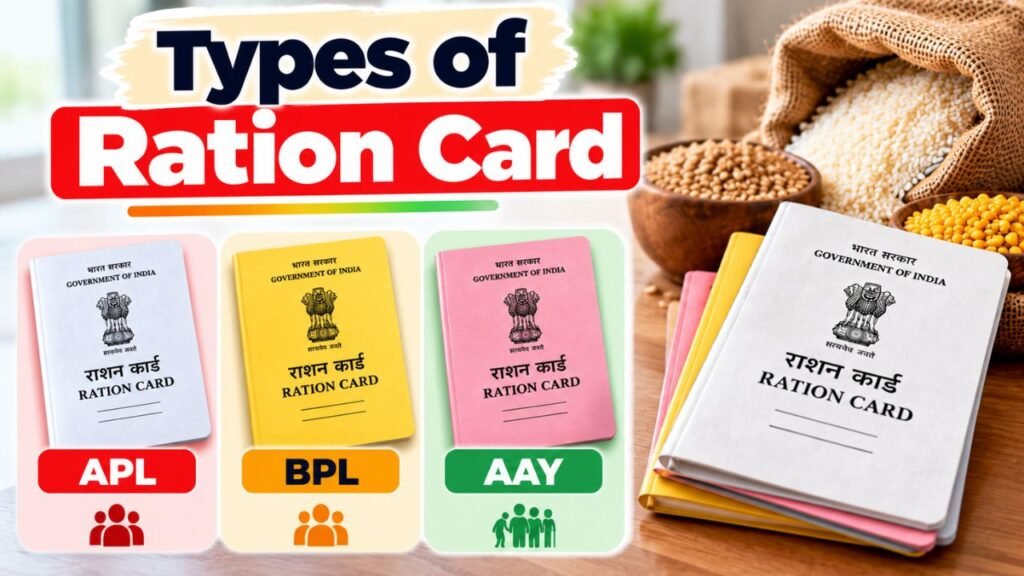
There are different Types of Ration Card in India, and the category assigned to a household can affect its eligibility for subsidised or free foodgrains under the public distribution system. However, one important point is often misunderstood: there is no single nationwide list of ration-card categories that is applied identically in every State and Union Territory.
Under the National Food Security Act, 2013 (NFSA), the two principal beneficiary categories are Antyodaya Anna Yojana (AAY) households and Priority Households (PHH). The identification of eligible households is carried out by the respective State Governments and UT administrations according to their applicable criteria.
Older terms such as APL and BPL are still commonly used when people talk about ration cards, but they should not automatically be treated as the current NFSA categories everywhere. Many State systems have their own terminology and categories outside or alongside NFSA coverage.
This guide explains the major Types of Ration Card, their eligibility framework, benefits, differences, and how ration-card categories work under the present food distribution system.
What Is a Ration Card?
A ration card is a household-related document or digital record used within the Public Distribution System (PDS) and State food-security administration.
Depending on the category and applicable State rules, eligible households can receive foodgrains through Fair Price Shops (FPS).
A ration card may also contain household information such as:
- Ration Card Number
- Head of Family
- Names of family members
- Address
- Ration-card category
- Fair Price Shop details
- Other beneficiary information
The exact format and services associated with the ration card vary between States and UTs.
For people who already have a ration card, digital facilities may also be available. You can read the guide on e Ration Card Download to understand the digital-card process.
Main Types of Ration Card Under NFSA
At the national level, the NFSA framework primarily covers two categories:
- Antyodaya Anna Yojana (AAY)
- Priority Households (PHH)
NFSA covers up to 75% of the rural population and 50% of the urban population through these two categories, subject to the State-wise coverage and identification framework.
1. Antyodaya Anna Yojana (AAY) Ration Card
The Antyodaya Anna Yojana (AAY) category is intended for the poorest and most vulnerable households covered under the applicable identification criteria.
AAY was introduced to target households facing severe food insecurity. The scheme originally focused on the poorest sections of the population and was subsequently expanded to cover additional vulnerable groups.
Under the NFSA entitlement framework, an AAY household is entitled to:
35 kg of foodgrains per household per month.
The entitlement is household-based rather than calculated by simply multiplying the number of family members by 5 kg.
Who May Fall Under AAY?
The actual identification is performed by the State/UT according to applicable criteria.
Historically, AAY identification has included particularly vulnerable households such as:
- Households without assured means of subsistence
- Certain landless agricultural labour households
- Marginal farmers
- Rural artisans and craftsmen
- Destitute households
- Certain households headed by widows
- Certain households headed by elderly persons without adequate support
- Persons with disabilities in vulnerable circumstances
- Other households facing severe food insecurity
These examples should not be treated as an automatic eligibility checklist because the State/UT is responsible for identifying eligible households within its allocated coverage.
2. Priority Household (PHH) Ration Card
The Priority Household (PHH) category is another major NFSA category.
Under the NFSA entitlement framework, eligible PHH beneficiaries receive:
5 kg of foodgrains per person per month.
For example, if a PHH household has four eligible members, the NFSA entitlement framework corresponds to:
4 × 5 kg = 20 kg per month
The actual distribution process and commodities can depend on the applicable government rules and State implementation.
Who Is Eligible for PHH?
The State or UT identifies eligible households using its own criteria within the NFSA coverage allocated to it.
This means that a household cannot determine PHH eligibility merely by looking at its income or family size without considering the applicable State rules.
The NFSA specifically places responsibility for identifying eligible households on State Governments and UT administrations.
AAY vs PHH Ration Card
The most important difference between the two NFSA categories is the basis of foodgrain entitlement.
| Feature | AAY | PHH |
|---|---|---|
| Full Form | Antyodaya Anna Yojana | Priority Household |
| Target Group | Poorest and most vulnerable eligible households | Eligible priority households |
| NFSA Entitlement | 35 kg per household/month | 5 kg per person/month |
| Basis of Entitlement | Household | Individual beneficiary |
| Identification | State/UT government | State/UT government |
| Covered Under NFSA | Yes | Yes |
The NFSA framework specifies 35 kg per AAY household per month and 5 kg per PHH person per month.
What About APL and BPL Ration Cards?
APL means Above Poverty Line, while BPL means Below Poverty Line.
These terms were widely used under the earlier Targeted Public Distribution System (TPDS) framework and are still commonly used in everyday conversations about ration cards.
However, after implementation of the National Food Security Act, 2013, the national food-security framework shifted toward AAY and PHH categories for NFSA coverage.
The Department of Food & Public Distribution notes that NFSA coverage is de-linked from the erstwhile poverty estimates.
Therefore, it is not accurate to assume that every State currently uses APL and BPL as the primary equivalent of PHH and AAY.
APL Ration Card
Historically, APL referred to households classified as being above the applicable poverty-line criteria under the earlier system.
The benefits, issue prices and eligibility conditions under the older system were different from the present NFSA framework.
If a State still uses an APL-related category or terminology for a particular non-NFSA purpose, the applicable State rules should be checked.
BPL Ration Card
BPL referred to households classified below the applicable poverty-line criteria under the earlier system.
Some people still use “BPL ration card” as a general term for a ration card belonging to a low-income household.
However, BPL should not automatically be treated as another name for an AAY or PHH ration card.
The current NFSA framework uses AAY and PHH for its principal categories.
APL vs BPL vs AAY vs PHH
| Category/Term | Current Context | Basic Meaning |
|---|---|---|
| AAY | Current NFSA category | Poorest/vulnerable eligible households |
| PHH | Current NFSA category | Priority households identified by States/UTs |
| BPL | Mainly legacy terminology | Below Poverty Line |
| APL | Mainly legacy terminology | Above Poverty Line |
The important distinction is that APL/BPL terminology comes from the earlier poverty-based classification framework, whereas AAY and PHH are the principal categories under NFSA.
Other State-Specific Ration Card Categories
Apart from NFSA categories, individual States and UTs may maintain additional classifications, schemes or terminology.
This happens because ration-card administration is implemented by State and UT governments.
For example, the official Delhi NFSA page currently lists:
- Antyodaya Anna Yojana (AAY)
- Priority Household (NFSA)
- Annapurna
under its department schemes.
This demonstrates why someone searching for “all types of ration cards in India” may encounter different names depending on the State.
Therefore, the safest approach is to distinguish between:
National NFSA categories: AAY and PHH
and
State-specific/legacy categories or schemes: categories and terminology that may exist under individual State systems.
What Is Annapurna Ration Card?
The Annapurna scheme is another food-security-related category/scheme that can appear in State food-distribution systems.
It should not simply be described as a third NFSA category equivalent to AAY and PHH.
For example, Delhi’s official NFSA page lists Annapurna separately from AAY and PHH among its department schemes.
Eligibility and benefits under such State-specific schemes should be checked against the relevant government rules.
How Are Ration Card Categories Decided?
A common misconception is that the Central Government automatically assigns every family an AAY, PHH, APL or BPL card.
In reality, identification under NFSA is handled by the respective State Government or UT administration.
The NFSA portal specifically states that identification of beneficiaries/households and issuance of AAY and PHH ration cards is dealt with by the respective State Government/UT Administration.
The State may consider factors such as:
- Household economic condition
- Family circumstances
- Vulnerability
- Existing beneficiary records
- State-specific eligibility criteria
- Exclusion criteria
- Available NFSA coverage
The exact criteria are therefore not identical throughout India.
How Many Ration Cards Can a Family Have?
A household should not assume that it can maintain multiple active ration cards for the same household merely because family members have separate documents.
Ration-card systems are designed around household and beneficiary records.
Duplicate or ineligible records can be identified and removed from the system. The NFSA describes beneficiary identification as a continuous process that includes exclusion of ineligible, fake and duplicate ration cards and inclusion of genuine left-out households.
If a family member moves to another household, gets married, migrates or otherwise becomes part of a different household, the appropriate addition, deletion or transfer process should be followed.
How Does Family Size Affect the Ration Card Category?
Family size does not automatically decide whether a household receives AAY or PHH status.
However, the quantity of NFSA entitlement differs significantly:
AAY
The entitlement is:
35 kg per household per month.
PHH
The entitlement is:
5 kg per eligible person per month.
Therefore, the number of eligible members matters directly for a PHH household’s monthly quantity, while AAY entitlement is household-based.
Can a Ration Card Category Be Changed?
A change may be possible if the household’s circumstances or eligibility change and the applicable State/UT rules permit reclassification.
For example, changes in household composition, economic circumstances, eligibility or other relevant information may require the department to review the record.
However, a person should not assume that simply submitting a request will guarantee conversion from one category to another.
The concerned State Food and Civil Supplies Department determines eligibility according to its applicable criteria.
What Happens If a Family Member Is Added?
When a new eligible family member becomes part of a household, the ration-card record may need to be updated.
Common examples include:
- Birth of a child
- Marriage
- A dependent joining the household
- Correction of household records
The exact documents and procedure vary by State.
For the detailed process, see Ration Card Family Member Add.
What Happens If a Family Member Leaves?
A member may need to be removed when:
- The person dies
- The person moves permanently to another household
- The person gets married and joins another household
- The person is transferred to another ration-card record
- The person was incorrectly included
The correct procedure is important because duplicate inclusion can create problems during verification.
You can also read Ration Card Name Remove for the related process.
Does Ration Card Type Affect Foodgrain Entitlement?
Yes.
Under the NFSA entitlement framework:
AAY: 35 kg per household per month
PHH: 5 kg per person per month
The Central Government has also been providing foodgrains free of cost to NFSA beneficiaries under the PMGKAY framework. The Department of Food & Public Distribution states that free foodgrains were continued for five years from 1 January 2024, covering AAY households at 35 kg per family per month and PHH beneficiaries at 5 kg per person per month.
This should not be confused with the separate question of which household is eligible for AAY or PHH in the first place.
Can I Use My Ration Card in Another State?
If you are an NFSA beneficiary, One Nation One Ration Card (ONORC) provides portability of entitled foodgrains.
The Department of Food & Public Distribution states that ONORC enables NFSA beneficiaries to obtain their entitled foodgrains from an ePoS-enabled Fair Price Shop anywhere in the country using their existing NFSA ration card, subject to authentication.
This is particularly useful for migrant workers and families that temporarily move away from their home State.
Importantly, ONORC is about portability of benefits. It does not mean that the original State-issued ration card has been replaced by a new nationwide physical card.
For more information, see One Nation One Ration Card.
How to Check Your Ration Card Category
If you already have a ration card, you can generally check the category through your State Food Department or ration-card portal.
Depending on the State, the record may show:
- AAY
- PHH
- State-specific category
- Other beneficiary classification
The NFSA portal provides a State/UT-wise directory of ration-card portals that can be used to locate the relevant government system.
You can also read Ration Card Status for information about checking application-related status.
How to Apply for a Ration Card
Since ration-card issuance is handled by State Governments and UT administrations, applicants should use the relevant State/UT Food Portal.
The NFSA’s official application page specifically directs applicants to their respective State/UT Food Portals for new ration-card applications.
A typical application involves:
- Visit the official State/UT Food Portal.
- Select the ration-card application service.
- Enter household details.
- Add eligible family members.
- Upload the required documents.
- Submit the application.
- Complete verification where required.
- Track the application status.
- Download the digital ration card if the State provides the facility.
For a detailed application guide, see Ration Card Apply Online.
Documents Usually Required
The exact document list varies by State and service, but applicants may be asked for:
- Aadhaar or other identity proof
- Address/residence proof
- Family member details
- Passport-size photographs, where applicable
- Mobile number
- Birth certificate for a child, where applicable
- Marriage-related documents, where applicable
- Deletion/surrender certificate, where applicable
- Income-related documents where specifically required
- Other State-specific supporting documents
The State/UT portal should always be treated as the final source for the applicable document checklist.
Common Mistakes About Ration Card Categories
Assuming BPL Always Means AAY
BPL is an older poverty-based term and should not automatically be treated as equivalent to AAY.
Assuming Every State Uses the Same Categories
State food systems can have different terminology and additional schemes.
Assuming Income Alone Determines AAY or PHH
State-specific eligibility and exclusion criteria also matter.
Assuming a Large Family Automatically Gets AAY
AAY is targeted toward the poorest and most vulnerable eligible households. Family size alone does not automatically determine AAY status.
Assuming ONORC Changes the Ration Card Category
ONORC provides portability of eligible NFSA benefits. It does not automatically convert a PHH card into an AAY card or vice versa.
Applying Through Unofficial Websites
Always use the official State/UT Food Portal or the portal identified through the NFSA directory.
Quick Comparison of Ration Card Types
| Ration Card/Category | Current Relevance | Main Basis | NFSA Entitlement |
|---|---|---|---|
| AAY | Current NFSA | Poorest/vulnerable eligible households | 35 kg/household/month |
| PHH | Current NFSA | Priority households identified by State/UT | 5 kg/person/month |
| BPL | Mainly legacy terminology | Earlier poverty-line classification | Depends on applicable system |
| APL | Mainly legacy terminology | Earlier poverty-line classification | Depends on applicable system |
| State-specific category | Varies | State rules | State-specific |
| Annapurna | State/scheme-specific | Applicable scheme criteria | Scheme-specific |
Frequently Asked Questions
Conclusion
Understanding the Types of Ration Card is important because not every ration card follows the same eligibility rules or foodgrain entitlement.
Under the current NFSA framework, the two principal categories are AAY and PHH. AAY households are entitled to 35 kg of foodgrains per household per month, while PHH beneficiaries are entitled to 5 kg per person per month under the NFSA entitlement framework.
Terms such as APL and BPL are still widely used, but they mainly belong to the older poverty-based classification system and should not automatically be treated as equivalent to today’s NFSA categories.
Because ration-card identification is handled by State and UT governments, the exact eligibility criteria, additional categories and application procedures can vary. Always check your State’s official Food Portal before applying or requesting a category change.
For more practical guides on ration cards and Indian government services, visit Sarkari Bakery.
Based on Google's Helpful Content System, this article emphasizes user value, transparency, and accuracy. It incorporates principles of E-E-A-T (Experience, Expertise, Authoritativeness, Trustworthiness).
Why Choose Sarkari Bakery?
Official Information
Government schemes & banking information based on official sources.
Step-by-Step Guides
Simple application process explained for every service.
Regular Updates
Content updated whenever official rules or services change.
People-First Content
Helpful, transparent and user-focused content.