
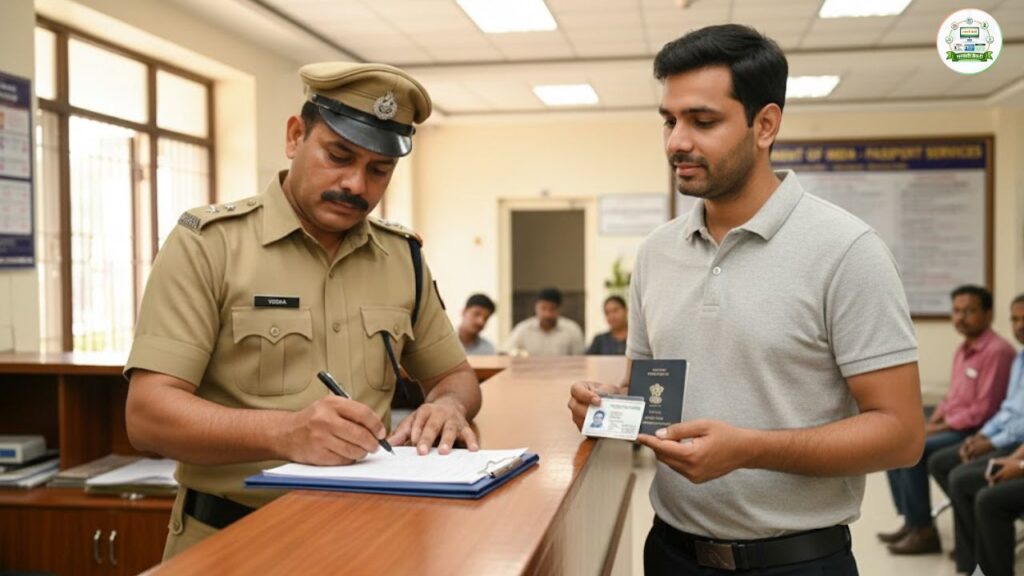
Police verification is one of the most important stages in the Indian passport issuance process. Many applicants feel nervous about this step, but in reality, it is a routine background and address verification conducted to confirm your identity and ensure security compliance.
If you understand how it works, what officers check, and how to prepare, the process becomes simple and stress-free.
Why Police Verification Is Required
Passport is an internationally recognized identity document. Before issuing it, the government must ensure:
- The applicant genuinely lives at the declared address
- The identity details are correct
- There are no serious undisclosed criminal records
- The applicant is not posing a security risk
Police verification helps confirm these facts.
Types of Police Verification
There are mainly three types:
1. Pre-Police Verification
Passport is issued only after police clearance.
Common for:
- First-time applicants
- Address change cases
- Certain reissue cases
2. Post-Police Verification
Passport is issued first and verification happens later.
Common in:
- Tatkal applications
- Some reissue cases
If the police report turns adverse later, the passport may be cancelled.
3. No Police Verification (Rare)
In limited cases such as:
- Government employees with prior verification
- Some renewals without change in details
This is not common for fresh passports.
Step-by-Step Police Verification Process
Step 1: Application Approval at PSK
After your visit to the Passport Seva Kendra (PSK), your application is forwarded to your local police station digitally.
Step 2: File Reaches Local Police Station
The police station receives:
- Your personal details
- Address information
- Photograph
- ID information
An officer is assigned to your case.
Step 3: Police Visit or Call
The officer may:
- Visit your residence
- Call you to visit the police station
- Or do both
This depends on your location and local procedure.
Step 4: Address Confirmation
The officer verifies:
- Whether you live at the stated address
- How long you have lived there
- Basic personal details
- Neighbour confirmation (in many areas)
Keep ID proof ready during the visit.
Step 5: Background Check
Police check:
- Criminal record (if any)
- Pending court cases
- Whether you disclosed correct information
Minor traffic challans usually do not affect approval.
Step 6: Police Report Submission
Police submit one of three reports:
- Clear (Positive)
- Adverse
- Incomplete
The report is sent back digitally to the Passport Office.
What Causes Adverse Police Reports
Common reasons include:
- Applicant not found at address
- Incorrect address details
- Fake rental agreement
- Neighbours denying residence
- Criminal case not disclosed
- Multiple addresses not properly mentioned
Accuracy in application prevents most issues.
How Long Does Police Verification Take?
Typical timeline:
- Metro cities: 3–10 days
- Smaller cities: 7–15 days
Delays may happen due to:
- Police workload
- Election duty
- Incomplete documentation
- Remote area residence
Does Tatkal Skip Police Verification?
No.
Tatkal only speeds up processing time.
Police verification is still required in most cases.
If verification fails later, the passport can be cancelled.
What Documents Should You Keep Ready?
- Aadhaar card
- Voter ID
- Utility bill
- Rental agreement (if applicable)
- Previous passport (if any)
Carry originals and photocopies if visiting police station.
Special Situations
Living on Rent
Provide valid rental agreement and landlord confirmation.
Staying in PG or Hostel
Provide bonafide letter from owner or institution.
Criminal Case Pending
Court permission may be required.
Frequent Address Change
Mention all previous addresses clearly.
What Happens After Clear Police Verification?
Once the report is marked clear:
- Passport is approved
- Printed and dispatched
- Delivered via Speed Post
You receive SMS and email updates.
Can Passport Be Cancelled After Issuance?
Yes, in cases where:
- False information was provided
- Criminal history was hidden
- Fraudulent documents were submitted
Always provide truthful information.
How to Make Police Verification Smooth
- Provide correct address
- Be present during visit
- Inform family members
- Keep neighbours aware
- Respond to police calls promptly
- Disclose criminal cases honestly
Cooperation ensures faster clearance.
Conclusion
Police verification is a standard and essential part of passport issuance in India. It is designed to ensure security and confirm applicant authenticity, not to create unnecessary hurdles.
Most verification problems occur due to incorrect information or incomplete documents. If your details are accurate and you cooperate with authorities, the process is usually straightforward.
For more simplified government process guides, visit Sarkari Bakery.