
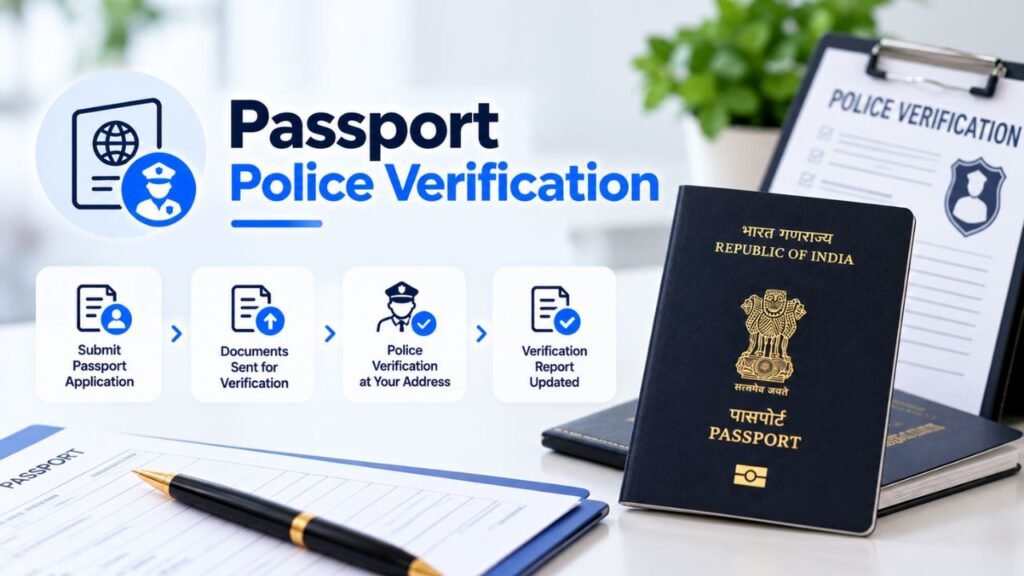
Passport Police Verification is an important part of the Indian passport process for many applicants. After a passport application is submitted and processed by Passport Seva, the concerned police authorities may be asked to verify the applicant’s identity, residential address and other details provided in the application.
Police verification is not identical for every applicant. Depending on the type of passport application, the applicant’s previous passport records and the circumstances of the case, verification may be conducted before passport issuance, after passport issuance, or may not be required at all. The Passport Office makes this decision based on the application and records available in its system.
Understanding the process is useful because incorrect address information, missing previous-address details, unavailable applicants or discrepancies in documents can create unnecessary delays.
What Is Passport Police Verification?
Passport Police Verification is the process through which the police verify information provided by an applicant during the passport application process.
The police may verify details such as:
- Applicant’s identity
- Current residential address
- Previous residential information where applicable
- Whether the applicant actually resides at the stated address
- Details provided in the passport application
- Other information relevant to the verification process
After verification, the police department submits a Police Verification Report (PVR) to the passport authorities.
The report can support issuance of the passport when the verification is recommendatory and no adverse information is found.
Is Police Verification Mandatory for Every Passport?
No. Police verification is not mandatory in exactly the same manner for every passport application.
The Passport Office decides whether police verification is required based on factors such as whether the application is for a fresh passport or re-issue and the applicant’s records.
According to the current Passport Seva instructions:
- Most fresh passport applications require pre-police verification.
- Some fresh passport applicants can fall under exceptions.
- In many re-issue cases, police verification may not be required.
- Some re-issue cases may require post-police verification.
- Certain exceptional cases, such as re-issue because of a lost passport or complete change of name, can require police verification.
Therefore, applicants should not assume that every passport application follows the same verification procedure.
Types of Passport Police Verification
There are mainly two situations applicants should understand.
Pre-Police Verification
In pre-police verification, the police verification is completed before the passport is issued.
For applications where pre-verification is required, Passport Seva waits for a recommendatory Police Verification Report before dispatching the passport.
The current Passport Seva instructions state that, for a normal application requiring pre-passport issuance verification, the passport is expected to be dispatched within three working days of receipt of a recommendatory Police Verification Report, excluding the date on which that report is received.
Post-Police Verification
In post-police verification, the passport can be dispatched without waiting for the police verification report.
The police verification is then carried out after passport issuance.
For a normal application where post-passport issuance verification is required, Passport Seva’s current instructions state that the passport is expected to be dispatched on the third working day excluding the date of application submission, without waiting for the Police Verification Report.
This is why two applicants who apply around the same time may experience different passport-processing timelines.
Passport Police Verification Process
The exact procedure can differ depending on the local police system, but the general process works as follows.
Step 1: Submit the Passport Application
The applicant submits a fresh passport or re-issue application through the official Passport Seva system.
After completing the online application, the applicant pays the applicable fee and schedules an appointment at the selected Passport Seva Kendra or Post Office Passport Seva Kendra.
At the appointment, the applicant submits the required documents and completes the applicable verification process.
Step 2: Passport Office Processes the Application
After the PSK/POPSK appointment, the application is processed by the concerned passport authorities.
The Passport Office determines whether police verification is required and whether it should be conducted before or after passport issuance.
Step 3: Police Verification Request Is Sent
If police verification is required, the verification request is forwarded to the appropriate police authority.
The applicant’s residential jurisdiction is relevant because verification is generally connected with the address provided in the passport application.
Step 4: Police Verification Is Conducted
The concerned police authority verifies the applicant’s details.
Depending on local procedures, the applicant may be contacted or asked to appear at the police station, or police personnel may visit the applicant’s residential address.
Applicants should cooperate with the verification and provide accurate information.
Step 5: Police Verification Report Is Submitted
After verification, the police department submits its report to the passport authorities.
The report can be recommendatory or can contain adverse observations depending on the findings.
Step 6: Passport Processing Continues
If the police verification is satisfactory and other passport checks are clear, the application continues through the applicable passport-processing stages.
Where pre-verification is mandatory, issuance depends on receipt of a recommendatory Police Verification Report.
Documents to Keep Ready for Police Verification
Applicants should keep their original documents and relevant supporting records available.
The exact documents required can vary depending on the application and the verification circumstances, but it is sensible to keep the following information ready:
- Passport application details
- Passport application File Number
- Aadhaar or other identity document used in the application
- Current address proof
- Previous address details, where applicable
- Existing passport for re-issue applications
- Date of birth proof used for the application
- Relevant supporting documents submitted with the passport application
- Details of family members where required
- Information about previous residences
The most important point is consistency. The information given to the police should match the information provided in the passport application and supporting documents.
Why Previous Address Details Matter
Previous residential information can become particularly important during police verification.
Passport Seva’s police-verification guidance has historically required applicants to provide residence details for the relevant preceding period and not suppress previous addresses.
For example, suppose an applicant currently lives in Delhi but moved there from another city within the relevant period. Simply providing the Delhi address while leaving out the previous residence can create a discrepancy.
Therefore, applicants should carefully review the address history they provided in the passport application.
Does Police Come to Your Home for Passport Verification?
Police verification may involve verification at the applicant’s residential address, depending on the local verification procedure.
Applicants should therefore make sure that:
- They actually reside at the address provided.
- The address is easy to identify.
- Their contact number is active.
- They can be reached when verification is required.
- Relevant documents are readily available.
- Family members or other persons at the address can provide accurate basic information if necessary.
The exact method of verification can vary according to local police procedures.
What Questions Are Asked During Passport Police Verification?
There is no single fixed list of questions that applies identically to every applicant.
However, the verification may involve questions intended to establish information such as:
- Applicant’s full name
- Date of birth
- Current address
- How long the applicant has lived at the address
- Previous residential address
- Family details
- Employment or occupation details where relevant
- Passport application information
- Identity and address documents
The purpose is to verify the information relevant to the passport application rather than to provide memorised answers.
Always provide truthful information.
What Happens If You Are Not at Home During Verification?
If you are unavailable when police personnel visit, do not assume that the application will automatically be rejected.
The appropriate response depends on the local police verification process.
If you miss a visit:
- Contact the concerned police authority if you have their details.
- Explain that you were unavailable.
- Ask whether another verification visit or appearance is required.
- Keep your mobile number active.
- Check your Passport Seva application status.
- Contact Passport Seva if the verification remains unresolved.
Avoid ignoring repeated verification attempts.
What If Your Current Address Is Different From Your Passport Address?
Address differences should be handled carefully.
If you are applying for a re-issue or another passport service and your current residence differs from the information on an older passport, provide the correct current details in the application and submit the applicable address proof.
Do not provide an old address simply because it appears on your existing passport.
The Passport Seva system allows applicants to apply based on their present residential location, and applicants may apply for passport services at PSK/RPO locations across India according to the current system.
What Happens If Police Verification Is Clear?
When the police verification report is recommendatory and other required checks are clear, the passport application can proceed.
For a normal application requiring pre-passport issuance verification, Passport Seva currently states that the passport is expected to be dispatched within three working days after receipt of a recommendatory PVR, excluding the date of receipt.
This does not mean every application will necessarily follow the same timeline because other checks, exceptional circumstances or adverse records can affect processing.
What Does Adverse Police Verification Mean?
An adverse Police Verification Report means that the police verification has identified an issue or discrepancy that requires attention.
Possible causes can include discrepancies in:
- Address
- Identity details
- Previous residence information
- Documents
- Information provided in the application
- Other relevant verification details
An adverse report does not mean that every case has the same outcome. The appropriate action depends on the reason recorded in the report and the passport authorities’ assessment.
If you receive information about an adverse verification, carefully determine the specific reason instead of submitting another application immediately.
Common Reasons for Adverse or Unsuccessful Verification
Some common practical reasons for problems during verification include:
Incorrect Address
The applicant does not actually reside at the address provided.
Incomplete Address History
Relevant previous residences were not properly disclosed.
Document Discrepancy
The information in supporting documents does not match the application.
Applicant Unavailable
The applicant repeatedly cannot be contacted or verified.
Incorrect Personal Information
Name, date of birth or other important details differ between documents and the application.
Incomplete Information
Important information required for verification has not been provided correctly.
The safest approach is to provide complete and truthful information from the beginning.
What to Do If Passport Police Verification Is Pending
If your Passport Application Status indicates that police verification is pending, first determine whether the application is actually waiting for verification or whether the police department has already completed verification and the report is awaiting processing.
You can:
- Check your passport application status.
- Keep your File Number available.
- Contact the concerned police authority if verification has been initiated.
- Confirm that your address is correct.
- Keep your documents ready.
- Contact Passport Seva if the matter remains unresolved.
You can also use the official Passport Seva grievance facility if there is an unresolved service issue. The grievance system asks for passport reference and applicant details before the complaint can be submitted.
For a detailed explanation of tracking the application, see Passport Application Status.
How Long Does Passport Police Verification Take?
There is no single fixed duration that applies to every police verification.
The timeline can depend on:
- Police jurisdiction
- Verification workload
- Applicant availability
- Accuracy of address information
- Completeness of documents
- Whether previous-address verification is required
- Whether the case contains discrepancies
- Whether the passport application requires pre- or post-verification
For pre-verification cases, Passport Seva’s stated service level after receipt of a recommendatory PVR is three working days for dispatch, excluding the date of receipt of the report.
That is different from the time taken by the police department to complete verification itself.
Passport Police Verification for Re-Issue
Police verification for a passport re-issue is not necessarily the same as for a fresh passport.
Passport Seva’s current instructions state that in most re-issue cases, police verification may not be required or only post-police verification may be required, depending on records available in the Passport Office system.
However, certain cases can require verification, including some re-issues involving a lost passport or complete change of name.
Therefore, applicants should not assume that a previous successful passport means police verification can never be required again.
Police Verification for Tatkaal Passport
Tatkaal applications can also have different verification arrangements.
Passport Seva’s current instructions state that for Tatkaal applications, police verification may be:
- Not required, or
- Required on a post-passport issuance basis.
Where post-verification is required, the passport can be dispatched without waiting for the Police Verification Report.
This is one reason Tatkaal processing can be faster than cases where pre-police verification is required.
For more information, see Tatkaal Passport.
Passport Police Verification and Fresh Passport
For most fresh passport applications, pre-police verification is generally required under the current Passport Seva instructions.
There are exceptions, including certain government employees submitting an Identity Certificate and certain minors whose parent or parents hold valid passports.
Because the Passport Office determines the applicable verification category, applicants should follow the status and instructions associated with their specific application.
Common Mistakes to Avoid During Police Verification
Giving an Incorrect Address
Do not provide an address where you do not ordinarily reside.
Hiding Previous Addresses
Do not leave out relevant residential history merely because you think it will make verification easier.
Providing Different Information to the Police
The information given during verification should be truthful and consistent with the application.
Ignoring Police Contact
If you receive a legitimate request related to verification, do not ignore it.
Keeping Documents Unavailable
Keep the relevant originals and supporting records ready.
Assuming Tatkaal Means No Verification
Tatkaal does not universally mean that police verification will never happen. Depending on the case, post-police verification can still be required.
Applying Again Because of a Delay
A pending police verification does not automatically mean that a new passport application should be submitted.
First identify the reason for the delay and follow the appropriate official process.
How to Check Passport Status After Police Verification
Once police verification has been completed, you can track the application through the Passport Seva portal.
Use your File Number and Date of Birth to check the latest application status.
The official Passport Seva website provides a Track Passport Application facility.
You can also read the detailed guide on Passport Application Status.
What If Passport Is Not Issued After Clear Police Verification?
If your police verification is clear but the passport has not yet been issued, remember that police verification is only one part of the overall passport-processing process.
Other checks may still be required.
Passport issuance is subject to system data checks and the absence of adverse entries or reports. Passport Seva’s current instructions also note that complex cases can require additional processing time.
If the application remains unusually delayed, check the application status and use the official Passport Seva grievance mechanism where appropriate.
Official Passport Seva Website
Always use the official Passport Seva website for passport applications and status-related services:
The Ministry of External Affairs has warned citizens about fraudulent websites and mobile applications that collect applicant information or charge additional fees. Passport Seva specifically advises applicants to use the official passportindia.gov.in website or the official Passport Seva mobile application.
Frequently Asked Questions
Conclusion
Passport Police Verification is an important part of the passport process for many applicants, but the procedure is not identical for everyone. Depending on the application, verification may take place before passport issuance, after issuance, or may not be required.
The best way to avoid problems is to provide accurate personal information, disclose relevant address history, keep supporting documents ready and remain available when verification is required. If your application becomes delayed, use the official Passport Seva tracking and grievance facilities instead of relying on unofficial websites.
For more practical guides on passports, government documents and citizen services, visit Sarkari Bakery.
Based on Google's Helpful Content System, this article emphasizes user value, transparency, and accuracy. It incorporates principles of E-E-A-T (Experience, Expertise, Authoritativeness, Trustworthiness).
Why Choose Sarkari Bakery?
Official Information
Government schemes & banking information based on official sources.
Step-by-Step Guides
Simple application process explained for every service.
Regular Updates
Content updated whenever official rules or services change.
People-First Content
Helpful, transparent and user-focused content.