
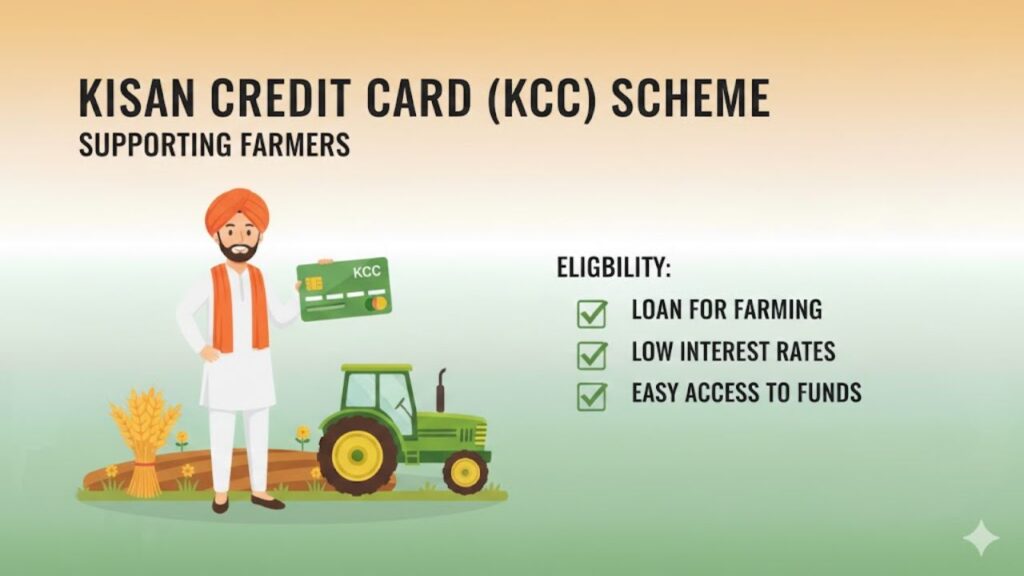
Indian agriculture depends heavily on timely access to credit. Farmers often need funds for seeds, fertilisers, irrigation, equipment, and allied activities like dairy or fisheries. To solve this problem, the Government of India introduced the Kisan Credit Card (KCC) Scheme, which ensures easy, flexible, and affordable credit for farmers.
This guide explains the Kisan Credit Card Scheme 2026 in detail, including interest rates, benefits, credit limits, eligibility, and step-by-step application methods—so nothing important is missed.
⭐ What is the Kisan Credit Card Scheme?
The Kisan Credit Card Scheme was launched in 1998 to provide short-term and long-term credit to farmers for agricultural and allied needs. Under this scheme, banks issue a Kisan Credit Card (KCC) that allows farmers to withdraw money as per their approved limit, similar to a revolving credit facility.
Over time, the scheme has expanded beyond crop cultivation to include investment credit and allied activities such as dairy, animal husbandry, fisheries, poultry, and beekeeping.
The scheme is implemented by the Government of India through banks and cooperative institutions.
⭐ Key Highlights of Kisan Credit Card Scheme 2026
- Interest rate: 7% per annum (for eligible loans)
- Interest subvention: Up to 3% for timely repayment
- Tenure: 5 years (with annual review)
- Credit limit: Based on landholding, crops, and purpose
- Loan coverage: Crop cultivation + allied activities
- Application mode: Online and offline
⭐ Purpose of Kisan Credit Card Scheme
The credit available under KCC can be used for multiple farming-related needs:
- Short-term loans for crop cultivation
- Working capital for medium and long-duration crops
- Expenses related to post-harvest activities
- Loans against e-Negotiable Warehouse Receipts (e-NWR)
- Marketing loans for farm produce
- Household consumption needs of farmers
- Maintenance and repair of farm assets
- Working capital for allied activities such as:
- Dairy
- Fisheries
- Poultry
- Mushroom farming
- Sericulture
- Beekeeping
⭐ Types of Kisan Credit Cards Issued by Banks
Banks issue KCCs in modern digital formats to ensure easy access and secure transactions:
- Magnetic stripe debit cards with PIN
- Biometric-enabled debit cards using UIDAI authentication
- RuPay and EMV chip-based smart cards
- Smart card–cum–debit card (mandatory for new and renewed KCCs)
These cards allow farmers to withdraw money, make payments to input dealers, and receive sale proceeds directly into their bank accounts.
⭐ Kisan Credit Card Delivery Channels
Farmers can use KCC facilities through multiple channels:
- ATM and Micro-ATM withdrawals
- Business Correspondents (BCs)
- PoS machines at fertiliser and seed dealers
- Mobile banking and IMPS
- Aadhaar-enabled payment systems
⭐ Interest Rate Under Kisan Credit Card Scheme
The interest rate structure is as follows:
- Loans up to ₹3 lakh:
- 7% per annum (with government interest subvention)
- Prompt Repayment Incentive (PRI):
- Additional 3% subvention for timely repayment
- Loans above ₹3 lakh:
- Interest rate as per bank norms
📌 Aadhaar submission is mandatory to avail interest subvention benefits.
📌 Actual rates may vary slightly between banks and can go up to 12–13% if benefits are not applicable.
⭐ How is the Kisan Credit Card Limit Calculated?
The KCC limit is calculated based on crop pattern, landholding, and farming needs.
📍 For Crop Cultivation (First Year)
- Scale of finance × cultivated area
- 10% for household and consumption needs
- 20% for farm asset maintenance
- crop and personal accident insurance
📍 For Subsequent Years
- Previous year limit
- 10% cost escalation for each year (up to 5 years)
- estimated term loan component
📍 For Multiple Crops
- Limit based on proposed cropping pattern
- Revised if cropping pattern changes
📍 For Investment Credit
- Used for farm equipment, irrigation, land development, and allied activities
- Based on asset cost, repayment capacity, and existing loan burden
📍 Maximum Permissible Limit (MPL)
- 5th-year short-term crop loan limit
- estimated term loan requirement
= Total KCC limit
- estimated term loan requirement
⭐ Who is Eligible for Kisan Credit Card?
The following categories can apply for KCC:
- Individual or joint owner cultivator farmers
- Tenant farmers, oral lessees, and sharecroppers
- Self Help Groups (SHGs) of farmers
- Joint Liability Groups (JLGs), including tenant farmers
⭐ How to Apply for Kisan Credit Card Online
The online application process generally works as follows:
- Visit the official website or mobile app of the bank
- Go to Agri Loans / Kisan Credit Card
- Click on Apply Online or download the form
- Fill in personal, land, and crop details
- Submit the form
- Receive an application reference number
- Bank contacts you within 3–4 working days
⭐ Offline Application Process for Kisan Credit Card
- Visit the nearest bank branch
- Collect the KCC application form
- Fill in details and attach documents
- Submit the form at the branch
- Bank verifies documents and processes the credit limit
⭐ Documents Required for Kisan Credit Card
- KCC application form
- Two passport-size photographs
- Identity proof (Aadhaar, Voter ID, PAN, Passport)
- Address proof
- Proof of landholding (certified by revenue authority)
- Crop details and acreage
- Security documents (for loans above ₹3 lakh, if required)
⭐ Impact of Kisan Credit Card Scheme
As of 31 December 2024, loans worth over ₹10.05 lakh crore have been sanctioned under the KCC scheme, benefiting more than 7.7 crore farmers across India. The scheme has become a backbone of agricultural financing by ensuring quick and affordable credit access.
Conclusion
The Kisan Credit Card Scheme plays a vital role in supporting Indian farmers by offering low-interest, flexible, and timely credit for farming and allied activities. With interest subvention, wide eligibility, and multiple usage options, KCC helps farmers manage both cultivation and investment needs efficiently. For more simple, step-by-step explanations of government schemes, banking, and farmer-focused initiatives, visit Sarkari Bakery.