
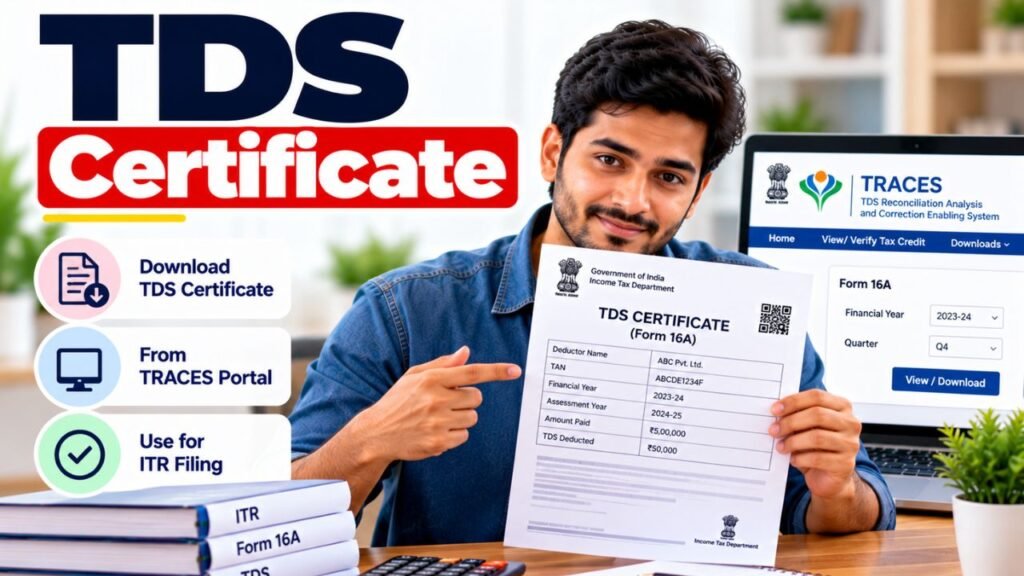
A TDS Certificate is an important tax document that confirms that tax has been deducted from a payment made to you and deposited with the Income Tax Department. It helps you verify the amount of tax deducted, the payment on which TDS was deducted, the deductor’s details and the tax deposited against your PAN.
For salaried employees, the relevant certificate is generally Form 16. For TDS deducted on income other than salary, Form 16A is issued quarterly by the deductor. The Income Tax Department describes Form 16A as a TDS certificate that contains details such as the amount paid or credited, nature of payment, TDS deducted and TDS deposited.
Understanding your TDS Certificate is particularly important while filing an Income Tax Return because the TDS shown on the certificate should be reconciled with your Form 26AS and AIS.
What Is a TDS Certificate?
A TDS Certificate is proof that tax has been deducted at source from a particular payment and reported to the tax authorities.
For example, suppose a company pays ₹1,00,000 to a professional and deducts ₹10,000 as TDS. The professional receives ₹90,000 after deduction, while ₹10,000 is deposited as TDS. The TDS Certificate provides the relevant details of this transaction.
The certificate can help the taxpayer:
- Verify the amount of TDS deducted
- Check the deductor’s details
- Match TDS with Form 26AS
- Reconcile information with AIS
- Claim eligible TDS credit while filing an ITR
- Identify errors in TDS reporting
- Maintain tax records for future reference
You can also understand the complete TDS mechanism through the guide on What Is TDS.
Types of TDS Certificates
The two commonly relevant TDS certificates are Form 16 and Form 16A.
| Certificate | Generally Used For | Issued By | Frequency |
|---|---|---|---|
| Form 16 | Salary income | Employer | Annually |
| Form 16A | Income other than salary | Deductor | Quarterly |
The Income Tax Department states that Form 16 is provided by an employer to an employee at the end of the financial year, while Form 16A is issued by the deductor to the deductee for TDS on income other than salary.
What Is Form 16?
Form 16 is the TDS certificate issued by an employer to an employee for salary income.
It generally helps the employee understand:
- Salary income
- Applicable exemptions and deductions
- Taxable salary
- TDS deducted
- Other relevant salary-tax information
Form 16 is especially useful while preparing your ITR because it provides important information about your salary and TDS.
If you want to understand the difference between the two major certificates, see Form 16 vs Form 16A.
What Is Form 16A?
Form 16A is a TDS Certificate for income other than salary.
It is generally issued quarterly and can apply to different types of payments where TDS is deducted, depending on the applicable provisions.
For example, Form 16A may be relevant when TDS has been deducted from:
- Professional fees
- Interest income
- Commission
- Rent in applicable cases
- Contractual payments
- Other specified non-salary payments
The certificate contains information about the payment, TDS deducted and tax deposited.
What Details Are Mentioned on a TDS Certificate?
A TDS Certificate contains several details that should be checked carefully.
Depending on the certificate, you may find:
Deductor Details
This identifies the person, company, bank or organisation that deducted the tax.
It can include:
- Deductor name
- Address
- PAN
- TAN
Deductee Details
These details identify the person from whose payment TDS was deducted.
They may include:
- Name
- Address
- PAN
Financial Year and Assessment Year
The certificate specifies the relevant financial year and assessment year.
Always check these details before using the certificate for ITR filing because selecting the wrong year can create a mismatch.
Payment Details
Form 16A can contain information about:
- Amount paid or credited
- Nature of payment
- Date of payment or credit
- Deductee reference number, where applicable
TDS Details
The certificate also contains details relating to:
- Tax deducted
- Tax deposited
- Challan information
- Relevant reporting details
The official Form 16A format includes payment details and information relating to tax deducted and deposited with the Central Government.
Who Issues the TDS Certificate?
The deductor is responsible for issuing the applicable TDS certificate to the deductee.
For salary, the employer issues Form 16.
For non-salary income, the deductor issues Form 16A.
Form 16 and Form 16A are not normally created by the taxpayer themselves. The taxpayer receives or downloads the certificate after the relevant TDS information has been reported and processed.
TRACES provides facilities for downloading Form 16 and Form 16A.
How to Download TDS Certificate Online
For Form 16A, the TDS certificate can be obtained through the TRACES system when the relevant TDS statement has been processed and the certificate is available.
A general process is:
- Visit the official TRACES portal.
- Log in using the applicable credentials.
- Go to the relevant download section.
- Select the required financial year.
- Select the applicable quarter.
- Select the required Form 16A details.
- Submit the request.
- Download the certificate when it becomes available.
TRACES currently provides download functionality for Form 16 and Form 16A.
For Form 16, TRACES documentation states that the certificate is generated based on the TDS information filed by the deductor and processed through TRACES.
Can a Taxpayer Download Form 16A?
Yes, Form 16A can be accessed through the applicable TRACES process when the certificate is available.
However, taxpayers should understand that Form 16A is not simply a manually created document. It is generated from TDS information reported by the deductor and processed through the TDS system.
If the TDS statement has not been properly filed, processed or reported against the correct PAN, the expected certificate may not be available or may contain incorrect information.
How to Check TDS Certificate Details
After receiving or downloading your TDS Certificate, do not immediately use it for ITR filing without checking the information.
Verify:
- Your name
- PAN
- Deductor name
- Deductor TAN
- Financial year
- Assessment year
- Nature of payment
- Amount paid or credited
- TDS amount
- Tax deposited details
The PAN is particularly important because TDS credit is associated with the taxpayer’s PAN.
You can also verify the reported TDS through Form 26AS and AIS.
TDS Certificate vs Form 26AS
A TDS Certificate and Form 26AS are related but they are not the same document.
| TDS Certificate | Form 26AS |
|---|---|
| Issued for specific TDS transactions | Tax credit statement available through the Income Tax e-Filing system |
| Form 16/16A may apply | Available against the taxpayer’s PAN |
| Provides certificate details from the deductor | Helps verify tax credits reported against PAN |
| Used as supporting tax documentation | Useful for reconciling tax credits while filing ITR |
For practical purposes, taxpayers should compare their TDS Certificate with Form 26AS and AIS rather than relying on only one source.
The Income Tax Department also advises taxpayers to check and reconcile tax-related information appearing in their records before filing their return.
TDS Certificate vs AIS
AIS provides broader information than a TDS certificate.
AIS can contain information relating to:
- TDS
- TCS
- SFT information
- Tax payments
- Demand and refund information
- Other reported financial information
Therefore, your TDS Certificate should be considered one part of your overall tax-record verification process.
If the amount shown on the certificate does not match the information available in AIS or Form 26AS, the difference should be investigated before filing the ITR.
What If TDS Certificate Is Not Received?
If you are expecting a TDS Certificate but have not received it, first determine which certificate applies.
For salary income, contact your employer’s payroll or HR department regarding Form 16.
For non-salary TDS, contact the deductor who made the payment and deducted the tax.
Before contacting the deductor, check whether the TDS is already appearing in your Form 26AS or AIS.
This can help determine whether the issue is only the certificate or whether the TDS itself has not been properly reported.
What If TDS Is Deducted but Not Showing in Form 26AS?
This is an important situation because simply having a TDS certificate does not mean every mismatch can be ignored.
Possible reasons include:
- Deductor has not filed the TDS statement
- TDS statement is still being processed
- Incorrect PAN was reported
- Incorrect assessment or financial year was selected
- Incorrect TDS amount was reported
- Deductor made an error in the TDS statement
- TDS statement requires correction
If your TDS is missing from Form 26AS, you should first compare your certificate with Form 26AS and AIS.
If the deductor has made an error, you generally need to contact the deductor so that the required TDS statement correction can be made.
You can also read TDS Credit Not Showing for the detailed mismatch process.
Can TDS Certificate Be Used While Filing ITR?
Yes. TDS certificates are important supporting documents while preparing an Income Tax Return.
However, taxpayers should not blindly enter the amount printed on a certificate without checking their other tax records.
A good reconciliation process is:
TDS Certificate → Form 26AS → AIS → Bank/Income Records → ITR
For example, if Form 16A shows ₹20,000 TDS but Form 26AS shows only ₹15,000, the difference should be investigated before finalising the return.
This can prevent tax-credit mismatches and unnecessary follow-up after ITR processing.
What Should You Do If There Is a TDS Mismatch?
If the TDS Certificate and Form 26AS show different amounts, follow a systematic approach.
Step 1: Check the PAN
Make sure the TDS has been reported against your correct PAN.
Step 2: Check the Financial Year
Confirm that both records relate to the same financial year and applicable assessment year.
Step 3: Compare the Deductor
Check the deductor’s name and TAN.
Step 4: Compare the TDS Amount
Compare the exact TDS amount rather than only checking whether a TDS entry exists.
Step 5: Contact the Deductor
If the deductor’s statement contains an error, request the deductor to make the required correction.
Step 6: Recheck Form 26AS and AIS
After correction and processing, check whether the updated TDS information appears correctly.
Do not claim unsupported tax credit merely because an amount appears on a document supplied to you. The tax credit should be properly reconciled with the records available to the tax authorities.
Common Mistakes While Checking TDS Certificates
Many TDS-related problems occur because taxpayers check only the final TDS amount and ignore the underlying details.
Common mistakes include:
- Checking the wrong financial year
- Entering the wrong PAN
- Ignoring the deductor’s TAN
- Not checking Form 26AS
- Not checking AIS
- Assuming every TDS certificate is automatically error-free
- Claiming TDS without reconciling the income
- Ignoring a mismatch until after filing the ITR
- Failing to contact the deductor when correction is required
A small PAN or year-related error can create a significant mismatch during ITR processing.
Documents to Keep Along With Your TDS Certificate
Keep your TDS Certificate safely with other tax records such as:
- Form 16 or Form 16A
- Form 26AS
- AIS
- Bank statements
- Salary slips, where applicable
- Invoices for professional or freelance income
- Investment documents
- Interest certificates
- Previous ITR acknowledgement
- Tax payment records
You can also use the ITR Documents Checklist before filing your return.
How Long Should You Keep a TDS Certificate?
It is sensible to retain TDS certificates and other supporting tax documents for the applicable tax-record retention period.
Do not delete old certificates simply because the ITR has already been filed. Older documents may become useful if there is a tax notice, mismatch, refund issue, verification requirement or other tax-related query.
Keeping digital copies in a secure folder can make future tax reconciliation much easier.
Is TDS Certificate Mandatory for ITR Filing?
A taxpayer should have the relevant TDS information available when filing an ITR if tax has been deducted.
However, ITR filing is not simply a matter of uploading a TDS certificate. Income, deductions, tax payments and TDS should all be reported correctly.
The return should be reconciled with available tax information before submission.
What If the TDS Certificate Contains Wrong Information?
If the certificate contains incorrect information, contact the deductor.
For example, if your PAN is wrong, the TDS amount is incorrect or the payment has been reported incorrectly, the deductor may need to correct the relevant TDS statement.
After the correction is processed, check your tax records again.
Do not make unsupported changes to the ITR simply to force the figures to match a certificate.
Why Is a TDS Certificate Important?
A TDS Certificate provides a clear record of tax deducted from your income or payment.
Its importance becomes particularly clear when:
- Filing an ITR
- Checking tax credit
- Investigating a TDS mismatch
- Checking income reported by a deductor
- Responding to certain tax-related queries
- Maintaining financial records
- Reconciling Form 26AS and AIS
For taxpayers receiving income from multiple sources, maintaining these records can significantly simplify year-end tax reconciliation.
TDS Certificate Checklist
Before using your TDS Certificate for ITR filing, check the following:
- Name is correct
- PAN is correct
- Deductor name is correct
- TAN is correct
- Financial year is correct
- Assessment year is correct
- Payment amount is correct
- TDS amount is correct
- Form 26AS has been checked
- AIS has been checked
- Income corresponding to TDS has been reported
- Any mismatch has been resolved
Final Takeaway
A TDS Certificate is an important tax document that records tax deducted at source and provides details that can be used for tax reconciliation and ITR preparation. For salary income, Form 16 is generally relevant, while Form 16A is used for TDS on income other than salary.
Do not rely on the certificate alone. Always compare the TDS details with Form 26AS, AIS and your actual income records. If there is a mismatch, identify whether the problem is related to your PAN, payment details, TDS amount or the deductor’s filing and take corrective action before finalising your return.
For more practical information on Income Tax, TDS, ITR and government services, visit Sarkari Bakery.
Frequently Asked Questions
Based on Google's Helpful Content System, this article emphasizes user value, transparency, and accuracy. It incorporates principles of E-E-A-T (Experience, Expertise, Authoritativeness, Trustworthiness).
Why Choose Sarkari Bakery?
Official Information
Government schemes & banking information based on official sources.
Step-by-Step Guides
Simple application process explained for every service.
Regular Updates
Content updated whenever official rules or services change.
People-First Content
Helpful, transparent and user-focused content.
Pingback: ITR Documents Checklist: Documents Required for Income Tax Return Filing - Sarkari Bakery