
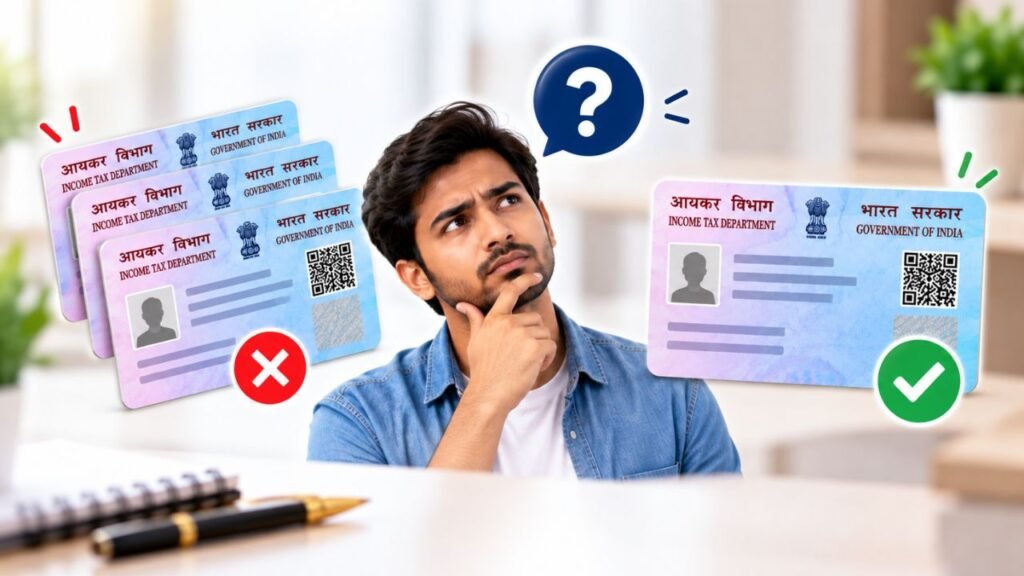
A common question among taxpayers is how many PAN cards one person can have. The answer is straightforward: one individual can have only one PAN.
PAN, or Permanent Account Number, is a unique 10-character alphanumeric number issued by the Income Tax Department. Once a PAN is allotted to an individual, that person should use the same PAN throughout their lifetime. The Income Tax Department specifically states that a person cannot hold more than one PAN and that a penalty of ₹10,000 may be imposed for having more than one PAN under Section 272B of the Income-tax Act, 1961.
However, people sometimes end up with multiple PANs because of duplicate applications, forgotten PAN details, changes in personal information, or applying for a new PAN instead of requesting a correction or reprint.
If you have accidentally received more than one PAN, you should not continue using both. The additional PAN should be surrendered.
How Many PAN Cards Can One Person Have?
An individual can have only one PAN.
PAN is not like a debit card or identity document that can be replaced by applying for a completely new number whenever the physical card is lost or personal details change.
The PAN number remains associated with the taxpayer.
The Income Tax Department confirms that a PAN obtained once is valid for the lifetime of the PAN holder throughout India. A change of address or Assessing Officer does not change the PAN number.
Therefore:
One person = One PAN number
You should not apply for another PAN because:
- You lost your PAN card.
- You changed your address.
- You changed your name.
- Your PAN card is damaged.
- You forgot your PAN number.
- You need to update your PAN information.
- You moved to another city or state.
For these situations, the existing PAN should generally be retained and the appropriate correction, reprint, or recovery process should be followed.
Is It Legal to Have Two PAN Cards?
No. A person cannot legally hold two PANs.
The Income Tax Department clearly states that if a PAN has already been allotted to a person, that person cannot apply for another PAN. If more than one PAN has been allotted, the additional PAN should be surrendered immediately.
This rule applies even if the second PAN was obtained accidentally.
For example, suppose a person already has:
PAN 1: ABCDE1234F
Later, they forget their PAN number and submit another application. If another PAN is allotted:
PAN 2: PQRST5678K
the person should not start using PAN 2 as a replacement. The additional PAN needs to be surrendered.
What Is the Penalty for Having More Than One PAN?
The Income Tax Department states that a penalty of ₹10,000 is liable to be imposed under Section 272B of the Income-tax Act, 1961 for having more than one PAN.
The official Income Tax Department material also explains that Section 272B covers defaults relating to PAN and provides for a ₹10,000 penalty for each applicable default.
Therefore, having a duplicate PAN should not be treated as a harmless mistake that can simply be ignored.
If you discover that more than one PAN has been allotted to you, take corrective action instead of continuing to use both numbers.
Why Do People End Up With Two PAN Cards?
In many cases, multiple PANs are created because the taxpayer does not realise that an existing PAN remains valid.
Some common situations are explained below.
1. The Original PAN Card Was Lost
A person may lose their PAN card and assume that they need to apply for a new PAN.
That is incorrect.
Losing the physical PAN card does not mean that your PAN number has disappeared.
You can request a reprint or obtain an e-PAN instead of applying for a fresh PAN number.
If you have forgotten your PAN number, you should first recover the existing number.
You can read the detailed Forgot PAN Number guide for ways to find your existing PAN.
2. The Applicant Forgot That PAN Was Already Allotted
This can happen when someone received a PAN many years ago and no longer remembers the number.
Instead of checking their old documents, Income Tax records, Form 16, ITR records or other financial documents, they may submit a fresh PAN application.
If a new PAN is subsequently allotted, the taxpayer can end up with multiple PANs.
The correct approach is to find the existing PAN rather than applying for another one.
3. Name Change After Marriage
A person may believe that a name change requires a new PAN.
It does not.
If your name changes, you should request a change or correction in PAN data rather than applying for another PAN.
The Income Tax Department’s PAN guidance specifically provides a correction process for changes in PAN data.
For example:
Old name:
PRIYA SHARMA
New name:
PRIYA VERMA
The PAN number does not need to change simply because the person’s name has changed.
4. Change of Address
Moving from Delhi to Mumbai, Bengaluru, Jaipur or any other location does not require a new PAN.
The Income Tax Department states that PAN remains valid throughout India and is not affected by a change of address or Assessing Officer.
Therefore, applying for another PAN after moving to another state is unnecessary.
5. PAN Card Was Damaged
If the physical PAN card is damaged, you do not need a new PAN number.
You can request a reprint or reissue of the existing PAN card.
The important distinction is:
New PAN number: Not required.
Replacement/reprint of existing PAN card: Possible.
Can I Apply for a New PAN If I Already Have One?
No.
If you already have a PAN, you should not submit a fresh application simply to obtain another PAN number.
The Income Tax Department explicitly states that once a PAN has been allotted, a person cannot apply for another PAN.
Instead, identify what you actually need:
| Your situation | Correct action |
|---|---|
| PAN card lost | Request reprint/reissue |
| PAN number forgotten | Recover existing PAN |
| Name changed | PAN correction |
| Date of birth incorrect | PAN correction |
| Address changed | Update PAN details |
| PAN card damaged | Request reprint |
| Need e-PAN | Download/retrieve existing e-PAN |
| Accidentally received two PANs | Surrender additional PAN |
What If I Accidentally Applied for a Second PAN?
If you submitted a second PAN application by mistake, do not panic.
First determine whether a second PAN was actually allotted.
If only an application was submitted and no second PAN was allotted, the situation is different from actually possessing two PANs.
If two PANs have been allotted to you, the Income Tax Department says that the additional PAN should be surrendered immediately.
The important thing is not to start using the additional PAN for your financial and tax transactions.
What If I Already Have Two PAN Cards?
If you already have two PANs, you should identify which PAN is your valid/current PAN and surrender the additional PAN.
For example:
PAN A: ABCDE1234F
PAN B: PQRST5678K
You should not use both.
The additional PAN should be surrendered according to the applicable Income Tax Department process.
The Income Tax Department’s PAN guidance specifically says that if a person has been allotted more than one PAN, the additional PAN card(s) should be surrendered immediately.
How to Surrender an Additional PAN
The Income Tax Department’s PAN guidance provides a cancellation mechanism through the PAN correction/change form.
When requesting cancellation of a PAN, the PAN to be cancelled is entered in the appropriate field, while the PAN being retained is used as the active PAN in the application. The Department’s guidance states that the PAN being cancelled should not be the same as the PAN mentioned as the PAN currently being used at the top of the form.
Basic process
- Identify the PAN you intend to retain.
- Identify the additional PAN.
- Obtain the applicable PAN correction/cancellation form.
- Enter the additional PAN in the cancellation section.
- Provide the required information.
- Submit the request through the applicable PAN service channel.
- Keep the acknowledgement/reference details for your records.
If you are unsure which PAN should be retained, do not randomly surrender one. Check your tax and financial records and seek official assistance if necessary.
Should I Surrender the Older PAN or Newer PAN?
There is no universal rule that says you should automatically surrender the older or newer PAN simply because of its issue date.
The important point is to retain the appropriate PAN and surrender the duplicate.
Before making a decision, check:
- Which PAN is being used in your ITRs.
- Which PAN is linked with your tax records.
- Which PAN is linked with your bank and financial accounts.
- Which PAN is associated with your Aadhaar where applicable.
- Whether TDS records are associated with the PAN.
- Whether there are outstanding tax matters associated with either PAN.
If there is any uncertainty, getting the record clarified through the Income Tax Department is safer than randomly cancelling a PAN.
Can I Have Different PANs for Different Businesses?
No, an individual cannot obtain a separate PAN for every business or profession carried on in their individual capacity.
The PAN belongs to the taxpayer.
For example, suppose a person operates:
- A digital marketing business
- A clothing business
- A freelance consulting activity
The individual does not obtain three personal PANs simply because they have three sources or types of business activity.
The applicable tax and business structure determines how those activities are reported, but an individual cannot hold multiple personal PAN numbers.
Different legal entities, however, can have their own PANs. PAN is also issued to entities such as companies, firms, trusts and other eligible persons. The Income Tax Department explains that PAN is issued according to the status/type of the PAN holder.
Can a Company and Its Owner Have the Same PAN?
No.
A company is a separate taxable entity and can have its own PAN.
The individual owner/director has their own personal PAN.
For example:
Individual:
ABCDE1234F
Company:
Company’s separate PAN
The existence of a company PAN does not mean the individual has two personal PANs.
The Income Tax Department explains that PAN is issued to different categories of taxpayers and the fourth character of the PAN indicates the status of the PAN holder.
Can I Have One PAN for Personal Use and Another for Business?
No, not as an individual.
If you are an individual carrying on business or professional activities in your own name, you generally continue to use your individual PAN for the applicable tax purposes.
A separate PAN may belong to a separate legal entity, such as a company or other entity that is independently required to obtain PAN.
You should therefore distinguish between:
Multiple PANs belonging to one individual — Not allowed
and
Separate PANs belonging to separate taxpayers/entities — Possible where legally applicable
What Happens If You Use Two PANs?
Using multiple PANs can create serious compliance problems.
Different PANs can result in tax information being distributed across separate records.
For example, one PAN may appear in:
- ITR filings
- Form 16
- TDS records
- Bank accounts
- Demat accounts
- Mutual fund investments
- Property transactions
while another PAN may appear in other transactions.
This can make your tax records difficult to reconcile.
The Income Tax Department can also impose the applicable penalty for holding more than one PAN.
Therefore, once you discover a duplicate PAN, you should take corrective action rather than continuing to use both.
What If I Used the Wrong PAN in an ITR?
This is different from simply having a duplicate PAN.
If you have filed an ITR or completed a financial transaction using an incorrect PAN, you should not create another PAN to fix the mistake.
Instead, determine whether the relevant return, transaction or tax record can be corrected through the appropriate process.
Keep copies of:
- ITR acknowledgement
- PAN details
- Form 16
- TDS records
- Tax payment challans
- Relevant correspondence
If the issue involves multiple PANs or tax records that cannot be reconciled, professional or departmental assistance may be appropriate.
Does Changing Your Name Require a New PAN?
No.
A name change does not mean that you need a new PAN.
For example, if your name changes because of marriage, legal name change or another valid reason, you should use the PAN correction mechanism.
The Income Tax Department provides a process for requesting changes or corrections in PAN data.
You can read the PAN Card Correction guide for more information about correcting PAN details.
Does Losing a PAN Card Mean I Need a New PAN?
No.
The physical card and the PAN number are two different things.
If you lose your physical PAN card, your PAN number does not change.
You should request a reprint/reissue of the existing PAN rather than applying for a new PAN.
If you do not remember your PAN number, first recover it.
You can read:
These processes help you deal with a missing PAN without unnecessarily creating another PAN.
What If I Have Two PANs Because of a Mistake?
Accidental duplicate PAN allotment can happen, particularly when someone:
- Forgot an old PAN number.
- Applied again after losing the card.
- Did not realise that a previous application had succeeded.
- Submitted applications through different channels.
- Made a duplicate application during a correction/reissue situation.
The fact that the second PAN was created accidentally does not mean you should keep using both.
The Income Tax Department’s position remains that a person cannot hold more than one PAN and that additional PANs should be surrendered.
PAN Card vs PAN Number
It is also important to understand the difference between a PAN and a PAN card.
PAN
The PAN is the unique number allotted by the Income Tax Department.
PAN Card
The PAN card is the physical or electronic representation containing your PAN and other details.
If the card is:
- Lost
- Damaged
- Old
- Misplaced
you do not need a new PAN number.
You need a replacement/reprint or access to the existing e-PAN, depending on your requirement.
What About e-PAN?
An e-PAN is an electronic form of PAN.
It does not mean that you receive a second PAN number.
For example, if your PAN is:
ABCDE1234F
your physical PAN card and e-PAN can both show:
ABCDE1234F
They represent the same PAN.
Therefore, downloading an e-PAN does not create another PAN.
If you already have a PAN but have lost your physical card, do not use a fresh PAN application simply to obtain another copy.
PAN and Aadhaar: Avoid Creating Another PAN
A PAN-Aadhaar linking problem should also never be solved by applying for another PAN.
If your PAN and Aadhaar cannot be linked because:
- Name does not match
- Date of birth does not match
- Aadhaar is already linked to another PAN
- PAN is already linked to another Aadhaar
- Validation has failed
you should resolve the underlying issue.
You can read the detailed PAN Aadhaar Linking Problem guide for common errors and solutions.
After making corrections, you can check your PAN Aadhaar Link Status to confirm whether the linking has been completed.
How to Avoid Getting a Duplicate PAN
A few simple habits can prevent most duplicate-PAN situations.
Always check whether you already have PAN
Before applying for a fresh PAN, search your existing records.
Check:
- Previous PAN card
- ITR acknowledgement
- Form 16
- Income Tax account
- Bank records
- Investment records
- TDS documents
Do not apply again after losing the card
Recover or reprint your existing PAN.
Use correction services for changes
Name, date of birth and address changes should be handled through the appropriate correction process.
Keep your PAN number safely recorded
Store your PAN number securely so that you do not need to apply again simply because you cannot remember it.
Quick Guide: What Should You Do in Each Situation?
| Situation | What you should do |
|---|---|
| Forgot PAN number | Find your existing PAN |
| Lost PAN card | Request reprint/reissue |
| Damaged PAN card | Request reprint |
| Name changed | Correct PAN data |
| DOB is incorrect | Correct PAN data |
| Address changed | Update PAN information |
| Need e-PAN | Obtain/download existing e-PAN |
| Accidentally applied twice | Check whether both were allotted |
| Two PANs allotted | Surrender the additional PAN |
| PAN-Aadhaar linking fails | Resolve the linking problem |
| Moving to another state | Continue using the same PAN |
| Starting another business personally | Do not obtain another personal PAN |
Important Points to Remember
- An individual can have only one PAN.
- PAN remains valid for the lifetime of the PAN holder.
- Changing your address does not require a new PAN.
- Changing your name does not normally require a new PAN.
- Losing the PAN card does not mean you need a new PAN.
- A second PAN should not be obtained simply because the first PAN is forgotten.
- Having more than one PAN can attract a ₹10,000 penalty under Section 272B.
- If multiple PANs have been allotted, the additional PAN should be surrendered.
- Do not use multiple PANs for different financial transactions.
- Do not create a new PAN to solve a PAN-Aadhaar linking problem.
The Income Tax Department’s current guidance continues to state that a person cannot hold more than one PAN and should surrender additional PANs immediately.
Frequently Asked Questions
Conclusion
So, how many PAN cards can one person have? The answer is one.
PAN is a unique identification number issued by the Income Tax Department and remains valid for the lifetime of the PAN holder. A person should not obtain another PAN because of a lost card, name change, address change, forgotten PAN number or PAN-Aadhaar linking problem.
If you have accidentally been allotted more than one PAN, do not use both. The Income Tax Department states that the additional PAN should be surrendered, and a penalty of ₹10,000 may apply under Section 272B.
If you have forgotten your PAN, use the existing Forgot PAN Number guide instead of applying for a new one. If you have lost the physical card, follow the Lost PAN Card process.
For more practical guides on PAN, Aadhaar, income tax and citizen services, visit Sarkari Bakery.
Based on Google's Helpful Content System, this article emphasizes user value, transparency, and accuracy. It incorporates principles of E-E-A-T (Experience, Expertise, Authoritativeness, Trustworthiness).
Why Choose Sarkari Bakery?
Official Information
Government schemes & banking information based on official sources.
Step-by-Step Guides
Simple application process explained for every service.
Regular Updates
Content updated whenever official rules or services change.
People-First Content
Helpful, transparent and user-focused content.