
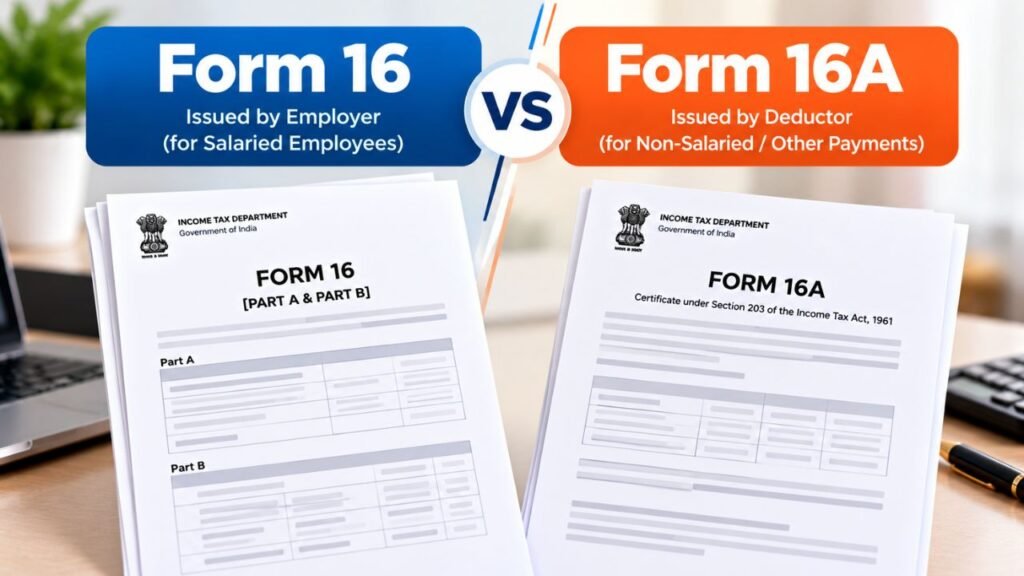
Form 16 vs Form 16A is a common point of confusion for taxpayers, especially when preparing an Income Tax Return. Both are TDS certificates, but they are issued for different types of income.
The simplest way to remember the difference is:
Form 16 = TDS on Salary
Form 16A = TDS on Income Other Than Salary
A salaried employee generally receives Form 16 from their employer, while Form 16A can be issued by a bank, company, professional client, tenant or another deductor when tax is deducted from eligible non-salary payments.
Understanding the difference is important because these certificates help you reconcile your income and TDS before filing your ITR.
What Is Form 16?
Form 16 is a TDS certificate for salary income issued by an employer to an employee.
It contains important information about the salary paid during the financial year and the tax deducted by the employer.
The Income Tax Department describes Form 16 as a certificate of tax deducted at source from salary under Section 203. It is provided by the employer to the employee at the end of the financial year. The certificate contains information useful for calculating the employee’s tax liability or refund.
Form 16 may contain details relating to:
- Salary paid
- Gross salary
- Exemptions
- Deductions
- Income chargeable under salaries
- Other income reported by the employee to the employer
- Deductions under applicable provisions
- TDS deducted
- Tax computation
For a detailed explanation, see What Is Form 16.
What Is Form 16A?
Form 16A is a TDS certificate for income other than salary.
It is issued by the person or organisation responsible for deducting TDS from eligible non-salary payments.
For example, depending on the applicable TDS provision, Form 16A may be relevant when TDS is deducted from:
- Bank interest
- Professional or contractual payments
- Certain rent payments
- Certain commission or other eligible payments
- Other income covered by applicable TDS provisions
Form 16A generally contains information such as:
- Name and details of the deductor
- Name and details of the deductee
- PAN
- TAN, where applicable
- Nature of payment
- Amount paid or credited
- TDS deducted
- TDS deposited
- Relevant quarter and financial year
The Income Tax Department describes Form 16A as a quarterly TDS certificate for income other than salary.
Form 16 vs Form 16A: Key Difference
The primary difference between Form 16 and Form 16A is the type of income on which TDS has been deducted.
| Feature | Form 16 | Form 16A |
|---|---|---|
| Purpose | TDS certificate for salary | TDS certificate for non-salary income |
| Income type | Salary | Income other than salary |
| Issued by | Employer | Relevant deductor |
| Issued to | Employee | Deductee |
| Frequency | Generally annual | Generally quarterly |
| Common example | Salary TDS | Bank interest TDS |
| Used for ITR | Yes | Yes |
| Main purpose | Shows salary and salary TDS details | Shows non-salary payment and TDS details |
The distinction is important because Form 16 and Form 16A are not interchangeable.
Form 16 vs Form 16A: Salary and Non-Salary Income
The easiest way to understand Form 16 vs Form 16A is to look at the source of income.
Example 1: Salary Income
Suppose Rahul works for ABC Private Limited.
During the financial year:
- Salary received = ₹9,00,000
- TDS deducted by employer = ₹45,000
The employer issues Form 16 showing the relevant salary and TDS details.
Example 2: Bank Interest
Suppose Rahul also has a fixed deposit with a bank and TDS is deducted from the interest.
The bank may issue Form 16A for the applicable non-salary TDS.
Therefore, Rahul can have both Form 16 and Form 16A in the same financial year.
Who Issues Form 16?
Form 16 is issued by the employer when tax has been deducted from salary.
If you worked for multiple employers during a financial year, you may receive Form 16 from more than one employer.
For example, if you changed jobs during the year:
Employer A → Form 16
Employer B → Form 16
You should consider the salary and TDS information from all relevant employers while preparing your ITR.
Do not calculate your annual salary only from the Form 16 issued by your current employer if you had another employer during the same financial year.
Who Issues Form 16A?
Form 16A is issued by the deductor for applicable TDS on income other than salary.
Depending on the nature of the payment, the deductor could be:
- Bank
- Company
- Client
- Tenant
- Organisation
- Other person responsible for deducting TDS
For example, if a bank deducts applicable TDS from interest income, the bank may issue Form 16A.
If a company deducts TDS from an eligible professional payment, the company may issue Form 16A.
How Often Is Form 16 Issued?
Form 16 is generally an annual TDS certificate for salary.
It covers salary and TDS information for the relevant financial year.
The employer provides it after the end of the financial year according to the applicable rules and timelines.
Employees should check the information carefully after receiving Form 16.
Important details to verify include:
- Name
- PAN
- Employer details
- Salary amount
- TDS amount
- Exemptions
- Deductions
- Tax computation
How Often Is Form 16A Issued?
Form 16A is generally issued quarterly for TDS on non-salary income.
This means a taxpayer may receive multiple Form 16A certificates during one financial year.
For example:
- Quarter 1 → Form 16A
- Quarter 2 → Form 16A
- Quarter 3 → Form 16A
- Quarter 4 → Form 16A
The exact certificate details depend on the payments and TDS provisions applicable to the transaction.
What Information Is Available in Form 16?
Form 16 provides more salary-specific information than Form 16A.
Depending on the applicable format and reporting requirements, it can include:
Salary Details
- Salary paid
- Gross salary
- Taxable salary
Exemptions
Applicable salary exemptions reported by the employer may be reflected.
Deductions
Eligible deductions considered by the employer for TDS calculation may be shown.
Other Income Reported to Employer
If the employee has provided information about certain other income to the employer for TDS purposes, relevant details may appear.
TDS Details
The certificate shows tax deducted from salary.
This information can then be compared with Form 26AS and AIS while preparing the ITR.
What Information Is Available in Form 16A?
Form 16A focuses on the non-salary payment and the tax deducted from it.
It can contain:
- Deductor information
- Deductee information
- PAN
- TAN, where applicable
- Nature of payment
- Amount paid or credited
- TDS deducted
- TDS deposited
- Relevant period
- Certificate number and other applicable details
For example, if ₹50,000 interest is subject to TDS, Form 16A helps identify the payment and the tax deducted from it.
Is Form 16 Part A the Same as Form 16A?
No.
This is one of the most common mistakes when understanding Form 16 vs Form 16A.
The terms look similar, but they refer to different things.
Form 16 Part A is a component of Form 16.
Form 16A is a separate TDS certificate for income other than salary.
Therefore:
Form 16 Part A ≠ Form 16A
Form 16 may contain different parts that together provide salary and TDS information.
Form 16A is issued for eligible non-salary TDS.
Can a Person Receive Both Form 16 and Form 16A?
Yes.
A person can receive both certificates during the same financial year.
For example:
Salary:
Employer deducts TDS → Form 16
Bank interest:
Bank deducts applicable TDS → Form 16A
Therefore, having Form 16A does not mean that you are not a salaried employee.
Similarly, having Form 16 does not mean that you cannot have non-salary income.
Your certificate requirements depend on your sources of income and the TDS deducted from those payments.
Form 16 vs Form 16A for ITR Filing
Both certificates can be useful while filing an Income Tax Return.
Form 16
Form 16 helps a salaried taxpayer verify:
- Salary income
- Taxable salary
- TDS on salary
- Employer-reported tax information
Form 16A
Form 16A helps verify:
- Non-salary income subject to TDS
- TDS deducted on that income
- Deductor information
- Relevant payment details
However, you should not prepare your entire ITR simply by copying numbers from these certificates.
You should also review:
- Form 26AS
- AIS
- Bank statements
- Investment records
- Other income
- Capital gains
- Rental income
- Other applicable financial records
See ITR Filing Documents for a complete checklist.
Form 16 vs Form 16A and Form 26AS
Form 16 and Form 16A are TDS certificates, while Form 26AS is a tax statement associated with your PAN.
For example:
Employer → Form 16 → Salary TDS
Bank → Form 16A → Non-salary TDS
Income Tax tax records → Form 26AS → TDS/TCS information
You should reconcile these records before filing your ITR.
Suppose your Form 16 shows ₹60,000 TDS but the corresponding tax credit in Form 26AS is ₹55,000.
Do not automatically claim ₹60,000 without investigating the difference.
You can read the detailed guide on Form 26AS.
Form 16 vs Form 16A and AIS
AIS provides broader information than the current Form 26AS.
While Form 16 and Form 16A are certificates issued by deductors, AIS is an information statement available through the Income Tax Department’s system.
AIS may contain information relating to areas such as:
- TDS
- TCS
- Interest
- Dividends
- Securities transactions
- Certain financial transactions
- Tax payments
- Demand/refund information
- Other reported information
Therefore, while filing your ITR, it is sensible to compare the relevant information across:
Form 16 → Form 16A → Form 26AS → AIS → Your financial records
For a detailed comparison, see AIS vs Form 26AS.
What If Form 16 and Form 26AS Do Not Match?
A mismatch should be investigated before you finalise your ITR.
For example:
| Record | TDS |
|---|---|
| Form 16 | ₹50,000 |
| Form 26AS | ₹45,000 |
| Difference | ₹5,000 |
Possible reasons can include:
- Deductor reporting issue
- Incorrect PAN
- TDS statement correction pending
- Processing delay
- Other reporting discrepancies
Start by comparing your Form 16 with Form 26AS and AIS.
If the problem relates to TDS reporting by the employer or deductor, contact the relevant deductor and ask them to verify the TDS statement.
For more guidance, see TDS Credit Not Showing.
What If Form 16A and Form 26AS Do Not Match?
The same principle applies to Form 16A.
Suppose your bank issues Form 16A showing ₹8,000 TDS, but the corresponding tax credit is not reflected correctly in Form 26AS.
You should:
- Check the financial year.
- Verify your PAN.
- Check the Form 16A details.
- Review Form 26AS.
- Check AIS.
- Contact the bank or relevant deductor if necessary.
- Recheck the records after correction or processing.
Do not claim an unsupported TDS credit simply because you have received a certificate.
Can Form 16A Be Used for Salary Income?
No.
Form 16A is for TDS on income other than salary.
Salary TDS is reported through Form 16.
If you receive salary income, you should use the salary information provided in Form 16 and reconcile the TDS with your tax records.
Can Form 16 Be Used for Bank Interest?
Form 16 is specifically for salary TDS.
If tax is deducted from eligible bank interest, the relevant TDS certificate is generally Form 16A.
The bank may also report the relevant information through the tax reporting system.
Therefore, do not confuse Form 16 with Form 16A simply because both documents show TDS.
Do You Need to Upload Form 16 or Form 16A With ITR?
Generally, you do not upload Form 16 or Form 16A as attachments while filing your ITR.
Income Tax Returns are generally annexure-less.
However, these documents should be retained safely because they can be useful for:
- Preparing your return
- Checking TDS
- Responding to tax queries
- Supporting your income information
- Resolving mismatches
- Future assessment or verification
Common Mistakes About Form 16 and Form 16A
Mistake 1: Thinking Form 16 and Form 16A Are the Same
They are not.
Form 16 relates to salary, while Form 16A relates to non-salary income.
Mistake 2: Confusing Form 16 Part A With Form 16A
Form 16 Part A is part of Form 16.
Form 16A is a separate TDS certificate.
Mistake 3: Checking Only Form 16
A salaried person may also have interest, dividend, capital gains, rental income or other income.
Mistake 4: Ignoring Form 26AS
TDS certificates should be reconciled with Form 26AS and other tax records.
Mistake 5: Ignoring AIS
AIS can contain broader information that may be relevant to your ITR.
Mistake 6: Claiming TDS Without Reconciliation
Always check that the tax credit being claimed is supported by the relevant records.
Form 16 vs Form 16A: Quick Comparison
| Point | Form 16 | Form 16A |
|---|---|---|
| Income covered | Salary | Income other than salary |
| TDS type | Salary TDS | Non-salary TDS |
| Issuer | Employer | Relevant deductor |
| Recipient | Employee | Deductee |
| Frequency | Generally annual | Generally quarterly |
| Bank interest | No | Yes, where applicable TDS is deducted |
| Salary | Yes | No |
| Professional payments | No | Yes, where applicable |
| Used for ITR | Yes | Yes |
| Can both be received by one person? | Yes | Yes |
Frequently Asked Questions About Form 16 vs Form 16A
Conclusion
Understanding Form 16 vs Form 16A is important when preparing your Income Tax Return because both documents relate to TDS but cover different types of income.
Form 16 is for salary income, while Form 16A is for income other than salary. A salaried employee can receive both if they also earn other income on which applicable TDS has been deducted.
Before filing your ITR, compare the information in Form 16 and Form 16A with Form 26AS, AIS and your own financial records. If you find a mismatch, investigate it before claiming the tax credit.
For more practical guides on income tax, PAN, Aadhaar and other government services, visit Sarkari Bakery.
Based on Google's Helpful Content System, this article emphasizes user value, transparency, and accuracy. It incorporates principles of E-E-A-T (Experience, Expertise, Authoritativeness, Trustworthiness).
Why Choose Sarkari Bakery?
Official Information
Government schemes & banking information based on official sources.
Step-by-Step Guides
Simple application process explained for every service.
Regular Updates
Content updated whenever official rules or services change.
People-First Content
Helpful, transparent and user-focused content.