
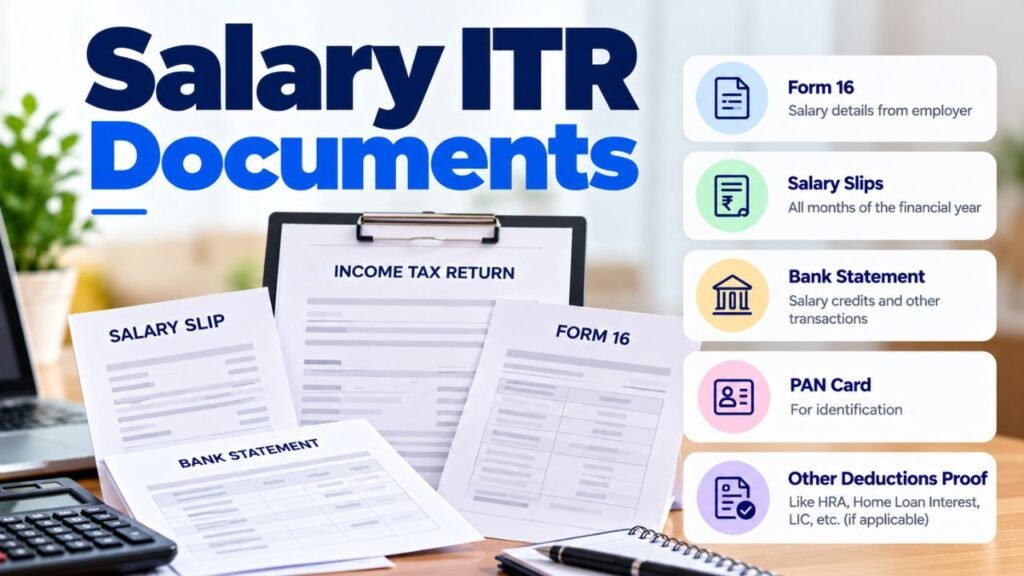
Filing an Income Tax Return (ITR) as a salaried employee is usually straightforward, but having the right Salary ITR Documents ready can prevent mistakes, tax-credit mismatches, incorrect income reporting and refund delays.
A salaried taxpayer may receive most of the required information from the employer, but Form 16 alone is not always enough. Salary income may be accompanied by bank interest, dividend income, rental income, capital gains, deductions, home-loan interest or other taxable receipts. These details may need to be checked separately before submitting the return.
For AY 2026–27, the Income Tax Department specifically advises taxpayers to keep documents such as Form 16, Form 16A, Form 26AS, AIS, payslips, bank statements, housing-loan interest certificates, rent receipts and investment-related documents ready, wherever applicable. ITRs are generally annexure-less, meaning these documents are not normally attached to the return, but they should be retained for future reference or if the tax authorities require them.
What Are Salary ITR Documents?
Salary ITR Documents are the records a salaried individual uses to calculate income, verify tax deducted at source (TDS), claim eligible deductions or exemptions and correctly report other sources of income while filing an Income Tax Return.
The exact documents depend on your financial situation.
For example:
- A private-sector employee with only salary and bank interest may need Form 16, Form 26AS, AIS and bank statements.
- An employee claiming HRA may also need rent-related records.
- A salaried person with a home loan may need a home-loan interest certificate.
- An employee who sold shares or mutual funds may need capital-gain statements.
- A person receiving interest with TDS deducted may need Form 16A.
- A taxpayer claiming eligible deductions should keep the relevant payment receipts and supporting records.
Therefore, there is no single document list that applies identically to every salaried employee.
Salary ITR Documents Checklist
Here is a practical checklist to keep ready before filing your return:
| Document | Why It Is Required |
|---|---|
| PAN Card | Identification and ITR filing |
| Aadhaar | Identity and e-verification |
| Form 16 | Salary income and TDS details |
| Payslips | Salary components and reconciliation |
| Form 26AS | TDS/TCS and tax-credit verification |
| AIS | Wider view of reported financial information |
| Form 16A | TDS on non-salary income, where applicable |
| Bank Statement | Interest and other income verification |
| Rent Receipts | HRA-related information, where applicable |
| Rental Agreement | Supporting rental details, where applicable |
| Home Loan Interest Certificate | Housing-loan interest information |
| Investment Proofs | Eligible deductions, where applicable |
| Insurance Premium Receipts | Eligible deduction claims, where applicable |
| Donation Receipts | Eligible Section 80G claims, where applicable |
| Capital Gain Statement | Share/mutual fund/property transactions, where applicable |
| Previous ITR/ITR-V | Reference and loss-related requirements, where applicable |
The Income Tax Department’s current guidance for salaried taxpayers specifically identifies Form 16, Form 16A, Form 26AS, AIS, payslips, bank statements, housing-loan interest certificates, rent receipts, rental agreements and investment or premium receipts among the documents that may be required depending on the taxpayer’s circumstances.
1. Form 16
Form 16 is one of the most important Salary ITR Documents for salaried employees.
It is issued by the employer and contains information relating to salary income, applicable exemptions and deductions and TDS deducted from salary.
You should carefully check Form 16 before filing your ITR.
Verify:
- Your name
- PAN
- Employer’s TAN
- Salary amount
- TDS deducted
- Exempt allowances
- Deductions
- Taxable income
- Tax payable or refund-related figures
If you changed jobs during the financial year, you may have received Form 16 from more than one employer.
In that situation, do not consider only the Form 16 from your current employer. Salary from all employers during the financial year needs to be considered.
You can also learn more about what is Form 16 and how it is used while filing an ITR.
2. Payslips
Monthly salary slips are another useful record for salaried taxpayers.
Although Form 16 is generally the primary salary-related tax document, payslips can help you understand and reconcile the salary credited during the year.
A payslip may show:
- Basic salary
- HRA
- Special allowance
- Conveyance-related components
- Bonuses
- Incentives
- Employee PF contribution
- Professional tax
- TDS
- Other deductions
- Net salary
Payslips become particularly useful when there is a difference between your salary records, Form 16 and bank credits.
For example, if your annual Form 16 shows a particular salary amount but your records indicate additional bonus or variable-pay payments, checking your monthly payslips can help identify where the difference came from.
3. Form 26AS
Form 26AS should be checked before filing your ITR.
It is particularly useful for verifying tax deducted or collected and other tax-credit information available through the tax system.
The Income Tax Department advises taxpayers to download Form 26AS and verify the actual TDS, TCS and tax-paid information before filing. If a discrepancy is found, it should be reconciled with the employer, tax deductor or relevant institution.
You can also read the detailed guide on Form 26AS.
Why should salaried employees check Form 26AS?
Suppose your employer deducted ₹60,000 as TDS during the year, but the tax credit appearing in the tax records does not match your Form 16.
If you ignore the difference and file the return without checking, it may create a tax-credit mismatch.
Therefore, Form 16 and Form 26AS should be compared before filing.
4. Annual Information Statement (AIS)
AIS, or Annual Information Statement, provides a broader view of information reported against your PAN.
It can contain information relating to areas such as:
- TDS/TCS
- Specified Financial Transactions
- Tax payments
- Refunds
- Demands
- Other information reported to the Income Tax Department
The Income Tax Department recommends checking AIS while preparing the return.
You can read the detailed explanation of AIS Income Tax before filing your return.
Do not blindly copy AIS into your ITR
AIS is an important reconciliation source, but taxpayers should still verify the information against their own records.
For example, if AIS shows bank interest, compare it with your bank statement and interest certificate.
If AIS contains information that appears incorrect, investigate the transaction rather than simply entering an unexplained figure into your return.
5. Form 16A
Form 16A becomes relevant when you receive certain income other than salary and TDS has been deducted from it.
For example, you may receive interest income from a fixed deposit on which the bank has deducted TDS.
The Income Tax Department describes Form 16A as a quarterly TDS certificate for income other than salary, containing information such as the nature of payment and TDS deposited.
A salaried employee can therefore have both:
- Form 16 for salary income
- Form 16A for applicable non-salary income
This is particularly important when your bank interest or another non-salary receipt has TDS attached to it.
6. Bank Statement
Your bank statement is an important supporting document while preparing your ITR.
It can help you identify:
- Salary credits
- Savings account interest
- Fixed deposit interest
- Dividend receipts
- Rental receipts
- Other income
- Refunds
- Large transactions requiring clarification
The Income Tax Department specifically lists bank statements among the documents taxpayers may need while preparing their ITR.
You can also read Bank Statement for ITR for a detailed explanation.
Important: Every bank credit is not taxable income
This is a common mistake.
For example, your bank account may receive:
- Money transferred from your own second bank account
- A loan from a friend or family member
- A refundable security deposit
- A reimbursement
- An ITR refund
- A credit-card reversal
- Salary
- Interest
- Rent
These transactions should not automatically be treated as taxable income merely because they appear as credits in your bank statement.
The source and nature of each relevant receipt should be identified correctly.
7. Rent Receipts
If you live in rented accommodation and HRA or another eligible claim is relevant to your tax computation, keep rent receipts and related rental records.
The Income Tax Department specifically mentions house-rent receipts and rental agreements among documents that may be required where applicable.
Keep records showing:
- Rent paid
- Period of tenancy
- Landlord details
- Payment details
- Rental agreement, where applicable
If you have already submitted the necessary information to your employer and it is properly reflected in your salary records, you should still retain the supporting documents.
8. Home Loan Interest Certificate
Salaried employees who have a home loan may need a housing-loan interest certificate.
This document can help provide the interest-related information required for reporting income from house property or claiming applicable tax treatment, depending on the circumstances.
The Income Tax Department lists housing-loan interest certificates among the documents that may be relevant while filing ITR-1.
Keep the certificate issued by your lender and check the financial year mentioned on it.
9. Investment Proofs
If you are claiming eligible deductions based on investments or payments, retain the relevant proof.
Examples can include:
- Life insurance premium receipts
- Eligible provident fund contributions
- Tuition-fee receipts
- Eligible health insurance premium receipts
- Other eligible investment/payment records
- Donation receipts where applicable
The exact deduction available depends on the applicable tax provisions and your chosen tax regime.
Do not assume that every investment automatically qualifies for a deduction.
10. Donation Receipts
If you have made donations for which you intend to claim an eligible deduction, retain the donation receipt and supporting details.
The receipt should be checked carefully for details such as:
- Name of the organisation
- Date of donation
- Amount
- Payment method
- Relevant identification details
For certain claims, additional transaction information may be required while filing the return.
11. Capital Gain Documents
A salaried employee may also have income from investments.
For example, you might have:
- Sold shares
- Redeemed mutual funds
- Sold other securities
- Sold property
In such cases, salary documents alone are not enough.
The Income Tax Department’s ITR-2 guidance specifically mentions a summary or profit/loss statement for capital-gain transactions in shares or securities where applicable.
Therefore, salaried taxpayers with investments should keep relevant capital-gain statements ready.
12. Fixed Deposit and Savings Interest Records
Salary may be your main income, but it does not mean your ITR contains only salary income.
Interest from:
- Savings accounts
- Fixed deposits
- Recurring deposits
- Other applicable deposits
may need to be considered while preparing the return.
Bank statements, interest certificates and Form 16A, where applicable, can help determine the correct amount.
The Income Tax Department’s ITR-2 guidance specifically refers to bank passbooks and fixed-deposit receipts for calculating interest income.
13. Previous ITR and ITR-V
Keeping your previous year’s ITR and ITR-V can be useful, particularly when you need to refer to previous income, deductions, losses or other details.
For some situations involving brought-forward losses, previous-year return information can become important.
Do not automatically carry forward figures from the previous year without checking whether they are applicable to the current assessment year.
14. PAN and Aadhaar Details
Your PAN is essential for filing an ITR.
Keep your PAN details readily available and ensure the personal information used in the tax return is correct.
Aadhaar may also be relevant for identity verification and e-verification.
Before submitting your return, check:
- PAN
- Name
- Date of birth
- Address
- Mobile number
- Email address
- Bank account details
The Income Tax Department advises taxpayers to verify the pre-filled personal and bank information before filing.
Salary ITR Documents for Employees With Multiple Jobs
If you worked for two or more employers during the same financial year, your document checklist becomes more important.
For example:
Employer A: January to September
Employer B: October to March
You may receive separate Form 16 certificates from both employers.
Do not file your return using only the latest employer’s Form 16.
Instead:
- Collect Form 16 from every employer.
- Compare salary figures.
- Check TDS from each employer.
- Compare the combined figures with Form 26AS.
- Review AIS.
- Check your bank salary credits.
- Calculate the complete annual income.
- File the applicable ITR using consolidated information.
This can prevent under-reporting of salary income.
Salary ITR Documents for Employees Claiming HRA
If you receive HRA and live in rented accommodation, keep your rent-related records ready.
A practical file may contain:
- Rent receipts
- Rental agreement
- Bank/UPI payment records
- Landlord details
- Salary slips
- Form 16
If rent was paid in cash or through a method that is difficult to trace, maintaining proper supporting records becomes even more important.
Salary ITR Documents for Employees With Home Loans
If you have a home loan, keep:
- Home-loan interest certificate
- Loan account statement
- Property-related documents where relevant
- Ownership information
- Relevant rental details if the property is let out
The correct treatment can differ depending on whether the property is self-occupied or let out and other applicable conditions.
Do You Need to Upload Salary ITR Documents?
Generally, you do not need to attach Form 16, investment proofs, rent receipts or similar supporting documents with your ITR simply because you are filing the return.
The Income Tax Department states that ITR forms are annexure-less. Therefore, supporting documents are generally not attached to the return. However, taxpayers should retain the documents because they may need to produce them during assessment, inquiry or other proceedings.
This does not mean that documents are unimportant.
It means you should maintain them properly even though they are not normally uploaded with the return.
Form 16 vs Bank Statement: Which One Is More Important?
They serve different purposes.
Form 16 primarily helps establish salary income and salary TDS.
Bank statements help you reconcile actual salary credits, interest and other financial transactions.
For example, Form 16 may show annual salary information, while the bank statement can help you identify whether there were additional interest payments or other receipts during the year.
Therefore, they should be treated as complementary documents rather than substitutes.
Form 16 vs Form 26AS vs AIS
These documents have different purposes.
| Document | Main Purpose |
|---|---|
| Form 16 | Salary income and salary TDS from employer |
| Form 16A | TDS on applicable non-salary income |
| Form 26AS | Tax-credit information, particularly TDS/TCS |
| AIS | Broader reported financial and tax-related information |
| Bank Statement | Actual account transactions and income reconciliation |
| Payslip | Monthly salary and deduction details |
You can also compare AIS and Form 26AS before filing your return.
Common Mistakes While Preparing Salary ITR Documents
Using only Form 16
Form 16 is important, but it may not contain every source of income.
Ignoring bank interest
Many salaried taxpayers forget savings-account or FD interest.
Not checking AIS
Information reported by banks, financial institutions and other reporting entities may appear in AIS.
Not comparing Form 16 with Form 26AS
This can result in TDS-credit discrepancies.
Reporting only the current employer’s salary
Employees who changed jobs during the year need to consider income from all relevant employers.
Claiming deductions without records
Keep supporting evidence for deductions you claim.
Treating every bank credit as income
A transfer between your own accounts is not automatically taxable income.
Uploading documents unnecessarily
ITRs are generally annexure-less. Keep supporting documents safely rather than assuming they must all be uploaded.
How to Organise Salary ITR Documents
A simple folder system can make future tax filing much easier.
Create a folder for each financial year.
For example:
FY 2025–26 / AY 2026–27
Inside it, maintain:
- Form 16
- Payslips
- Form 26AS
- AIS
- Bank statements
- Interest certificates
- Rent receipts
- Home-loan certificate
- Investment proofs
- Insurance receipts
- Donation receipts
- Capital-gain statements
- Previous ITR acknowledgement
This approach can also make it easier to respond if you later need to explain a transaction or tax-credit difference.
Final Salary ITR Documents Checklist
Before filing your ITR, go through this checklist:
- PAN details checked
- Aadhaar details checked
- Form 16 collected
- Form 16 from previous employers collected, if applicable
- Payslips checked
- Form 26AS downloaded and checked
- AIS reviewed
- Bank statements checked
- Savings/FD interest verified
- Form 16A collected, if applicable
- Rent receipts collected, if applicable
- Rental agreement retained, if applicable
- Home-loan interest certificate collected, if applicable
- Investment proofs retained
- Insurance receipts retained
- Donation receipts retained, if applicable
- Capital-gain statements collected, if applicable
- Previous ITR/ITR-V retained
- Bank account details checked
- Correct ITR form identified
- Tax regime selection reviewed
- ITR verified after filing
Conclusion
Having the correct Salary ITR Documents ready can make income-tax filing much easier and reduce the possibility of errors. Form 16 is the key salary document, but salaried taxpayers should also review Form 26AS, AIS, payslips, bank statements and other applicable records before submitting the return.
Your document requirements will depend on your complete financial situation. Someone with only salary and bank interest may need a relatively simple set of records, while an employee with HRA, a home loan, investments, capital gains or multiple employers may need several additional documents.
Most importantly, do not wait until the last day of ITR filing to collect your records. Check Form 16, Form 26AS, AIS and your bank information together so that discrepancies can be identified before the return is submitted.
For more practical guides on income tax, documents and government services, visit Sarkari Bakery.
FAQs
Based on Google's Helpful Content System, this article emphasizes user value, transparency, and accuracy. It incorporates principles of E-E-A-T (Experience, Expertise, Authoritativeness, Trustworthiness).
Why Choose Sarkari Bakery?
Official Information
Government schemes & banking information based on official sources.
Step-by-Step Guides
Simple application process explained for every service.
Regular Updates
Content updated whenever official rules or services change.
People-First Content
Helpful, transparent and user-focused content.