
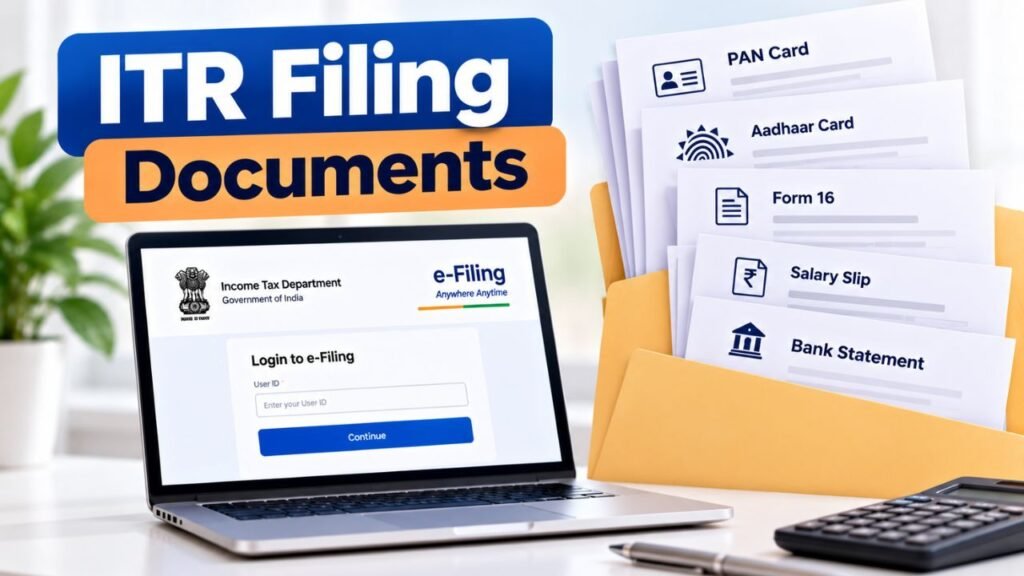
Filing an Income Tax Return becomes much easier when you have all the required ITR filing documents ready before starting the return. The documents you need depend on your income sources, employment status, investments, deductions, capital gains and other financial activities during the financial year.
A salaried employee may mainly need Form 16, bank statements, Form 26AS, AIS and investment records. A freelancer may additionally need invoices, business-related records and expense information. A person earning from investments may need capital-gain statements, dividend details and interest certificates.
One important point is that taxpayers generally do not have to upload every supporting document while submitting an ITR because income tax returns are generally annexure-less. However, the supporting records should be kept safely because they may be required later for verification, assessment or an income tax inquiry.
This guide explains the important ITR filing documents you should collect based on your income and tax situation.
What Are ITR Filing Documents?
ITR filing documents are the records and financial information used to correctly prepare and verify your Income Tax Return.
These documents help you determine:
- Total income
- Income from different sources
- Taxable income
- TDS deducted
- TCS collected
- Advance tax paid
- Self-assessment tax paid
- Eligible deductions
- Exempt income
- Capital gains or losses
- Bank interest
- Dividend income
- Rental income
- Business or professional income
- Tax refund or additional tax payable
Not every taxpayer needs every document.
For example, an employee who has only salary income will have a different document requirement from a freelancer who receives payments from several clients.
Basic Documents Required for ITR Filing
Before collecting income-specific documents, keep the following basic information available:
- PAN
- Aadhaar
- Bank account details
- Bank statements
- Form 26AS
- AIS
- Form 16, if applicable
- Previous ITR details, if applicable
- Details of income from all sources
- Details of deductions and investments
- Tax payment details, where applicable
Your PAN and Aadhaar details should be checked carefully before filing because incorrect personal information can create problems during ITR submission or verification.
For a detailed list of documents related specifically to PAN, you can also check PAN Card Documents Required.
Form 16 for Salaried Employees
Form 16 is one of the most important ITR filing documents for salaried employees.
It is issued by the employer and contains important salary and TDS-related information.
Depending on the applicable details, Form 16 can help you verify:
- Salary income
- Gross salary
- Exemptions
- Deductions
- Taxable salary
- TDS deducted
- Other income reported to the employer
- Tax computation
Before filing your ITR, compare Form 16 with your salary slips and tax records.
You can learn more about it through What Is Form 16.
What If You Have More Than One Employer?
If you changed jobs during the financial year, you may have received salary from more than one employer.
In that situation, keep the Form 16 issued by each employer.
Do not consider only your current employer’s salary while preparing the return.
You should account for the income and applicable TDS from all employers for the relevant financial year.
Form 16A for Non-Salary Income
If TDS was deducted from certain non-salary income, you may receive Form 16A from the deductor.
Examples can include certain:
- Bank interest payments
- Professional payments
- Contractual payments
- Rental payments
- Other eligible non-salary payments
Form 16A helps you verify the amount of TDS deducted and the related payment information.
If you receive both salary and non-salary income, you may have both Form 16 and Form 16A during the same financial year.
For a detailed comparison, see Form 16 vs Form 16A.
Form 26AS
Form 26AS is another important tax record to check before filing your ITR.
It primarily provides TDS and TCS-related information under the current system.
You should compare the TDS shown in Form 26AS with:
- Form 16
- Form 16A
- Other TDS certificates
- Your income records
For example, if your employer’s Form 16 shows ₹50,000 TDS but the corresponding tax credit in Form 26AS is lower, you should investigate the difference before claiming the credit in your ITR.
Read the detailed Form 26AS guide for more information.
Annual Information Statement (AIS)
The Annual Information Statement (AIS) provides broader information reported to the Income Tax Department.
AIS can contain information relating to areas such as:
- TDS
- TCS
- Interest
- Dividends
- Securities transactions
- Certain financial transactions
- Tax payments
- Demand and refund information
- Other reported information
Before filing your ITR, compare relevant AIS information with your own financial records.
If something appears in AIS that you believe is incorrect, do not simply ignore it. Review the transaction and use the applicable feedback or correction mechanism where appropriate.
You can read more about AIS Income Tax.
Bank Statements
Bank statements are among the most useful supporting documents for ITR filing.
They can help you identify:
- Savings account interest
- Fixed deposit interest
- Recurring deposit interest
- Dividend credits
- Rental receipts
- Freelance payments
- Business receipts
- Investment transactions
- Tax payments
- Large financial transactions
Bank statements are particularly useful when you have multiple income sources and need to reconcile your income with AIS and Form 26AS.
However, remember that a bank statement is not itself a substitute for calculating taxable income. You still need to identify the nature of each receipt and apply the applicable tax treatment.
You can also refer to Bank Statement for ITR for more detailed guidance.
Salary Slips
Although Form 16 is an important document, salary slips can still be useful.
Keep your salary slips for the relevant financial year because they can help verify:
- Basic salary
- HRA
- Allowances
- Bonuses
- Deductions
- Professional tax, where applicable
- Other salary components
Salary slips can be particularly useful if you identify a difference between your Form 16 and actual salary payments.
Investment Proofs and Deduction Documents
If you are claiming eligible deductions, keep the documents supporting those claims.
Depending on your situation, these may include:
- Life insurance premium receipts
- Health insurance premium receipts
- Eligible investment statements
- Tuition fee receipts
- Donation receipts
- Home-loan documents
- Eligible education-loan interest certificates
- Other documents supporting claimed deductions
Do not claim a deduction merely because you made a payment. Confirm that the payment qualifies under the applicable provision and that you have adequate supporting records.
Home Loan Documents
If you have a home loan, keep the relevant documents if you intend to claim applicable benefits.
These may include:
- Home-loan interest certificate
- Loan statement
- Principal repayment details
- Property-related information
- Co-borrower details, where applicable
The exact tax treatment depends on factors such as the property, purpose of the loan, ownership, occupancy and the tax regime applicable to you.
Rent Receipts and Rental Documents
If you pay rent and are claiming an eligible deduction or exemption, retain relevant rent-related documents.
These can include:
- Rent receipts
- Rental agreement
- Landlord details
- Rent payment records
- Bank statements showing rent payments
If you earn rental income from property, you should maintain documents related to:
- Rent received
- Property ownership
- Municipal taxes, where relevant
- Home-loan interest, where applicable
- Other relevant property expenses and records
The documentation required depends on the nature of your claim and the applicable tax provisions.
Capital Gains Documents
If you sold shares, mutual funds, property or other capital assets during the financial year, you may need additional records.
For securities and investments, keep:
- Broker statements
- Contract notes
- Capital-gain statements
- Mutual-fund statements
- Purchase records
- Sale records
- Dividend records, where relevant
For property transactions, keep documents such as:
- Purchase deed
- Sale deed
- Purchase consideration
- Sale consideration
- Registration-related records
- Eligible improvement expenses
- Other supporting records
Capital gains can be more complicated than salary income, so accurate transaction records are particularly important.
Mutual Fund Documents
If you invested in mutual funds, you should keep your consolidated account statement or relevant transaction statements.
These can help you determine:
- Purchase date
- Purchase value
- Sale date
- Sale value
- Units sold
- Capital gains
- Relevant dividend or distribution information
Do not calculate capital gains merely from the amount credited to your bank account. The tax treatment depends on the nature of the transaction and applicable rules.
Share Market Documents
If you bought or sold shares, retain:
- Broker statement
- Contract notes
- Trade records
- Capital-gain statement
- Dividend information
- Purchase and sale details
Frequent investors and traders should maintain their records carefully because the correct tax treatment can depend on the nature of the activity.
Bank Interest and Fixed Deposit Documents
If you earn interest from savings accounts, fixed deposits or other deposits, keep:
- Bank interest certificates
- Deposit statements
- Bank statements
- TDS certificates, where applicable
Compare the interest income with the information available in AIS and other tax records.
Remember that TDS being deducted does not necessarily mean that the corresponding income can be ignored while filing your return.
Dividend Income Documents
If you receive dividends from shares, mutual funds or other investments, keep relevant:
- Dividend statements
- Broker statements
- Bank statements
- Investment records
Dividend income may also appear in AIS, so compare the information with your own records.
Freelancer ITR Filing Documents
Freelancers may have a different set of ITR filing documents compared with salaried employees.
Important records can include:
- PAN
- Aadhaar
- Bank statements
- Client invoices
- Payment records
- Form 16A, where applicable
- Form 26AS
- AIS
- Business-related expense records
- Professional receipts
- TDS certificates
- Previous ITR information
For freelancers, maintaining proper invoice and payment records throughout the year is much easier than trying to reconstruct income at the end of the financial year.
See Freelancer ITR Documents for a more focused checklist.
Business ITR Filing Documents
Business owners and professionals may need considerably more documentation.
Depending on the nature and size of the business, relevant records may include:
- Sales records
- Purchase records
- Expense records
- Bank statements
- Invoices
- GST-related records, where applicable
- TDS records
- TCS records
- Fixed-asset records
- Loan statements
- Interest records
- Debtor and creditor details
- Accounting records
- Previous-year financial statements
- Tax payment records
The exact documents required depend on the type of business, applicable ITR form, accounting requirements and tax provisions.
You can refer to Business ITR Documents for a dedicated checklist.
Documents for Tax Deductions
If you are claiming deductions, maintain the supporting evidence.
Depending on your circumstances, this can include:
Section 80C-related records
Potential supporting documents may include eligible investment or payment receipts such as:
- Life insurance premiums
- Eligible provident fund contributions
- Tuition fees
- Eligible investments
- Other qualifying payments
Health Insurance Documents
If you are claiming an eligible health insurance deduction, keep:
- Premium receipt
- Policy document
- Payment proof
Donation Receipts
If claiming an eligible deduction for donations, keep the donation receipt containing the required details.
Home Loan Interest Certificate
Keep the interest certificate issued by the lender where a home-loan-related claim is applicable.
The exact deduction available depends on the applicable tax regime and conditions.
Previous ITR and ITR-V
Your previous ITR can be useful when preparing a current return.
It may help you check:
- Previous income
- Brought-forward losses, where applicable
- Deduction history
- Tax details
- Bank account information
- Previous filing information
Keep your previous ITR-V acknowledgement as part of your tax records.
If you need to download an ITR-V, you can refer to ITR V Download.
Documents for Tax Payments
If you paid tax directly during the financial year, retain the relevant challan and payment information.
This can include:
- Advance tax
- Self-assessment tax
- Other applicable tax payments
Verify that the payment is correctly reflected in your tax records before claiming it in your ITR.
Do You Need to Upload ITR Filing Documents?
Generally, taxpayers do not upload all their supporting documents with the ITR.
Income Tax Returns are generally annexure-less.
This means you normally do not attach documents such as:
- Form 16
- Form 16A
- Investment receipts
- Bank statements
- Insurance receipts
- Donation receipts
with the return itself.
However, this does not mean that you should throw away the documents.
Keep them safely because the Income Tax Department may require supporting evidence in an assessment, inquiry or other proceedings.
Documents Required Based on Your Income Type
A quick comparison can help you identify the records you are most likely to need.
| Taxpayer Type | Important ITR Filing Documents |
|---|---|
| Salaried Employee | Form 16, salary slips, Form 26AS, AIS, bank statements |
| Employee with Investments | Form 16, Form 26AS, AIS, investment statements, capital-gain statements |
| Freelancer | Invoices, bank statements, TDS certificates, Form 26AS, AIS, expense records |
| Business Owner | Books/accounts, invoices, bank statements, GST records where applicable, TDS/TCS records |
| Property Owner | Rent records, property documents, bank statements, loan interest certificate where applicable |
| Investor | Broker statements, capital-gain statements, dividend records, AIS, bank statements |
| Pensioner | Pension records, Form 16 where applicable, bank statements, Form 26AS, AIS |
This table is a practical starting point, not a universal document list. Your actual requirements depend on your income sources and the ITR form applicable to you.
ITR Filing Documents Checklist
Before starting your ITR, use this checklist:
- PAN
- Aadhaar
- Bank account details
- Bank statements
- Form 16
- Form 16A, where applicable
- Form 26AS
- AIS
- Salary slips
- Interest certificates
- Fixed deposit details
- Investment statements
- Capital-gain statements
- Dividend statements
- Home-loan interest certificate
- Rent receipts, where applicable
- Rental income records, where applicable
- Insurance premium receipts
- Eligible investment proofs
- Donation receipts
- Business records, where applicable
- Freelancer invoices, where applicable
- TDS certificates
- Tax-payment challans
- Previous ITR
- ITR-V
- Records supporting any deductions claimed
Common Mistakes When Preparing ITR Documents
Relying Only on Form 16
Form 16 does not necessarily cover all your income.
Bank interest, capital gains, freelance income, rental income and other income sources may need separate consideration.
Ignoring AIS
AIS can contain information that may not be obvious from Form 16.
Always review it before filing.
Not Checking Form 26AS
TDS credit should be reconciled before claiming it in your return.
Claiming Deductions Without Proof
Do not claim an eligible-looking deduction without retaining supporting evidence.
Forgetting Previous Employer Income
If you changed jobs during the year, include relevant income from all employers.
Ignoring Small Sources of Income
Interest from savings accounts, fixed deposits, dividends and other smaller amounts should not be ignored merely because they are small.
Not Keeping Documents After Filing
Even though documents generally do not have to be uploaded with the ITR, keep them safely after filing.
When Should You Collect ITR Filing Documents?
Do not wait until the last day of the ITR filing period.
Ideally, start collecting your records after the financial year ends and reconcile them before beginning the return.
A practical sequence is:
Collect documents → Check Form 16 → Check Form 26AS → Check AIS → Review bank statements → Verify income → Check deductions → Prepare ITR → Verify ITR
This process can help reduce mistakes and make it easier to identify discrepancies while there is still time to correct them.
Frequently Asked Questions About ITR Filing Documents
Conclusion
Having the correct ITR filing documents ready before starting your Income Tax Return can make the entire process more accurate and easier to manage. The documents required depend on your income sources, so a salaried employee, freelancer, investor and business owner will not necessarily need the same records.
At a minimum, most taxpayers should review their PAN, Aadhaar, bank records, Form 26AS, AIS and applicable income documents before filing. Salaried taxpayers should also check Form 16, while taxpayers with investments, rental income, freelance receipts or business income should maintain the additional records relevant to those sources.
Remember that supporting documents generally do not have to be uploaded with an ITR, but they should be retained safely for future verification or assessment.
For more practical guides on income tax, PAN, Aadhaar and other government services, visit Sarkari Bakery.
Based on Google's Helpful Content System, this article emphasizes user value, transparency, and accuracy. It incorporates principles of E-E-A-T (Experience, Expertise, Authoritativeness, Trustworthiness).
Why Choose Sarkari Bakery?
Official Information
Government schemes & banking information based on official sources.
Step-by-Step Guides
Simple application process explained for every service.
Regular Updates
Content updated whenever official rules or services change.
People-First Content
Helpful, transparent and user-focused content.