
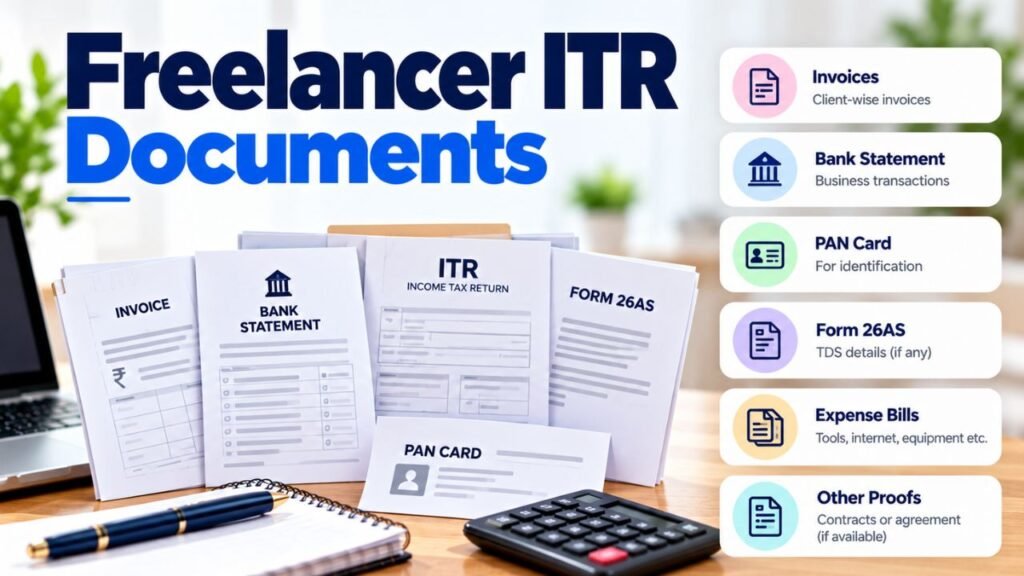
Freelancers do not receive a standard salary from one employer, so filing an Income Tax Return can require more preparation than a regular salaried employee. Payments may come from multiple clients, freelancing platforms, Indian companies, overseas clients, UPI, bank transfers or payment gateways.
Knowing the correct Freelancer ITR Documents before filing can help you calculate your total income correctly, identify deductible expenses, reconcile TDS and avoid problems later if the Income Tax Department asks for supporting records.
For AY 2026–27, individuals earning income from a business or profession may generally fall under ITR-3 or, where eligible, ITR-4 under the presumptive taxation provisions. The Income Tax Department states that ITR-3 applies to individuals and HUFs having income from profits and gains of business or profession, while ITR-4 can apply to eligible resident individuals, HUFs and firms using presumptive taxation under sections such as 44AD, 44ADA or 44AE.
The documents you need depend on how you earn, whether you use the presumptive taxation scheme, whether clients deduct TDS, whether you have foreign income and whether you claim actual business or professional expenses.
What Are Freelancer ITR Documents?
Freelancer ITR Documents are the records used to calculate and support income earned from freelance or professional activities and to report the applicable tax information in the Income Tax Return.
These may include:
- Client invoices
- Payment receipts
- Bank statements
- UPI transaction records
- Payment gateway statements
- Freelancing platform statements
- Form 16A
- Form 26AS
- AIS
- Expense invoices
- Professional subscriptions
- Internet and telephone bills
- Software bills
- Office or coworking-space expenses
- Travel records related to work
- GST records, where applicable
- Foreign payment records
- Foreign tax documents, where applicable
- Loan or asset records, where relevant
- Previous ITR and tax records
Not every freelancer will need every document.
For example, a freelance content writer working entirely with Indian clients may have a relatively simple set of records, while a software developer receiving payments from international clients may need additional foreign-income and foreign-exchange documentation.
Freelancer ITR Documents Checklist
| Document | Why It May Be Required |
|---|---|
| PAN | Taxpayer identification |
| Aadhaar | Identity and e-verification |
| Client Invoices | Evidence and calculation of professional receipts |
| Bank Statements | Reconciliation of receipts and expenses |
| UPI Statements | Verification of digital payments |
| Payment Gateway Statements | Reconciliation of online collections |
| Freelancing Platform Statements | Income received through platforms |
| Form 16A | Verification of TDS on non-salary income |
| Form 26AS | TDS/TCS and tax-credit verification |
| AIS | Broader reported financial information |
| Expense Bills | Supporting business/professional expenses |
| Software Subscription Bills | Supporting eligible professional expenses |
| Internet/Telephone Bills | Supporting relevant business expenses |
| Office Rent/Coworking Bills | Supporting business expenses |
| Travel Records | Supporting business-related travel |
| GST Records | Where GST registration/compliance applies |
| Foreign Payment Statements | International client income reconciliation |
| Foreign Tax Documents | Foreign tax credit, where applicable |
| Previous ITR | Reference and continuity |
| Advance Tax Challans | Verification of tax payments |
1. PAN Card
PAN is one of the basic documents required for income-tax filing.
A freelancer should ensure that the PAN used on:
- Client invoices
- Bank records
- Form 16A
- Form 26AS
- AIS
- Income Tax e-Filing account
is correct.
If there is a discrepancy in your PAN details, resolve it before filing rather than entering inconsistent information in the return.
2. Aadhaar Details
Aadhaar can be relevant for identity verification and e-verification of the ITR.
Keep your Aadhaar and PAN information consistent, particularly your name and date of birth.
Before filing, also verify the mobile number and email address available in your income-tax profile.
3. Client Invoices
For a freelancer, invoices are among the most useful records for establishing professional receipts.
If you provide services to clients, maintain copies of invoices issued during the financial year.
An invoice may contain:
- Invoice number
- Invoice date
- Client name
- Description of service
- Amount
- GST, where applicable
- Total amount
- Payment terms
- Your business/professional details
For example, if you provided SEO services to 10 clients during the year, maintain the invoices for all 10 clients rather than relying only on the amount appearing in your bank account.
Invoices make it easier to reconcile your declared professional receipts with actual payments.
4. Bank Statements
Bank statements are particularly important for freelancers because professional payments may arrive throughout the year from different sources.
A bank statement can help identify:
- Client payments
- Freelancing platform payments
- Interest income
- Refunds
- Transfers between your own accounts
- Business expenses
- Personal expenses
- Loan receipts
- Other financial transactions
The Income Tax Department advises taxpayers to study bank statements or passbooks and other relevant records while preparing an ITR.
You should not, however, treat every bank credit as professional income.
For example:
₹50,000 received from a client → potentially professional receipt.
₹50,000 transferred from your own savings account → not automatically new income.
₹20,000 received as a loan → not automatically professional income.
₹5,000 savings-account interest → potentially taxable income and needs separate consideration.
This classification is extremely important for freelancers.
5. UPI Transaction Records
Many freelancers receive payments through UPI.
If clients regularly pay you through UPI, maintain appropriate records of those transactions.
You can use UPI transaction history to reconcile:
- Client name
- Payment date
- Amount
- Invoice number
- Payment reference
- Bank credit
Do not depend entirely on the UPI app history because transaction availability and retention can vary.
Your bank statement should remain an important source for reconciliation.
6. Payment Gateway Statements
Freelancers selling services through online platforms may receive payments through payment gateways.
Examples can include payments processed through online payment services or marketplace platforms.
Keep statements showing:
- Gross payment received
- Platform charges
- Transaction fees
- Refunds
- Net amount credited
Suppose a client pays ₹10,000 and the payment gateway deducts ₹200 as a processing charge before crediting ₹9,800 to your bank account.
Your records should clearly establish the gross receipt and the applicable expense rather than assuming that the bank credit alone represents the complete transaction.
The exact tax treatment depends on the circumstances and accounting method being followed.
7. Freelancing Platform Statements
If you work through a freelancing platform, download and retain your annual transaction or earnings statement.
Examples of relevant records include:
- Total earnings
- Platform fees
- Withdrawals
- Refunds
- Client payments
- Currency conversion
- Taxes or withholding, where applicable
This becomes particularly important when the platform is located outside India or payments are received in foreign currency.
8. Form 16A
Freelancers may receive Form 16A when tax is deducted from applicable non-salary income.
Form 16A is a quarterly TDS certificate issued by the deductor and contains information such as the amount credited, TDS amount, nature of payment and TDS deposited.
For example, if an Indian company deducts TDS from your professional payment, the corresponding tax information may need to be reconciled with your records.
Do not ignore Form 16A simply because you are not a salaried employee.
9. Form 26AS
Form 26AS should be checked before filing your freelancer ITR.
It is particularly important for checking tax deducted or collected against your PAN.
The Income Tax Department provides Form 26AS through the e-Filing portal and identifies it as a source for TDS/TCS information.
Suppose you earned ₹5 lakh from different clients and several clients deducted TDS.
You should reconcile:
Client records → Form 16A → Form 26AS → AIS → Bank statement
If the figures do not match, investigate the difference before filing.
10. Annual Information Statement (AIS)
AIS provides a broader picture of information reported against your PAN.
It can include information such as:
- TDS/TCS
- Specified Financial Transactions
- Tax payments
- Refunds
- Demands
- Other information reported to the Income Tax Department
The Income Tax Department describes AIS as containing broader information than the TDS/TCS information shown in Form 26AS.
You should compare AIS with your own records instead of blindly copying every entry.
You can learn more about AIS Income Tax and AIS vs Form 26AS before filing.
11. Expense Bills and Receipts
If you are reporting actual professional income and claiming eligible expenses, maintain supporting bills and receipts.
Depending on your profession, these could include:
- Office rent
- Coworking charges
- Internet expenses
- Professional software
- Computer-related expenses
- Advertising
- Professional subscriptions
- Accounting services
- Legal/professional fees
- Business travel
- Office supplies
- Other eligible professional expenses
The expense should have a genuine connection with your professional activity and should be properly recorded.
Do not claim personal expenses simply because they were paid from your business bank account.
12. Software Subscription Bills
Digital professionals often use paid tools.
For example:
- SEO tools
- Design software
- Video editing software
- Cloud storage
- Project management software
- Website hosting
- Domain services
- Communication tools
Keep invoices and payment records for subscriptions that are genuinely related to your professional activity.
For a freelancer working in digital marketing, for example, an annual subscription to a professional SEO platform may be directly connected with the work performed for clients.
13. Internet and Telephone Bills
If internet or telephone services are used for professional work, maintain the relevant bills.
However, if the same connection is used for both personal and professional purposes, do not automatically treat the entire bill as a business expense.
The appropriate treatment depends on the facts and applicable tax rules.
Maintain a reasonable and supportable record of the professional-use portion.
14. Laptop, Computer and Other Equipment Records
Freelancers may purchase equipment needed to perform their work.
Examples include:
- Laptop
- Desktop computer
- Monitor
- Printer
- Camera
- Microphone
- External hard drive
- Other professional equipment
Keep:
- Purchase invoice
- Date of purchase
- Payment proof
- Warranty documents
- Relevant asset details
The tax treatment of such assets can differ from ordinary recurring expenses, particularly where depreciation or other provisions apply.
Therefore, do not simply deduct the entire purchase price without checking the applicable treatment.
15. Office Rent or Coworking Space Documents
If you work from a rented office or coworking facility, retain:
- Rent agreement
- Monthly invoices
- Payment records
- Receipts
- Relevant tax documents
These records can help establish the nature and amount of professional expenditure.
If you work from home, the treatment of home-related expenses can be more complicated. Do not automatically claim a percentage of every household bill without considering whether the expense is actually allowable and how it should be allocated.
16. Travel and Business Expense Records
Freelancers who travel for professional assignments should maintain supporting records.
These may include:
- Travel tickets
- Hotel invoices
- Cab bills
- Client meeting records
- Conference registration
- Business-related travel receipts
For example, if a freelance photographer travels to another city for a paid client assignment, maintaining the travel and accommodation records can help establish the professional purpose of the expenditure.
Personal holidays should not be converted into professional expenses merely because some work was performed during the trip.
17. GST Documents, Where Applicable
Some freelancers are required to register under GST depending on their turnover, services, location and other applicable conditions.
If GST applies to your freelance activity, maintain relevant records such as:
- GST registration details
- Tax invoices
- GST returns
- GST payment records
- Input tax credit records, where applicable
- Export-of-services documentation, where relevant
Income-tax reporting and GST compliance are separate matters.
A freelancer should not assume that filing an ITR automatically completes GST compliance.
18. Foreign Client Payment Documents
Freelancers working with overseas clients need additional care.
If you receive payments from foreign clients, maintain records showing:
- Client name
- Invoice
- Invoice currency
- Payment date
- Amount
- Bank credit
- Exchange-rate information
- Payment gateway statement
- Applicable bank charges
- Foreign tax deducted, if any
For example, suppose you invoice a US client for USD 1,000.
Do not record the transaction only by looking at the final rupee amount credited without maintaining supporting information about the original invoice and conversion.
The exact tax and foreign-exchange treatment can depend on the transaction and applicable rules.
19. Foreign Tax Documents
If tax has been deducted or paid in another country, keep the relevant foreign tax documentation.
Depending on the circumstances, foreign tax credit may be available subject to applicable conditions and compliance requirements.
Such cases can require additional reporting, so freelancers earning substantial foreign income should not rely only on the bank statement.
20. Advance Tax Payment Challans
Freelancers may have tax liability during the financial year even though there is no employer deducting tax from a monthly salary.
If you paid advance tax or self-assessment tax, retain the relevant challan and payment details.
Before filing, reconcile tax payments with the information available through the Income Tax Department.
A tax payment made but not correctly reflected in your records should be investigated before submitting the return.
21. Previous ITR and ITR-V
Keep copies of previous returns and ITR-V acknowledgements.
These can help you check:
- Previous income
- Brought-forward losses
- Tax payments
- Bank account information
- Previous disclosures
- Other relevant information
Do not blindly copy figures from an earlier return. Use previous returns as reference documents and verify the current year’s information independently.
Freelancer ITR Documents for Presumptive Taxation
Freelancers who are eligible to use presumptive taxation may have a different compliance approach from those maintaining detailed accounts of actual expenses.
For AY 2026–27, the Income Tax Department states that eligible professionals can use ITR-4 where income from profession is computed on a presumptive basis under Section 44ADA, subject to the applicable conditions.
This does not mean that a freelancer should throw away invoices, bank statements or payment records.
You should still maintain sufficient records to understand:
- Total receipts
- Client payments
- TDS
- Bank transactions
- Tax payments
- Other income
The exact documentation and bookkeeping requirements depend on the applicable taxation method and circumstances.
Freelancer ITR Documents for Actual Expense Reporting
If your tax computation involves actual professional expenses, maintaining detailed records becomes especially important.
For example, a freelance video editor may have:
Income:
- Client invoices
- Platform earnings
- Bank receipts
Expenses:
- Editing software
- Computer equipment
- Internet
- Cloud storage
- Office rent
- Professional subscriptions
The records should allow you to trace the major income and expense entries.
How to Reconcile Freelancer Income Before Filing ITR
A simple reconciliation can prevent many mistakes.
Step 1: Prepare your client list
List every client from whom you received money during the financial year.
Step 2: Match invoices
Match each client payment with the corresponding invoice.
Step 3: Check bank statements
Search your bank statements for the actual credits.
Step 4: Check freelancing platforms
Download annual statements from every platform you used.
Step 5: Check Form 16A
Collect TDS certificates from clients or deductors wherever applicable.
Step 6: Check Form 26AS
Verify the TDS/TCS information.
Step 7: Check AIS
Review broader information reported against your PAN.
Step 8: Check tax payments
Verify advance tax and self-assessment tax payments.
Step 9: Review expenses
If applicable, match professional expenses with invoices and payment records.
Step 10: File the appropriate ITR
Choose the return applicable to your income and taxation method.
The Income Tax Department specifically advises taxpayers to check AIS and Form 26AS, reconcile discrepancies and carefully study relevant documents before filing.
Common Freelancer ITR Document Mistakes
1. Reporting only bank credits
A freelancer should reconcile invoices, platform records and bank statements instead of treating every credit as income or ignoring receipts that have not yet appeared in a particular account.
2. Ignoring TDS
If a client deducted TDS, check Form 16A, Form 26AS and AIS.
3. Forgetting platform fees
Freelancing platforms may deduct commissions or service charges before payment reaches your bank account.
Maintain the platform statement so that you understand the complete transaction.
4. Mixing personal and professional transactions
Using one bank account for everything makes reconciliation more difficult.
A separate account for professional receipts can make record keeping easier.
5. Claiming unsupported expenses
An expense should not be claimed merely because it was paid from the account used for freelance work.
Keep proper supporting records.
6. Ignoring foreign income
Foreign-client payments require careful reporting and documentation.
Do not assume that an overseas payment is outside the Indian tax system simply because the client is located outside India.
7. Not checking AIS
Information reported by financial institutions or other entities can appear in AIS.
Always review it before filing.
Do Freelancers Need to Upload Documents With ITR?
Generally, supporting documents are not simply attached to the ITR as proof of every income or expense.
The important point is that not uploading a document does not mean you should not maintain it.
The Income Tax Department states in its ITR guidance that returns can be annexure-less and supporting documents may need to be retained for situations such as assessment or inquiry.
For freelancers, retaining invoices, bank statements, expense bills, TDS certificates and other relevant records is therefore important.
How Long Should Freelancers Keep ITR Documents?
Do not delete your financial records immediately after filing the return.
Maintain a properly organised folder for each financial year containing:
- Client invoices
- Bank statements
- Platform statements
- Form 16A
- Form 26AS
- AIS
- Expense bills
- GST records, where applicable
- Tax challans
- Previous ITR
- ITR-V
- Foreign income records, where applicable
The exact retention period can depend on the applicable tax provisions and circumstances, so records should be retained in accordance with the relevant statutory requirements rather than discarded immediately after filing.
Freelancer ITR Documents: Final Checklist
Before filing your return, check the following:
- PAN details checked
- Aadhaar details checked
- All client invoices collected
- Bank statements downloaded
- UPI transactions reconciled
- Payment gateway statements collected
- Freelancing platform statements downloaded
- Form 16A collected, where applicable
- Form 26AS checked
- AIS checked
- Professional receipts reconciled
- Professional expenses reviewed
- Expense invoices retained
- Software subscription bills retained
- Internet and telephone records retained
- Office/coworking records retained
- Equipment purchase invoices retained
- Travel records retained, where applicable
- GST records checked, where applicable
- Foreign-client payments reconciled, where applicable
- Foreign tax documents retained, where applicable
- Advance tax challans checked
- Previous ITR and ITR-V retained
- Appropriate ITR form identified
- Tax regime reviewed
- Bank account details verified
- Return verified after filing
Conclusion
The correct Freelancer ITR Documents depend on how you earn and how your professional income is taxed. Unlike a salaried employee who may receive one Form 16 from an employer, a freelancer may need to combine information from invoices, bank accounts, UPI payments, freelancing platforms, Form 16A, Form 26AS, AIS and professional expense records.
The most important practice is reconciliation. Your invoices, client payments, bank credits, TDS records and tax information should make sense when compared with each other.
If you work with multiple clients, receive foreign payments or claim professional expenses, maintaining records throughout the year is much easier than trying to reconstruct everything just before the ITR deadline.
For more practical guides on income tax, ITR documents and government services, visit Sarkari Bakery.
FAQs
Based on Google's Helpful Content System, this article emphasizes user value, transparency, and accuracy. It incorporates principles of E-E-A-T (Experience, Expertise, Authoritativeness, Trustworthiness).
Why Choose Sarkari Bakery?
Official Information
Government schemes & banking information based on official sources.
Step-by-Step Guides
Simple application process explained for every service.
Regular Updates
Content updated whenever official rules or services change.
People-First Content
Helpful, transparent and user-focused content.