
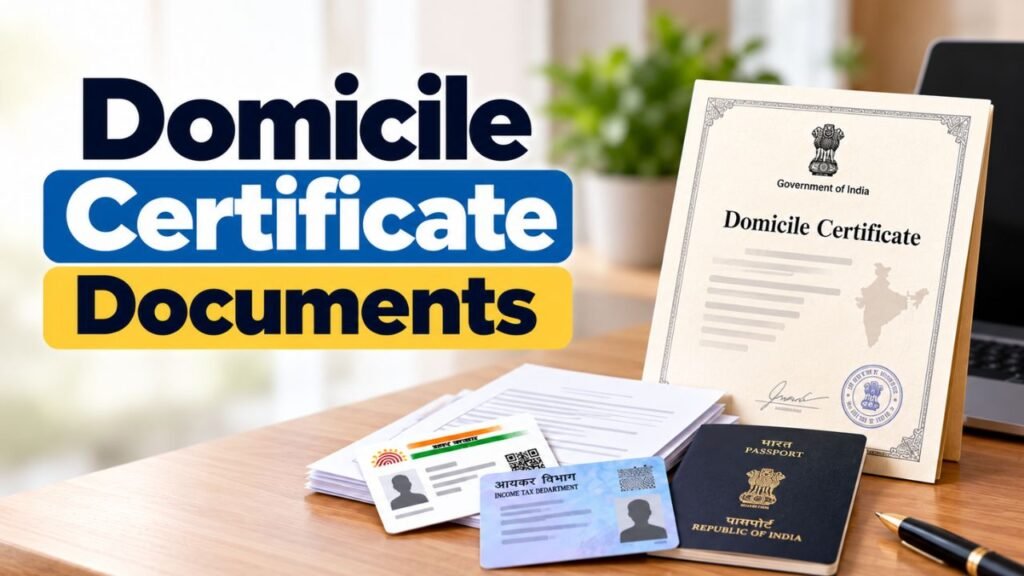
A Domicile Certificate is used to establish that a person is a permanent or long-term resident of a particular State or Union Territory. It may be required for education, government jobs, State-specific schemes, scholarships, admissions, reservations and other services where proof of State residence is required.
The Domicile Certificate Documents Required are not exactly the same across India. Each State or Union Territory can prescribe its own eligibility conditions, residence period, application procedure and supporting documents. Therefore, applicants should check the official portal of the concerned State before submitting an application.
In general, applicants may be asked to provide identity proof, address or residence proof, date-of-birth proof, photographs and documents establishing the required period of residence. Additional documents may be required for minors, applicants who have recently moved to the State, or applicants applying through a parent or guardian.
What Documents Are Required for a Domicile Certificate?
The commonly requested documents include:
- Aadhaar Card
- Voter ID Card
- Passport
- Driving Licence
- Ration Card
- Electricity Bill
- Water Bill
- Telephone Bill
- Registered Rent Agreement
- Bank Passbook
- Birth Certificate
- School Certificate or School Leaving Certificate
- Educational certificate
- Proof of long-term residence
- Passport-size photograph
- Self-declaration or affidavit, where required
- Parent’s documents, in case of a minor
- Other State-specific supporting documents
Not every applicant has to submit all these documents. The final requirement depends on the State, applicant’s circumstances and purpose of the domicile certificate.
Domicile Certificate Documents Required for a New Application
For a standard application, applicants generally need documents that prove three important things:
- Who the applicant is
- Where the applicant lives
- Whether the applicant satisfies the State’s domicile/residence conditions
1. Identity Proof
An identity document establishes the applicant’s identity.
Commonly accepted documents may include:
- Aadhaar Card
- Voter ID
- Passport
- Driving Licence
- PAN Card
- Other government-issued identity documents
The exact list should be checked on the State’s official application portal.
2. Address Proof
Address proof establishes the applicant’s present residential address.
Common documents include:
- Aadhaar Card
- Voter ID
- Passport
- Driving Licence
- Electricity Bill
- Water Bill
- Telephone Bill
- Gas Bill
- Registered Rent Agreement
- Bank Passbook
- Ration Card
- Other government-issued address documents
An address document does not always prove domicile by itself. Some States require additional evidence showing that the applicant has been residing in the State for the prescribed period.
3. Date of Birth Proof
A date-of-birth document may be required to verify the applicant’s personal details.
Depending on the State, this may include:
- Birth Certificate
- School Certificate
- Matriculation Certificate
- Passport
- Other accepted government records
For minors, a birth certificate is often particularly useful because it establishes the applicant’s age and parentage.
4. Passport-Size Photograph
The application may require a recent passport-size photograph.
For online applications, the portal may specify:
- Image format
- File size
- Photograph dimensions
- Background requirements
Always follow the specifications shown on the application form rather than uploading a random image.
Documents Required to Prove Domicile or Long-Term Residence
This is one of the most important parts of a domicile application.
Simply having an Aadhaar Card with a State address does not necessarily mean that an applicant automatically satisfies every State’s domicile requirement.
Depending on the State, applicants may need documents showing residence over a specified period.
Possible documents include:
- Old ration card
- Old voter ID
- School records
- Birth certificate
- Property documents
- Electricity bills from previous years
- Water bills
- Registered rent agreements
- Government employment records
- Educational records
- Parent’s domicile certificate
- Other historical residence documents
The period of residence required varies by State and by the applicable rules.
Is Aadhaar Required for a Domicile Certificate?
Aadhaar is commonly used as an identity and address document, but it should not automatically be treated as a universal mandatory document for every domicile application.
The State authority determines the accepted documents.
For example, Delhi’s official caste-related residence documentation lists Aadhaar among accepted present and permanent address proofs, alongside documents such as Voter ID, Driving Licence, Passport, Ration Card, registered rent agreement, bank passbook and utility bills.
For a domicile application specifically, applicants should follow the document list displayed by their State’s official portal.
Is a Birth Certificate Required for a Domicile Certificate?
A birth certificate can be useful when the applicant needs to establish:
- Date of birth
- Place of birth
- Parent details
- Connection with the State
However, it is not necessarily mandatory in every State.
Some States may accept school certificates, matriculation certificates, passports or other documents instead.
For minors, the birth certificate can be particularly important because the applicant may not have many independent address or identity documents.
Documents Required for a Minor’s Domicile Certificate
A minor may not have enough documents in their own name to prove long-term residence.
In such cases, the State may require:
- Child’s birth certificate
- Aadhaar Card of the child, if available
- Parent’s Aadhaar
- Parent’s address proof
- Parent’s domicile/residence certificate
- School certificate
- Parent’s identity proof
- Other documents establishing the relationship between child and parent
The exact requirements depend on the State’s rules.
The application should clearly establish the relationship between the minor and the parent whose residence documents are being relied upon.
Documents Required for Domicile Certificate Through Parents
Some States allow an applicant to establish domicile through the domicile or residence status of a parent.
Possible documents include:
- Parent’s domicile certificate
- Parent’s Aadhaar
- Parent’s voter ID
- Parent’s ration card
- Birth certificate showing parent-child relationship
- School records
- Other proof of relationship
- Parent’s long-term residence documents
The relationship should be supported by an acceptable document.
Domicile Certificate Documents for Students
Students may require domicile certificates for:
- State quota admissions
- Scholarships
- Government educational schemes
- State-specific entrance processes
- Fee concessions
- Other State benefits
Possible documents include:
- Birth certificate
- School certificate
- Transfer Certificate
- Bonafide certificate
- Parent’s address proof
- Parent’s domicile certificate
- Aadhaar
- Ration card
- Long-term residence proof
Students should check the admission or scholarship authority’s requirements as well because the document needed for admission may be different from the documents needed to obtain the domicile certificate.
Domicile Certificate Documents for Government Jobs
Some State government recruitments may require proof of domicile or permanent residence.
Depending on the recruitment rules, an applicant may need:
- Domicile certificate
- Aadhaar
- Voter ID
- Educational certificates
- Residence proof
- Birth certificate
- Other supporting documents
It is important to distinguish between documents required to apply for a domicile certificate and documents required to claim domicile-based eligibility in a government recruitment.
The recruitment notification should always be checked separately.
Documents Required If You Have Recently Moved to a State
A recent move to a State can create additional documentation requirements.
A current address proof may show where you live now, but the authority may also want evidence of the required period of residence.
Depending on the State, useful supporting records may include:
- Previous address documents
- Current address proof
- School records
- Employment records
- Rent agreements
- Utility bills
- Property documents
- Parent’s domicile documents
- Other evidence of continuous residence
Do not assume that a recently updated Aadhaar address automatically establishes eligibility for a domicile certificate.
Documents Required If You Are Renting a House
Applicants living in rented accommodation may not have an electricity or property document in their own name.
Depending on State rules, possible documents can include:
- Registered rent agreement
- Landlord-related supporting documents, where required
- Electricity bill
- Water bill
- Aadhaar
- Voter ID
- Bank passbook
- Other accepted residence proof
A rent agreement is particularly useful when the applicant needs to establish their present address.
However, the authority may require additional evidence to establish long-term residence.
Is a Rent Agreement Accepted as Domicile Proof?
A rent agreement may be accepted as address or residence proof in some State procedures, but it does not automatically prove that the applicant qualifies as a domicile resident.
The distinction is important:
Address proof: Shows where you currently live.
Domicile proof: Helps establish that you satisfy the State’s legal or administrative conditions for domicile.
The State authority decides whether the submitted documents are sufficient.
Is a Ration Card Required for a Domicile Certificate?
A ration card may be accepted as one form of address or residence evidence in some State procedures, but it is not universally mandatory.
Applicants should not assume that a ration card is required in every State.
If the State portal lists multiple acceptable residence documents, you can generally provide an appropriate alternative from the permitted list.
Is an Affidavit Required for a Domicile Certificate?
An affidavit or self-declaration may be required in some States or specific circumstances.
It may be used to declare:
- Residence details
- Period of stay
- Personal information
- Family information
- Other facts relevant to domicile eligibility
However, an affidavit is not universally required across India.
Do not create an affidavit unless the concerned authority specifically asks for one or its application form includes it as a requirement.
Documents Required for Domicile Certificate in Delhi
Delhi provides domicile-related certificate services through its government e-District system.
The District Administration’s official website lists Issuance of Domicile Certificate among the available forms and directs applicants to the Delhi e-District portal for more information.
Because document requirements can depend on the applicant’s circumstances, Delhi applicants should follow the current requirements displayed by the e-District service.
Commonly relevant documents can include:
- Aadhaar Card
- Voter ID
- Passport
- Driving Licence
- Ration Card
- Address proof
- Birth certificate
- School certificate
- Other residence-related documents
Applicants should not rely only on a general checklist if the e-District portal asks for additional documents.
How to Prepare Documents for Online Application
If the domicile certificate application is submitted online, prepare the documents before starting the application.
Step 1: Check Your State
Find the official domicile certificate service for your State or Union Territory.
Step 2: Read the Document List
Check the current requirements carefully.
Step 3: Collect Identity Proof
Keep one or more accepted identity documents ready.
Step 4: Collect Residence Proof
Choose an address document accepted by the concerned authority.
Step 5: Prepare Domicile Evidence
If the State requires proof of long-term residence, collect older documents showing the required residence period.
Step 6: Scan the Documents
Make sure the scans are:
- Clear
- Complete
- Readable
- Not cropped incorrectly
- Within the permitted file size
- In the required file format
Step 7: Check Information
Names, dates of birth and addresses should be consistent across the application and supporting documents.
Common Document Problems in Domicile Applications
Name Mismatch
If the applicant’s name differs between Aadhaar, school records and other documents, the authority may ask for clarification.
Address Mismatch
An application showing one address while the submitted proof shows another can create verification issues.
Insufficient Residence Proof
A single recent utility bill may not establish the long-term residence period required under a particular State’s rules.
Unclear Scanned Documents
Poor-quality scans can make verification difficult.
Wrong Document Uploaded
Uploading an unrelated document instead of the requested proof can result in an objection.
Missing Parent Documents
For minors or applications relying on parental domicile, parent-related documents may be important.
Do Documents Need to Be Self-Attested?
Whether self-attestation is required depends on the State and the particular service.
Some government applications ask applicants to upload self-attested copies, while others may use online verification or require original documents during physical verification.
Follow the instructions displayed on the official application portal.
Do not add unnecessary attestation by a Gazetted Officer, notary or other authority unless the application specifically requires it.
Do Original Documents Need to Be Submitted?
For online applications, applicants usually upload scanned copies or enter document information.
However, the issuing authority may ask for original documents during verification.
Therefore, keep the original documents safely available until the domicile certificate process is completely finished.
Domicile Certificate Documents Checklist
Before submitting the application, keep the following checklist ready:
- Aadhaar Card
- Identity proof
- Current address proof
- Permanent residence proof, if required
- Birth certificate
- School or educational certificate
- Parent’s domicile certificate, if applicable
- Parent’s identity/address proof, if applicable
- Long-term residence documents
- Ration card, if accepted/required
- Registered rent agreement, if applicable
- Passport-size photograph
- Self-declaration or affidavit, if required
- Other State-specific supporting documents
Domicile Certificate Documents: Important Difference Between States
There is no single document list that can be treated as mandatory throughout India.
For example, Delhi’s official government pages provide specific caste-certificate documentation and distinguish between present address proof, permanent address proof and supporting documents related to paternal relatives and residence history.
This illustrates why applicants should check the rules applicable to their own State instead of copying a document checklist from another State.
Frequently Asked Questions
Conclusion
The Domicile Certificate Documents Required depend on the State or Union Territory and the applicant’s circumstances. In most cases, applicants should be prepared with identity proof, address proof, date-of-birth documents and evidence supporting the required period of residence. Additional documents may be necessary for minors, students, applicants relying on parental domicile or people who have recently moved to the State.
The most important step is to check the current requirements of the concerned State before submitting the application. A recent address document alone may not always establish domicile because some States have separate conditions relating to the duration and nature of residence.
For more practical guides on government certificates and online citizen services, visit Sarkari Bakery.
Based on Google's Helpful Content System, this article emphasizes user value, transparency, and accuracy. It incorporates principles of E-E-A-T (Experience, Expertise, Authoritativeness, Trustworthiness).
Why Choose Sarkari Bakery?
Official Information
Government schemes & banking information based on official sources.
Step-by-Step Guides
Simple application process explained for every service.
Regular Updates
Content updated whenever official rules or services change.
People-First Content
Helpful, transparent and user-focused content.