
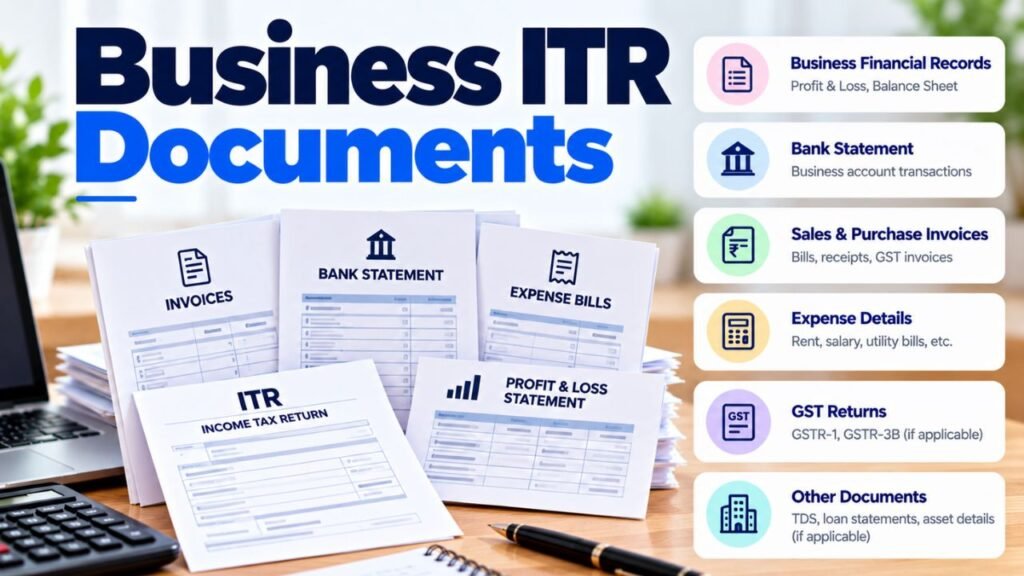
Filing an Income Tax Return for business income requires more preparation than filing a simple salary return. A business owner may have sales receipts, purchase expenses, bank transactions, GST records, TDS, loans, fixed assets, depreciation, employee payments and several other financial transactions during the year.
Having the correct Business ITR Documents ready helps you calculate business income accurately, reconcile your tax credits and support the figures reported in your Income Tax Return.
The documents required depend on the nature and size of the business, the applicable ITR form, the accounting method being followed and whether the taxpayer uses regular taxation or a presumptive taxation scheme.
For AY 2026–27, the Income Tax Department states that ITR-3 applies to individuals and HUFs having income from profits and gains of business or profession who are not eligible to use ITR-1, ITR-2 or ITR-4. ITR-4 is available to eligible resident individuals, HUFs and firms other than LLPs having business or professional income computed under presumptive taxation under sections such as 44AD, 44ADA or 44AE, subject to the applicable conditions.
What Are Business ITR Documents?
Business ITR Documents are the financial, tax and supporting records used to calculate business income and prepare the Income Tax Return.
Depending on the business, these may include:
- PAN and Aadhaar details
- Sales invoices
- Purchase invoices
- Bank statements
- Cash book
- Ledger accounts
- Profit and loss statement
- Balance sheet
- Books of account
- Expense bills
- GST returns
- GST sales and purchase records
- Form 16A
- Form 26AS
- AIS
- TDS records
- Advance tax challans
- Self-assessment tax challans
- Loan statements
- Fixed-asset invoices
- Depreciation records
- Salary and employee-payment records
- Rent and office-expense records
- Previous ITR
- Audit report, where applicable
Not every business needs every document.
A small shop using presumptive taxation may have a relatively simple record-keeping requirement, while a business maintaining regular books may need detailed accounting records.
Business ITR Documents Checklist
| Document | Main Purpose |
|---|---|
| PAN | Tax identification |
| Aadhaar | Identity and e-verification |
| Sales Invoices | Business revenue |
| Purchase Bills | Cost and expense records |
| Bank Statements | Income and transaction reconciliation |
| Cash Book | Cash transactions |
| Ledger | Account-wise transaction records |
| Profit & Loss Statement | Business profit calculation |
| Balance Sheet | Financial position |
| GST Returns | GST and turnover reconciliation |
| Form 16A | TDS on non-salary income |
| Form 26AS | TDS/TCS verification |
| AIS | Broader tax and financial information |
| Expense Bills | Supporting business expenses |
| Loan Statements | Interest and outstanding liability |
| Fixed Asset Invoices | Asset records |
| Depreciation Schedule | Depreciation calculation |
| Advance Tax Challans | Tax-payment verification |
| Previous ITR | Reference and continuity |
| Audit Report | Where tax audit applies |
1. PAN Card and Aadhaar Details
PAN is one of the basic details required for filing an Income Tax Return.
Before filing, check that the PAN used in your:
- Business records
- Bank account
- GST records
- TDS records
- Form 26AS
- AIS
- Income Tax e-Filing account
is correct.
Aadhaar may also be relevant for identity verification and e-verification.
Check your name, date of birth and other personal information before submitting the return.
2. Sales Invoices
Sales invoices are among the most important Business ITR Documents.
They help establish the amount of revenue generated by the business.
Maintain records showing:
- Invoice number
- Invoice date
- Customer name
- Product or service
- Quantity, where applicable
- Taxable value
- GST, where applicable
- Total invoice value
- Payment status
For example, suppose a business issued 500 invoices during the financial year.
The business should have a reliable system for determining the total sales rather than calculating turnover from memory or looking only at the bank account.
This becomes particularly important when customers make payments after the invoice date or when some sales are made in cash.
3. Purchase Bills
Purchase invoices and bills help establish the cost of goods and other business expenses.
Depending on the business, purchase records may include:
- Inventory purchases
- Raw materials
- Packaging material
- Office supplies
- Equipment
- Business services
- Professional services
- Repairs and maintenance
Keep the original invoices or reliable digital copies.
If GST is involved, ensure the GST information is also properly recorded.
4. Bank Statements
Business bank statements are extremely useful for reconciling business transactions.
They can help identify:
- Customer receipts
- Supplier payments
- Bank charges
- Loan payments
- Interest
- Salary payments
- GST payments
- Tax payments
- Business expenses
However, a bank statement should not automatically be treated as a profit-and-loss statement.
A bank account may contain transactions that are not business income, such as:
- Capital introduced by the owner
- Loan received
- Transfer from another account
- Refund
- Security deposit
- Personal transaction
Similarly, not every bank debit is automatically a deductible business expense.
You should classify transactions according to their actual nature.
The Income Tax Department also identifies bank statements among the records taxpayers may need while preparing ITRs.
5. Cash Book
Businesses that handle cash should maintain proper records of cash receipts and payments.
A cash book can help track:
- Cash sales
- Cash purchases
- Office expenses
- Travel expenses
- Petty cash
- Cash deposited into bank
- Cash withdrawn from bank
A common problem occurs when the business records cash sales but does not maintain corresponding cash records.
Maintaining a consistent cash book makes the figures easier to reconcile.
6. Ledger Accounts
A ledger provides an account-wise record of transactions.
Depending on the business, ledgers may include:
- Sales ledger
- Purchase ledger
- Customer ledger
- Supplier ledger
- Salary ledger
- Rent ledger
- Bank ledger
- Loan ledger
- Expense ledger
- Fixed-asset ledger
A properly maintained ledger makes it easier to prepare the profit and loss statement and identify unusual transactions.
7. Profit and Loss Statement
A business earning income under the regular accounting method should maintain appropriate financial records.
A profit and loss statement generally helps determine:
Revenue − Allowable Business Expenses = Business Profit
The exact calculation can be more complex depending on the business, accounting method and applicable tax provisions.
The profit and loss statement may contain:
- Sales
- Other business income
- Purchases
- Employee expenses
- Rent
- Electricity
- Professional fees
- Advertising
- Repairs
- Depreciation
- Interest
- Other applicable expenses
Do not simply take the total amount credited into your bank account and call it business profit.
8. Balance Sheet
Depending on the applicable requirements, a business maintaining regular books may need a balance sheet or financial-position information.
It may include:
Assets
- Cash
- Bank balance
- Inventory
- Receivables
- Equipment
- Furniture
- Vehicles
- Other assets
Liabilities
- Business loans
- Trade payables
- Other liabilities
- Outstanding expenses
Capital
- Owner’s capital
- Drawings
- Retained business balance
The balance sheet helps provide a broader picture of the business’s financial position.
9. GST Returns and GST Records
If your business is registered under GST, maintain relevant GST records.
These may include:
- GST registration details
- GSTR-1
- GSTR-3B
- Other applicable GST returns
- Sales register
- Purchase register
- GST invoices
- Input tax credit records
- GST payment challans
- Credit notes
- Debit notes
GST turnover and income-tax turnover should be properly reconciled.
A difference does not necessarily mean that one of the returns is wrong because GST and income-tax reporting can have different concepts and timing considerations. However, significant unexplained differences should be investigated.
10. Form 16A
Business owners may receive or have TDS deducted on certain payments, depending on the nature of the transaction.
Form 16A is a quarterly TDS certificate for income other than salary. The Income Tax Department identifies Form 16A as containing information such as the amount credited, TDS amount, nature of payment and TDS deposited.
For example, professional or contractual receipts may have TDS deducted by the payer.
Keep the relevant Form 16A and reconcile the TDS with your books and tax records.
11. Form 26AS
Form 26AS should be checked before filing the business ITR.
It is particularly useful for verifying TDS and TCS information.
The Income Tax Department currently provides Form 26AS through the e-Filing portal under:
Login → e-File → Income Tax Return → View Form 26AS
The Department’s current business/profession guidance identifies Form 26AS as a source of TDS/TCS information.
If your books show TDS of ₹40,000 but Form 26AS shows a different amount, investigate the difference before filing.
You can also read the detailed guide on Form 26AS.
12. Annual Information Statement (AIS)
AIS provides broader information reported against your PAN.
It can include:
- TDS/TCS
- Specified Financial Transactions
- Tax payments
- Refunds
- Demands
- Other reported information
The Income Tax Department’s AY 2026–27 guidance identifies AIS as containing broader information such as TDS/TCS, SFT information, tax payments, demand/refund and other information.
Business owners should review AIS before filing rather than relying only on their accounting software.
You can learn more about AIS Income Tax and AIS vs Form 26AS.
13. Expense Bills
Business expenses should be supported by appropriate records.
Depending on your business, these could include:
- Rent
- Electricity
- Telephone
- Internet
- Advertising
- Professional fees
- Repairs
- Office supplies
- Transportation
- Insurance
- Software
- Business travel
- Packaging
- Delivery charges
Do not claim an expense simply because money was withdrawn from the business bank account.
The underlying nature of the payment matters.
For example, a ₹30,000 payment to a supplier may be a genuine business purchase, while a ₹30,000 personal purchase made using the same account is not automatically a business expense.
14. Employee Salary Records
If your business has employees, retain relevant salary records.
These may include:
- Salary register
- Payroll records
- Employee payment details
- TDS records
- Salary-related challans
- Applicable statutory payment records
If TDS has been deducted from employee salaries, the corresponding compliance records should also be maintained.
15. Rent and Office Expense Records
If you operate from a rented office, retain:
- Rent agreement
- Rent receipts
- Bank payment records
- Landlord details
- Applicable TDS records
For a business operating from a home, do not automatically treat the entire household rent or utility bill as a business expense.
The actual tax treatment depends on the circumstances and applicable provisions.
16. Loan Statements
If the business has taken a loan, keep the lender’s statement.
It can help separate:
- Principal repayment
- Interest
- Outstanding loan
- Bank charges
This distinction matters because repayment of loan principal and interest may have different tax and accounting treatment.
Loan statements are also useful when preparing the financial statements and reconciling bank transactions.
17. Fixed Asset Purchase Invoices
Businesses often purchase assets such as:
- Computers
- Machinery
- Furniture
- Vehicles
- Office equipment
- Tools
- Production equipment
Keep the original purchase invoices and payment records.
For tax purposes, the treatment of capital assets can differ from ordinary business expenses.
Therefore, do not automatically claim the entire purchase price as a normal expense.
The appropriate treatment may involve depreciation or other applicable provisions.
18. Depreciation Records
If your business maintains regular books and has depreciable assets, maintain an appropriate fixed-asset schedule.
It can contain:
- Asset name
- Purchase date
- Original cost
- Date put to use
- Depreciation
- Written-down value
- Sale/disposal details
This helps prevent repeated or incorrect depreciation claims.
19. Inventory Records
Businesses selling physical products should maintain inventory information where applicable.
Records may include:
- Opening stock
- Purchases
- Sales
- Closing stock
- Quantity
- Cost
- Stock adjustments
For example, a retailer cannot accurately determine business results simply by adding all purchases and subtracting bank payments.
Inventory remaining at the end of the year can affect the calculation.
20. Advance Tax Challans
Business owners may have advance-tax obligations depending on their tax liability.
If advance tax has been paid, keep the relevant challans and verify that the payments are properly reflected in the tax records.
Before filing, reconcile:
Advance Tax Paid + TDS/TCS Credit + Other Eligible Tax Credits
with the tax calculation.
21. Self-Assessment Tax Challan
If additional tax is payable while filing the return, the taxpayer may need to pay self-assessment tax.
Keep the challan details, including:
- BSR code or applicable payment reference
- Challan serial/reference
- Date
- Amount
- Assessment year
The payment should also be correctly reflected while preparing the ITR.
22. Previous ITR and ITR-V
Keep previous Income Tax Returns and ITR-V acknowledgements.
These records can help with:
- Previous-year income
- Business details
- Brought-forward losses
- Tax payments
- Depreciation records
- Bank details
- Other disclosures
Previous returns should be used for reference, not blindly copied into the current year’s return.
Business ITR Documents Under Presumptive Taxation
Some eligible businesses may use presumptive taxation.
For AY 2026–27, ITR-4 can be used by eligible taxpayers with business or professional income computed under sections 44AD, 44ADA or 44AE, subject to the applicable conditions. The Income Tax Department states that the presumptive scheme is intended to reduce the compliance burden for eligible small taxpayers.
For example:
- Section 44AD can apply to eligible businesses.
- Section 44ADA can apply to eligible specified professionals.
- Section 44AE relates to eligible businesses involving goods carriages, subject to its conditions.
Using presumptive taxation does not mean that business owners should stop maintaining basic records.
You should still maintain evidence of:
- Gross receipts
- Client/customer payments
- Bank transactions
- TDS
- Tax payments
- Major business transactions
For AY 2026–27, the Income Tax Department states that ITR-4 is available where total income does not exceed ₹50 lakh and the applicable presumptive-taxation conditions are satisfied.
Business ITR Documents for Regular Accounting
Businesses that do not use presumptive taxation may need much more detailed financial records.
Depending on the business and applicable requirements, this may include:
- Books of account
- Cash book
- Ledger
- Sales register
- Purchase register
- Stock records
- Debtor records
- Creditor records
- Profit and loss statement
- Balance sheet
- Fixed-asset schedule
- Depreciation schedule
- Bank reconciliation
- GST reconciliation
The Income Tax Department provides ITR-3 for individuals and HUFs having income from profits and gains of business or profession where ITR-3 is applicable.
Business ITR Documents for Tax Audit Cases
Some businesses may fall under tax-audit requirements depending on turnover, receipts, income and other applicable conditions.
If tax audit provisions apply, additional records and audit-related documents may be required.
These may include:
- Books of account
- Financial statements
- Audit report
- Tax-audit information
- Supporting schedules
- GST reconciliation
- TDS records
- Fixed-asset details
- Stock information
Do not assume that every business needs a tax audit. The applicability depends on the specific facts and the provisions applicable to the relevant financial year.
How to Reconcile Business Income Before Filing ITR
A good reconciliation process can prevent many errors.
Step 1: Calculate total sales or receipts
Start with your sales register, invoices and other business receipts.
Step 2: Compare with bank statements
Match customer receipts with bank credits.
Step 3: Check cash transactions
Reconcile cash sales and cash expenses with the cash book.
Step 4: Review GST records
Where GST applies, compare relevant turnover figures and investigate material differences.
Step 5: Check Form 26AS
Verify TDS and TCS.
Step 6: Review AIS
Look for reported financial information that may affect your return.
Step 7: Review expenses
Check supporting bills for business expenses.
Step 8: Review loans
Separate loan receipts and repayments from normal business transactions.
Step 9: Check fixed assets
Verify purchases and depreciation records.
Step 10: Check tax payments
Reconcile advance tax and self-assessment tax.
Step 11: Select the appropriate ITR
Determine whether ITR-3, ITR-4 or another applicable return is required.
Step 12: Verify the return
After filing, complete the applicable verification process.
Common Business ITR Document Mistakes
1. Treating bank credits as total business income
A bank statement contains many types of transactions.
Loans, capital introduced and transfers between accounts should not automatically be classified as sales.
2. Ignoring cash sales
If your business accepts cash, those transactions need to be properly recorded.
3. Not reconciling GST and books
Large unexplained differences can create questions later.
4. Ignoring TDS
Business owners sometimes focus on sales and expenses while forgetting to claim or reconcile TDS.
5. Not checking AIS
AIS may contain information that is not immediately visible in your accounting software.
6. Claiming personal expenses
Business and personal expenses should be properly distinguished.
7. Not maintaining purchase invoices
A business should maintain proper supporting records for significant purchases and expenses.
8. Treating capital expenditure as an ordinary expense
A computer, machine or other asset may require different tax treatment from a routine business expense.
9. Ignoring loans
Loan receipts can significantly affect bank balances but are not necessarily business revenue.
10. Filing the wrong ITR
The applicable ITR depends on the taxpayer’s income sources and circumstances.
Do Businesses Need to Upload All Documents With ITR?
Not necessarily.
The fact that you maintain business records does not mean that every invoice, purchase bill or bank statement must automatically be uploaded with the ITR.
However, maintaining supporting records is extremely important.
The documents may be required later if the Income Tax Department seeks clarification, conducts an assessment or asks for supporting evidence.
Therefore:
Do not upload unnecessary documents simply because you have them, but do not discard them simply because you did not upload them.
How to Organise Business ITR Documents
Create a separate folder for each financial year.
For example:
FY 2025–26 / AY 2026–27
Keep separate subfolders for:
Income
- Sales invoices
- Receipts
- Customer ledger
- Platform statements
Expenses
- Purchase invoices
- Rent
- Utilities
- Advertising
- Professional fees
- Other business expenses
Tax
- Form 26AS
- AIS
- TDS certificates
- GST returns
- Advance-tax challans
- Self-assessment tax challans
Banking
- Bank statements
- Bank reconciliation
- Loan statements
Accounts
- Ledger
- Cash book
- Profit and loss
- Balance sheet
- Stock records
- Fixed assets
Previous Records
- Previous ITR
- ITR-V
- Audit report, where applicable
This system makes tax filing much easier and reduces the risk of missing important records.
Business ITR Documents: Final Checklist
Before filing your business ITR, check:
- PAN verified
- Aadhaar details verified
- Sales invoices collected
- Purchase invoices collected
- Bank statements downloaded
- Cash book reconciled
- Ledgers reviewed
- Sales register checked
- Purchase register checked
- Inventory records checked, where applicable
- Profit and loss statement prepared
- Balance sheet prepared, where applicable
- GST returns reconciled, where applicable
- Form 16A collected
- Form 26AS checked
- AIS checked
- Expense bills retained
- Loan statements checked
- Fixed-asset records checked
- Depreciation reviewed
- Employee-payment records checked
- Advance-tax payments verified
- Self-assessment tax verified
- Previous ITR retained
- Audit requirements checked, where applicable
- Correct ITR form identified
- Tax regime reviewed
- Bank account details verified
- ITR submitted and verified
Conclusion
The required Business ITR Documents depend on the size and nature of your business, accounting method, applicable tax provisions and the ITR form you are eligible to file.
A small eligible business using presumptive taxation may have a simpler compliance process, while a business maintaining regular books may need detailed sales, purchase, inventory, expense, banking and financial-statement records.
Before filing, do not rely on a single source of information. Reconcile your books with bank statements, GST records where applicable, Form 26AS, AIS and tax-payment records.
The most important documents are those that allow you to explain where your business income came from, how your expenses were calculated and how the tax shown in your return was determined.
For more practical guides on income tax, ITR documents and government services, visit Sarkari Bakery.
FAQs
Based on Google's Helpful Content System, this article emphasizes user value, transparency, and accuracy. It incorporates principles of E-E-A-T (Experience, Expertise, Authoritativeness, Trustworthiness).
Why Choose Sarkari Bakery?
Official Information
Government schemes & banking information based on official sources.
Step-by-Step Guides
Simple application process explained for every service.
Regular Updates
Content updated whenever official rules or services change.
People-First Content
Helpful, transparent and user-focused content.