
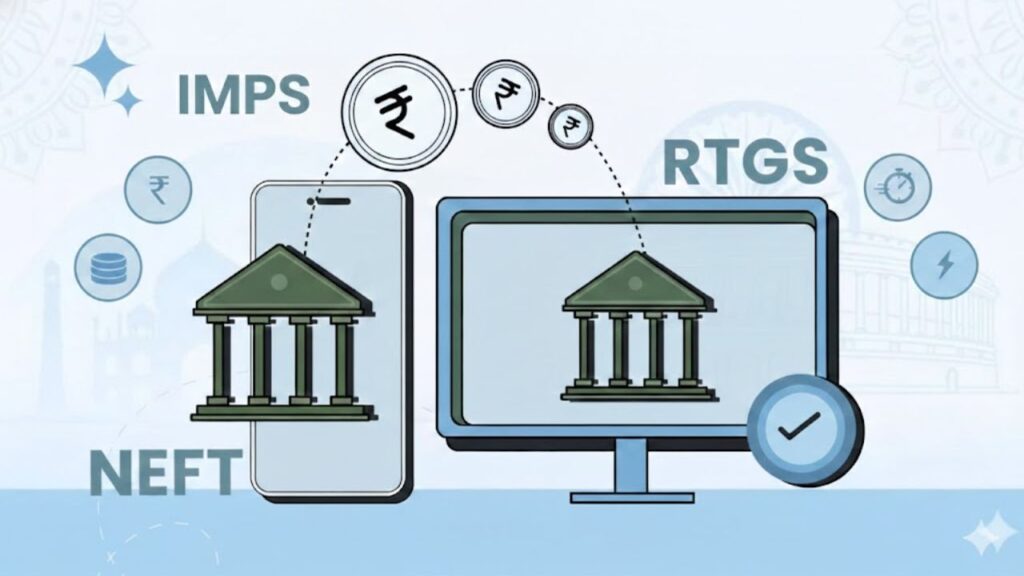
When transferring money online in India, most people choose between NEFT, RTGS, and IMPS. While all three methods allow electronic fund transfers 24×7, they differ in speed, minimum limits, settlement type, and ideal use cases.
Choosing the wrong method can result in delays, unnecessary charges, or failed transactions. This guide clearly explains the difference between NEFT, RTGS and IMPS, so you can select the right option every time.
⭐ Quick Comparison: NEFT vs RTGS vs IMPS
| Feature | NEFT | RTGS | IMPS |
|---|---|---|---|
| Full Form | National Electronic Funds Transfer | Real-Time Gross Settlement | Immediate Payment Service |
| Settlement Type | Batch-based | Real-time (gross) | Real-time |
| Minimum Limit | ₹1 | ₹2 lakh | ₹1 |
| Maximum Limit | No upper limit | No upper limit | ₹5 lakh (bank-dependent) |
| Availability | 24×7 | 24×7 | 24×7 |
| Best For | Routine payments | High-value urgent transfers | Instant personal transfers |
| Managed By | RBI | RBI | NPCI |
⭐ What Are the Full Forms?
🔹 NEFT
National Electronic Funds Transfer
It is a batch-based electronic fund transfer system regulated by RBI. Transactions are processed in batches, which means they may take some time to settle.
🔹 RTGS
Real-Time Gross Settlement
Funds are transferred individually and settled in real-time. Used mainly for high-value urgent payments.
🔹 IMPS
Immediate Payment Service
An instant fund transfer system managed by NPCI. Designed for immediate transfers using mobile or internet banking.
⭐ Transfer Limits Explained
Understanding limits is crucial before initiating a transaction.
🔹 NEFT Limit
- Minimum: ₹1
- Maximum: No limit
- Indo-Nepal cash remittance limit: ₹50,000
Suitable for small to large transfers without urgency.
🔹 RTGS Limit
- Minimum: ₹2,00,000
- Maximum: No limit
Best for high-value business transactions like property purchases.
🔹 IMPS Limit
- Minimum: ₹1
- Maximum: ₹5,00,000 (may vary by bank)
Ideal for instant personal transfers.
⭐ Charges Comparison
Charges vary based on whether the transaction is online or offline.
🔹 NEFT Charges
- Online transfers: Usually free
- Offline (branch-based): ₹2.50 to ₹25 + GST
🔹 RTGS Charges
- Online transfers: Usually free
- Offline: ₹25 to ₹50 + GST
🔹 IMPS Charges
- ₹2.50 to ₹15 + GST (bank-dependent)
IMPS may have slightly higher charges for instant processing.
⭐ Timings: Are They Really 24×7?
Yes, all three systems now operate 24×7, including weekends and holidays.
However:
- NEFT: Processes in half-hourly batches.
- RTGS: Real-time settlement.
- IMPS: Instant credit within seconds.
For immediate transfers, IMPS and RTGS are preferable.
⭐ How Settlement Works (Important Difference)
🔹 NEFT – Batch Settlement
Transactions are grouped and processed together. This can take 30 minutes to 2 hours.
🔹 RTGS – Gross Settlement
Each transaction is processed individually and immediately.
🔹 IMPS – Instant Settlement
Money is credited instantly within seconds.
⭐ When Should You Use NEFT?
Choose NEFT if:
✔ The payment is not urgent
✔ You are paying rent, fees, or vendor invoices
✔ You want minimal charges
✔ You prefer flexibility (online or branch visit)
Examples:
- Salary transfers
- Utility bill payments
- Scheduled business payments
⭐ When Should You Use RTGS?
Choose RTGS if:
✔ You are transferring ₹2 lakh or more
✔ The transaction must be settled immediately
✔ You are handling high-value business payments
Examples:
- Property purchase
- Corporate fund settlement
- Large supplier payments
⭐ When Should You Use IMPS?
Choose IMPS if:
✔ You need instant transfer anytime
✔ It’s a weekend or bank holiday
✔ Amount is within ₹5 lakh limit
✔ You prefer mobile banking
Examples:
- Emergency medical payments
- Sending money to family urgently
- Repaying a friend instantly
⭐ Things to Consider Before Transferring Money
Before choosing between NEFT, RTGS, or IMPS:
✔ Check Transfer Amount
- Below ₹2 lakh → NEFT or IMPS
- Above ₹2 lakh → RTGS
✔ Check Urgency
- Instant needed → IMPS or RTGS
- Not urgent → NEFT
✔ Verify Beneficiary Details
Incorrect account number or IFSC can delay or misroute funds.
✔ Understand Charges
Online NEFT/RTGS are often free. IMPS may attract small charges.
✔ GST
18% GST applies on transaction charges.
⭐ Practical Example for Better Understanding
Suppose:
- You need to send ₹8,000 to a friend on Sunday → IMPS is best.
- You need to pay ₹1,50,000 to a vendor → NEFT works fine.
- You need to transfer ₹10 lakh for property booking → RTGS is ideal.
⭐ Common Mistakes to Avoid
❌ Using RTGS for small amounts below ₹2 lakh
❌ Choosing NEFT for urgent payments
❌ Ignoring daily IMPS limits
❌ Entering incorrect IFSC codes
❌ Not saving transaction reference numbers
⭐ Security & Reliability
All three systems are:
✔ Secure
✔ RBI/NPCI regulated
✔ Widely accepted across Indian banks
Funds are traceable through UTR (Unique Transaction Reference) number.
🔚 Conclusion
NEFT, RTGS, and IMPS each serve different purposes.
- NEFT is ideal for routine and non-urgent payments.
- RTGS is best for high-value urgent transfers above ₹2 lakh.
- IMPS is perfect for instant personal transfers anytime.
Understanding the difference between NEFT, RTGS and IMPS helps you avoid delays, reduce charges, and choose the most efficient payment method.
For more simplified banking and finance guides, visit Sarkari Bakery.