
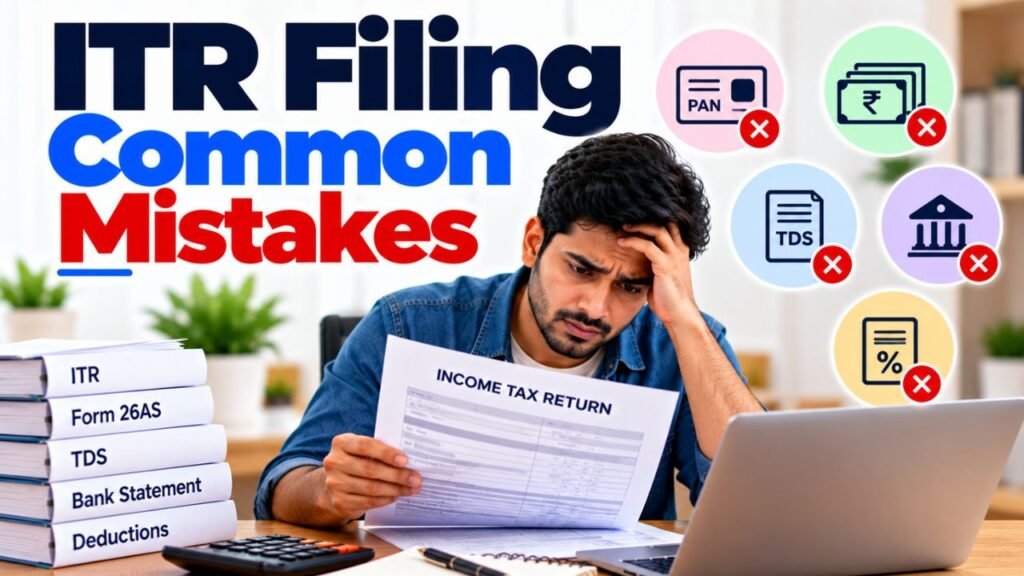
Filing an Income Tax Return (ITR) is not simply a matter of entering your salary or income and submitting the form. A small mistake in income details, tax regime selection, bank information, TDS, deductions, or verification can create problems later.
Some mistakes may result in an incorrect tax calculation, while others can lead to a lower refund, additional tax liability, delayed processing, difficulty in claiming deductions, or the need to file a revised return.
The Income Tax Department itself advises taxpayers to carefully select the tax regime, check AIS and Form 26AS, reconcile TDS and tax payments, verify pre-filled information, select the correct ITR form, provide complete income and deduction details, and file the return within the applicable deadline.
Before filing, taxpayers should also keep their supporting records ready. These can include Form 16, Form 16A, Form 26AS, AIS, salary slips, bank statements, interest certificates, investment documents, rent receipts and other relevant records depending on the type of income and deductions claimed. ITR forms are generally annexure-less, meaning these documents normally do not have to be attached to the return, but they should be retained for future reference or if the tax authorities require them.
Why Avoiding ITR Filing Mistakes Matters
An incorrect ITR does not always result in an immediate error message on the Income Tax portal.
Some mistakes can pass through the initial filing stage and become visible later during processing or when the information reported by different sources does not match.
For example:
- Salary reported in the ITR does not match Form 16.
- TDS claimed does not match Form 26AS.
- Interest income visible in AIS is not reported.
- A wrong bank account is selected for refund.
- A taxpayer selects an incorrect ITR form.
- A deduction is claimed without meeting its conditions.
- The wrong financial year or Assessment Year is selected.
- The return is filed but not verified.
- Capital gains are omitted from the return.
- Income from freelancing or a side business is not reported.
- Tax regime is selected without comparing the final tax liability.
These mistakes can create unnecessary follow-up work.
1. Choosing the Wrong ITR Form
One of the most important ITR Filing Common Mistakes is selecting the wrong return form.
Different ITR forms are designed for different taxpayers and types of income.
For example, a salaried taxpayer with relatively straightforward income may be eligible for ITR-1 subject to the applicable conditions. A taxpayer with certain capital gains, multiple house properties, foreign assets or other specified income may need another form. Business or professional income can require ITR-3 or, where eligible under the presumptive taxation provisions, ITR-4.
The correct form depends on the taxpayer’s complete income profile rather than simply their occupation.
Before filing, check:
- Salary income
- Interest income
- Rental income
- Capital gains
- Business income
- Professional income
- Foreign income or assets
- Agricultural income
- Investments
- Losses
- Other applicable sources
The Income Tax Department specifically advises taxpayers to identify the correct ITR form from ITR-1 to ITR-7.
2. Confusing Financial Year and Assessment Year
Many taxpayers confuse Financial Year (FY) with Assessment Year (AY).
The Financial Year is the year in which the income is earned.
The Assessment Year is the year in which that income is reported and assessed for tax purposes.
For example, income earned during FY 2025-26 is generally reported in AY 2026-27.
Selecting the wrong Assessment Year can result in filing the return for a different period from the one intended.
Always check the year carefully before entering income details.
The Income Tax Department also lists confusion between AY and FY among the mistakes taxpayers should avoid.
3. Selecting the Tax Regime Without Comparing Tax Liability
Choosing the tax regime without checking the actual tax calculation is another common mistake.
A taxpayer should not assume that one regime is automatically better for everyone.
The appropriate choice can depend on factors such as:
- Salary structure
- Eligible deductions
- Exemptions
- Home loan interest
- Investments
- Insurance premiums
- Rent-related eligibility
- Other applicable deductions and exemptions
- Total taxable income
The Income Tax Department specifically advises taxpayers to select the tax regime carefully.
Do not make the decision simply because a colleague, friend or family member selected a particular regime.
Your tax position can be different.
4. Not Checking AIS Before Filing
The Annual Information Statement (AIS) is an important source of information for taxpayers.
AIS can contain information relating to various financial transactions and tax-related information reported to the Income Tax Department.
Before filing, compare relevant AIS information with your own records.
For example, check:
- Interest income
- TDS/TCS
- Securities transactions
- Tax payments
- Other reported financial information
- Other information appearing in AIS
If something looks incorrect, do not blindly copy it into the ITR.
First understand the transaction and, where appropriate, contact the relevant reporting entity or submit feedback through the available AIS facility.
You can also learn how to check AIS online before filing your return.
5. Ignoring Form 26AS
Form 26AS is another important document to check before filing.
It primarily contains tax credit information such as TDS/TCS-related information under the current system, while AIS provides broader information. The Income Tax Department advises taxpayers to download and check both AIS and Form 26AS and reconcile discrepancies with the employer, tax deductor or bank where required.
For example, suppose your employer deducted ₹40,000 as TDS but the tax credit available in your records does not match.
Do not simply enter ₹40,000 and assume everything will be accepted.
First identify the reason for the mismatch.
You can refer to the guide on Form 26AS for more information.
6. Claiming TDS That Is Not Reflected Correctly
TDS is one of the areas where mistakes can directly affect your tax calculation and refund.
A taxpayer may claim TDS based on:
- Form 16
- Form 16A
- Form 26AS
- AIS
- Other relevant tax records
If the TDS reported by the employer or deductor is incorrect or missing, the taxpayer should get the discrepancy corrected rather than assuming that the ITR itself will automatically fix the issue.
Before submitting the return, compare:
Income reported → TDS deducted → Form 16/16A → Form 26AS → AIS → ITR
If TDS credit is missing, you can also refer to the guide on TDS credit not showing.
7. Forgetting Interest Income
Many taxpayers remember salary or business income but forget interest earned from bank accounts, fixed deposits, recurring deposits and other sources.
Interest may be reported through different information channels.
Check your:
- Savings account statements
- Fixed deposit statements
- Interest certificates
- Bank passbook
- AIS
- Form 26AS where applicable
Do not assume that a small amount of interest can simply be ignored.
A taxpayer may have several bank accounts, and the combined interest can become significant.
8. Not Checking Bank Statements
Bank statements are useful for reconciling income and identifying transactions that may have tax implications.
The Income Tax Department recommends studying bank statements or passbooks, interest certificates and other relevant documents while preparing the return.
You can use your bank statement to identify:
- Interest received
- Salary credits
- Business receipts
- Freelance payments
- Investment transactions
- Loan-related transactions
- Large financial transactions
- Other income
However, remember that every bank credit is not automatically taxable income.
Transfers between your own accounts, loan receipts, certain refunds, capital introduced into a business and other non-income transactions need to be properly distinguished from actual income.
For detailed preparation, see Bank Statement for ITR.
9. Forgetting Freelance or Side Income
A taxpayer may have a full-time job and still earn money from:
- Freelancing
- Consulting
- Online services
- Content creation
- Affiliate income
- Commission
- Part-time work
- Professional services
- Online platforms
A common mistake is to report only salary and ignore additional income.
The correct treatment depends on the nature of the income and the applicable provisions.
Before filing, review all sources of income rather than looking only at Form 16.
10. Not Reporting Capital Gains
Capital gains can arise from transactions involving assets such as:
- Shares
- Mutual funds
- Property
- Other capital assets
Taxpayers sometimes assume that the broker or investment platform has already reported the transaction, so nothing needs to be entered into the ITR.
That is not a safe approach.
Information reported by a broker or financial institution can help with reconciliation, but the taxpayer remains responsible for filing an accurate return.
Check your transaction statements and relevant tax records before filing.
11. Claiming Deductions Without Checking Eligibility
Another major mistake is claiming deductions simply because a taxpayer made a payment.
Not every expense automatically qualifies for a deduction.
Before claiming a deduction, check:
- Whether the deduction is applicable to you
- Whether the payment qualifies
- Whether the required conditions are satisfied
- Whether the selected tax regime allows the deduction
- Whether the amount is within the applicable limit
- Whether you have supporting documents
Keep receipts, certificates and other evidence safely even though ITR forms are generally annexure-less.
The Income Tax Department specifically advises taxpayers to retain supporting documents for situations such as assessment or inquiry.
12. Entering Incorrect PAN or Personal Details
Pre-filled information should not be accepted blindly.
Check:
- PAN
- Name
- Address
- Mobile number
- Email address
- Date of birth
- Bank details
- Other personal information
The Income Tax Department specifically advises taxpayers to verify PAN, permanent address, contact details and bank account information in the pre-filled data.
A small spelling or account-number error can create problems later.
13. Entering the Wrong Bank Account for Refund
If your return results in a refund, bank-account details become particularly important.
Before filing, check:
- Account number
- IFSC
- Account status
- Account holder details
- Whether the account is eligible and validated
- Whether the correct account is nominated for refund
The Income Tax Department advises taxpayers to pre-validate their bank account so that any refund due can be credited properly.
If your bank details have changed, review the available bank-account management options before submitting the return.
You can also read ITR Bank Account Change for the detailed process.
14. Forgetting Previous-Year Losses or Carry-Forward Details
Taxpayers with eligible losses may need to report and carry them forward according to the applicable provisions and deadlines.
A mistake in entering previous-year loss information can affect future tax calculations.
If you have:
- Capital losses
- Business losses
- Other eligible losses
review your previous ITRs and relevant tax records before filing the current return.
Do not enter an old loss figure from memory.
15. Filing the Return Without Reviewing the Preview
Some taxpayers enter information and immediately click submit.
This can be risky.
Before final submission, review the return carefully.
Check:
- Total income
- Salary
- Interest income
- Capital gains
- Business/professional income
- Deductions
- Exempt income
- TDS
- Advance tax
- Self-assessment tax
- Refund or tax payable
- Bank details
- Personal details
The Income Tax portal also performs validation checks before submission. Where errors are displayed, taxpayers should return to the relevant section and correct them before proceeding.
16. Filing After the Due Date Without Understanding the Consequences
Another important mistake is assuming that filing late has no consequences.
The Income Tax Department warns that delayed filing can result in consequences such as late filing fees, loss of eligibility to carry forward certain losses and restrictions affecting certain deductions or exemptions, depending on the circumstances.
Therefore, taxpayers should not wait until the final day if all documents are already available.
If something is unclear, resolve it before the filing deadline where possible.
17. Forgetting to Verify the ITR
Filing the ITR online and verifying it are two separate steps.
Your return must be verified after submission.
Electronic verification can be completed through available methods such as:
- Aadhaar OTP
- EVC
- Net banking
- DSC
Physical verification through ITR-V is also available where applicable.
The current time limit for e-Verification or submission of ITR-V is 30 days from the date of filing the return. If verification happens after 30 days, the verification date can become the date of furnishing the return, with applicable consequences of late filing.
You can read the detailed guide on ITR Verification.
18. Assuming Successful Filing Means the Return Is Processed
A return can be successfully submitted and verified but still be pending for processing.
These are different stages:
Filed → Verified → Processed → Refund/Demand, if applicable
Do not assume that a successful filing message means your refund has already been approved.
After verification, continue checking the return status when necessary.
If you are expecting a refund, you can check the Income Tax Refund Status.
19. Not Reviewing the Return After Filing
Even after submitting the ITR, keep an eye on the return status and tax-related communications.
A taxpayer may receive:
- Intimation
- Notice
- Refund communication
- Demand-related communication
- Request for additional information
- Other communication from the Income Tax Department
Ignoring an official communication can create a bigger problem later.
Keep your registered email address and mobile number accessible and check relevant communications.
20. Filing a Revised Return Without Understanding the Error
If you discover a genuine mistake after filing, do not panic.
Depending on the applicable rules and timeline, a taxpayer may be able to revise the return.
The Income Tax Department states that taxpayers can revise a submitted return when they discover an error or omission, subject to the applicable provisions and deadline. For AY 2026-27, the department states that the revised-return deadline has been extended up to 31 March of the relevant Assessment Year, with an additional fee under the specified provision for certain revisions made after 31 December.
Before revising, identify exactly what was wrong in the original return.
Common reasons for revision include:
- Missing income
- Incorrect income
- Wrong deduction
- Incorrect bank information
- Incorrect tax credit
- Wrong ITR form
- Omitted transaction
Do not revise the return repeatedly without understanding the original error.
21. Uploading Documents That Do Not Need to Be Attached
Many taxpayers unnecessarily attach Form 16, investment proofs, bank statements or other documents while filing the ITR.
Most ITR forms are annexure-less.
This means supporting documents generally do not need to be attached to the return. However, you should retain them safely because the tax authorities may require them later during assessment, inquiry or other proceedings.
The correct approach is:
Collect → Verify → Enter information → Retain documents
rather than uploading every document with the return.
22. Relying Completely on Pre-Filled Data
Pre-filled information makes filing easier, but taxpayers should not assume that everything is automatically complete and correct.
Compare the pre-filled data with your own records.
Check:
- Form 16
- Bank statements
- AIS
- Form 26AS
- Investment records
- Capital gains statements
- Other income documents
The Income Tax Department specifically recommends checking the pre-filled information and reconciling tax information before submitting the return.
23. Ignoring Small Amounts of Income
Another common mistake is ignoring income because the amount appears small.
Examples include:
- Bank interest
- Savings interest
- Freelance income
- Commission
- Small consulting payments
- Dividend income
- Rental income
- Other miscellaneous receipts
The amount being small does not automatically mean it should be ignored.
Always consider the nature of the income and the applicable tax provisions.
24. Rushing Through the Filing Process
The Income Tax Department itself advises taxpayers not to hurry while filing their ITR.
Rushing can lead to:
- Wrong figures
- Wrong bank account
- Missed deductions
- Incorrect tax regime
- Wrong Assessment Year
- Missing income
- Incorrect TDS
- Failure to verify the return
A better approach is to prepare your documents first and then file the return carefully.
ITR Filing Common Mistakes Checklist
Before clicking the final submit button, use this checklist:
| Check | What to Verify |
|---|---|
| Assessment Year | Correct AY selected |
| ITR Form | Correct form based on income |
| Tax Regime | Correct regime selected |
| PAN | Correct |
| Name | Correct |
| Address | Correct |
| Bank Account | Correct and eligible |
| Salary | Matches Form 16 |
| Interest | Checked from bank records |
| TDS | Reconciled with Form 26AS/AIS |
| AIS | Reviewed |
| Capital Gains | Checked where applicable |
| Business/Freelance Income | Fully reported |
| Deductions | Eligibility checked |
| Tax Paid | Correct |
| Refund | Bank details checked |
| Filing | Completed before applicable deadline |
| Verification | Completed within 30 days |
A Simple Way to Prevent Most ITR Mistakes
Instead of starting the ITR form immediately, prepare your information in this order:
Step 1: Collect Documents
Keep Form 16, Form 16A, bank statements, AIS, Form 26AS, investment records and other relevant documents ready.
Step 2: Identify All Income Sources
List salary, interest, rent, business income, freelance income, capital gains and other relevant income.
Step 3: Reconcile Tax Information
Compare TDS and other tax information with Form 26AS and AIS.
Step 4: Check the Tax Regime
Calculate your tax liability under the applicable options before making the final selection.
Step 5: Select the Correct ITR
Choose the return form based on your complete income profile.
Step 6: Enter Information Carefully
Do not blindly accept pre-filled information.
Step 7: Review the Return
Check income, deductions, taxes, bank details and personal information.
Step 8: Submit and Verify
After filing, complete ITR verification within the applicable 30-day period.
What If You Discover a Mistake After Filing?
Finding an error after submission does not necessarily mean the situation cannot be corrected.
First determine whether:
- The return has already been verified.
- The return can be revised under the applicable provisions.
- The revision deadline is still available.
- The mistake affects income, deductions, tax credits or other information.
- A notice or intimation has already been issued.
For an ordinary filing error, the appropriate correction may be a revised return if the applicable conditions are satisfied.
Do not submit another return blindly. First understand the status and correction option available for the original return.
Frequently Asked Questions About ITR Filing Common Mistakes
[su_accordion]

[su_spoiler title="What are the most common ITR filing mistakes?"]

Common mistakes include selecting the wrong ITR form, choosing the tax regime without checking the tax calculation, not checking AIS or Form 26AS, missing interest or other income, claiming incorrect deductions, entering wrong bank details, filing after the applicable deadline and forgetting to verify the return.

[/su_spoiler]

[su_spoiler title="Why should I check AIS before filing ITR?"]

AIS contains information reported to the Income Tax Department from various sources. Checking AIS helps you identify relevant income and transaction information and reconcile discrepancies before submitting your return.

[/su_spoiler]

[su_spoiler title="Should I check Form 26AS before filing ITR?"]

Yes. Form 26AS should be checked for relevant TDS/TCS and tax-credit information. If there is a discrepancy, it should be reconciled with the employer, deductor or other relevant entity before filing.

[/su_spoiler]

[su_spoiler title="What happens if I select the wrong ITR form?"]

Selecting the wrong ITR form can make the return incorrect or defective depending on the circumstances. If you discover the mistake, check whether the return can be corrected or revised under the applicable rules and timeline.

[/su_spoiler]

[su_spoiler title="Can I correct a mistake after filing ITR?"]

In many situations, a taxpayer can correct an error through a revised return, subject to the applicable provisions and deadline. The Income Tax Department provides a revised-return facility for eligible corrections.

[/su_spoiler]

[su_spoiler title="Do I need to attach Form 16 with my ITR?"]

Generally, no. ITR forms are annexure-less, so documents such as Form 16 and investment proofs normally do not have to be attached. However, taxpayers should retain these documents for future reference or if required by the tax authorities.

[/su_spoiler]

[su_spoiler title="Is bank interest required to be reported in ITR?"]

Interest income should be considered while preparing the return. Taxpayers should check bank statements, interest certificates and AIS and report the applicable income according to the relevant tax provisions.

[/su_spoiler]

[su_spoiler title="What happens if I forget to verify my ITR?"]

An ITR must be verified after filing. The current time limit for e-Verification or submission of ITR-V is 30 days from the date of filing. If verification is not completed within the applicable period, the return can face validity and late-filing consequences.

[/su_spoiler]

[su_spoiler title="Can I rely completely on pre-filled ITR data?"]

No. Pre-filled information should be checked against your own records, including Form 16, bank statements, AIS, Form 26AS and other relevant documents. Taxpayers remain responsible for the accuracy and completeness of the return.

[/su_spoiler]

[su_spoiler title="What should I check before submitting ITR?"]

Check the Assessment Year, ITR form, tax regime, income from all sources, AIS, Form 26AS, TDS, deductions, tax payments, personal details, bank details and refund information. After submission, complete verification within the applicable time.

[/su_spoiler]

[/su_accordion]
Conclusion
Avoiding ITR Filing Common Mistakes is mainly about checking the information before submitting the return instead of trying to correct problems later.
The most important checks are to select the correct ITR form, choose the tax regime carefully, review AIS and Form 26AS, report all relevant income, verify deductions, check bank details, review the complete return and complete verification after filing. These precautions are consistent with the Income Tax Department’s own filing guidance.
If you discover an error after filing, do not immediately submit another return. First check the return status and determine whether a revised return or another correction mechanism is applicable.
For more practical guides on ITR filing, tax documents, refunds and income-tax services, visit Sarkari Bakery.
Based on Google's Helpful Content System, this article emphasizes user value, transparency, and accuracy. It incorporates principles of E-E-A-T (Experience, Expertise, Authoritativeness, Trustworthiness).
Why Choose Sarkari Bakery?
Official Information
Government schemes & banking information based on official sources.
Step-by-Step Guides
Simple application process explained for every service.
Regular Updates
Content updated whenever official rules or services change.
People-First Content
Helpful, transparent and user-focused content.