
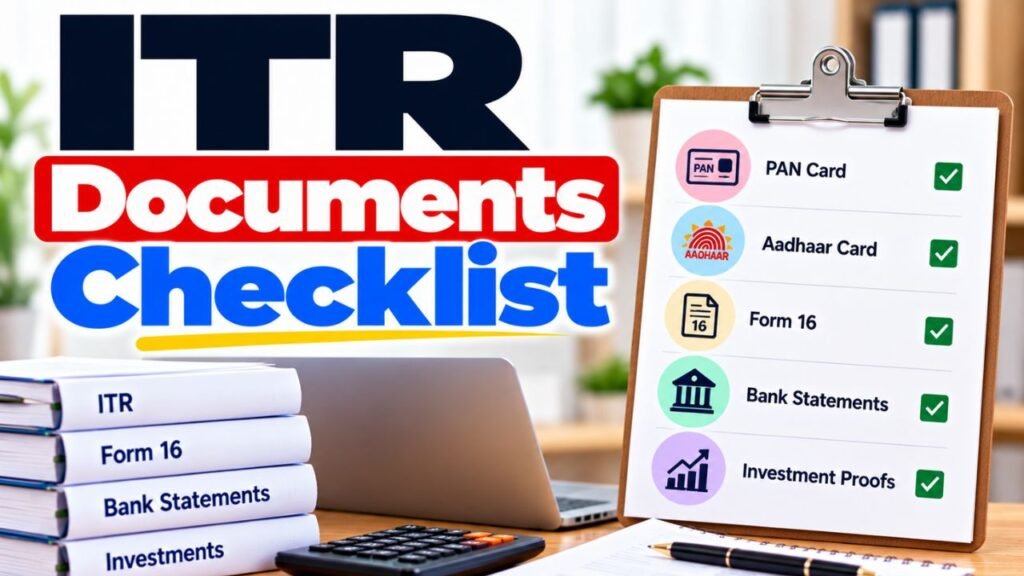
Filing an Income Tax Return becomes much easier when all the necessary documents are collected before starting the return. The documents required depend on your income sources, investments, deductions, bank transactions, capital gains, property income and the ITR form applicable to you.
For a salaried person, the basic documents may include Form 16, Form 26AS, AIS, salary details and bank statements. A person with investments, rental income or capital gains may need additional documents. Freelancers and business owners may need invoices, expense records, bank statements, TDS certificates and business-related financial information.
The Income Tax Department also advises taxpayers to download and check AIS and Form 26AS and reconcile TDS, TCS and tax payments with the employer, deductor or bank wherever required.
Use the following ITR Documents Checklist to prepare your records before filing.
Basic Documents Required for ITR Filing
Every taxpayer should keep their basic identification and tax information ready.
PAN Card
Your PAN is one of the most important details required for filing an ITR.
Check that:
- Your PAN is active
- Your name is correct
- Your date of birth is correct
- PAN details match your other records
Aadhaar Card
Keep your Aadhaar details available because Aadhaar and PAN information may be relevant to your e-Filing profile and verification process.
The Income Tax Department recommends linking PAN with Aadhaar where applicable.
Bank Account Details
Keep details of your bank accounts available, especially the account that you want to use for receiving an income-tax refund.
You may need:
- Bank account number
- IFSC
- Bank name
- Account type
- Bank statement or passbook
Make sure your bank details are correct on the e-Filing portal.
Form 16
If you are a salaried employee, Form 16 is one of the most important documents for filing your ITR.
Form 16 is issued by your employer and contains important information about salary income and TDS.
Check Form 16 for:
- Employer details
- Salary information
- TDS deducted
- Taxable salary
- Deductions and exemptions, where applicable
- PAN and other personal details
The Income Tax Department specifically lists Form 16 among the documents required for taxpayers with salary income.
If you changed jobs during the financial year, you may have more than one Form 16. Collect the Form 16 from each employer.
Form 16A
Form 16A is relevant when TDS has been deducted from income other than salary.
It may be applicable to income such as:
- Bank interest
- Certain professional payments
- Commission
- Rent in applicable cases
- Other payments subject to TDS
If you have received Form 16A from a bank or another deductor, keep it ready while preparing your ITR.
The Income Tax Department specifically mentions Form 16A for taxpayers who have TDS deducted on interest and other non-salary income.
You can also check the detailed guide on TDS Certificate.
Form 26AS
Form 26AS is an important document for checking your tax credits.
Before filing your ITR, compare the TDS and other relevant tax information in Form 26AS with your records.
Check:
- TDS deducted by employer
- TDS deducted by banks
- Other TDS
- TCS, where applicable
- Tax payments reflected in the statement
The Income Tax Department provides Form 26AS through the e-Filing portal.
For more information, see What Is Form 26AS.
Annual Information Statement (AIS)
AIS should also be checked before filing your return.
AIS can contain information relating to:
- TDS
- TCS
- Specified financial transactions
- Tax payments
- Demand and refund information
- Other information reported to the Income Tax Department
The Income Tax Department advises taxpayers to review AIS and reconcile discrepancies before filing their return.
You can read the detailed guide on AIS Income Tax.
Salary Slips
Salary slips are useful for verifying your salary information.
Keep salary slips for the relevant financial year, particularly if:
- You changed jobs
- You received bonuses
- You received incentives
- There were salary revisions
- Your Form 16 needs verification
- You received taxable allowances or benefits
Salary slips can help you reconcile the figures reported by your employer.
Bank Statements
Bank statements are important when filing an ITR because they can help identify income, interest and other financial transactions.
Check your statements for:
- Savings account interest
- Fixed deposit interest
- Recurring deposit interest
- Dividend receipts
- Rent received
- Freelance payments
- Business receipts
- Other taxable income
The Income Tax Department specifically lists bank statements or passbooks among documents that may be required for ITR preparation.
You can also keep a copy of your Bank Statement for ITR for reconciliation.
Interest Certificates
If you have money in savings accounts, fixed deposits or other interest-bearing accounts, collect the relevant interest certificates.
These can help you calculate:
- Savings account interest
- Fixed deposit interest
- Recurring deposit interest
- Other interest income
For ITR-2, the Income Tax Department specifically mentions bank passbooks and FDRs for calculating interest income.
Documents for House Rent and HRA
If you live in a rented property and are claiming eligible HRA-related benefits, keep your rent documents ready.
Depending on your situation, these may include:
- Rent receipts
- Rental agreement
- Landlord details
- PAN of landlord, where applicable
- Bank/payment records for rent
The Income Tax Department specifically lists rent receipts where required for HRA calculations.
Home Loan Documents
If you have a home loan, keep the following documents available:
- Home loan interest certificate
- Principal repayment details
- Loan account statement
- Property-related documents where relevant
A housing loan interest certificate can help determine the eligible interest amount to be reported in the return.
The Income Tax Department includes housing loan interest certificates in its ITR document guidance.
Investment and Tax-Saving Documents
If you are claiming eligible deductions, keep proof of your investments and payments.
Common documents include:
- PPF statement
- ELSS investment statement
- Life insurance premium receipts
- Health insurance premium receipts
- NPS contribution statement
- Tuition fee receipts
- Eligible donation receipts
- Other eligible investment/payment records
The Income Tax Department specifically advises taxpayers to keep investment and premium payment receipts where relevant.
Donation Receipts
If you are claiming a deduction for eligible donations, retain the donation receipt and relevant details.
Check the receipt for:
- Name of organisation
- Date of donation
- Amount
- Payment method
- Applicable registration or reference details
For certain deductions, additional information may be required while filing the return.
Capital Gains Documents
If you sold shares, mutual funds, securities, property or other capital assets, additional documents may be necessary.
For shares and securities, keep:
- Capital gains statement
- Broker statement
- Contract notes, where useful
- Purchase details
- Sale details
- Dividend information
- Demat statement
The Income Tax Department specifically mentions a summary or profit/loss statement for capital-gain transactions in shares or securities for ITR-2 taxpayers.
For property transactions, keep:
- Purchase deed
- Sale deed
- Purchase cost details
- Sale consideration
- Improvement expenses
- Brokerage details
- Relevant property expenses
Documents for Rental Income
If you earn rent from a property, keep documents that help calculate your house-property income.
These may include:
- Rent received details
- Rental agreement
- Property tax payment details
- Home loan interest certificate
- Tenant details
- Bank statement showing rent receipts
The Income Tax Department’s ITR-2 guidance specifically mentions tenant details, local tax payments and interest on borrowed capital for house-property income calculations.
Documents for Freelancers
Freelancers should maintain records of their professional income and related transactions.
Useful documents include:
- Client invoices
- Bank statements
- Payment gateway statements
- UPI transaction records
- Form 16A
- Form 26AS
- AIS
- Expense records
- GST records, if applicable
- Advance tax payment details
Do not assume that every bank credit is professional income. Reconcile your invoices, payment records, bank statements, TDS and tax information before filing.
Documents for Business Income
Business owners may need more detailed records depending on their business structure and applicable ITR form.
Keep relevant records such as:
- Sales invoices
- Purchase invoices
- Bank statements
- Business expense records
- GST records
- TDS certificates
- Form 26AS
- AIS
- Profit and loss statement
- Balance sheet, where applicable
- Loan statements
- Fixed asset records
- Advance tax details
The exact requirements can vary depending on the nature of business and the applicable ITR form.
Previous ITR and ITR-V
Keep your previous year’s ITR acknowledgement or ITR-V where relevant.
Previous returns can be useful for checking:
- Previous-year income
- Carried-forward losses
- Previous deductions
- Tax details
- Personal information
- Earlier disclosures
The Income Tax Department specifically mentions the previous year’s return or acknowledgement where previous-year losses are being claimed.
You can also keep your ITR V safely with your tax records.
Documents for Previous-Year Losses
If you want to carry forward or claim a previous year’s eligible loss, keep the relevant previous return and supporting records.
Depending on the type of loss, you may need documents supporting:
- Capital loss
- Business loss
- House-property loss
- Other eligible losses
The Income Tax Department’s ITR-2 guidance specifically asks taxpayers claiming previous-year losses to retain the relevant previous return or acknowledgement showing the loss.
Advance Tax and Self-Assessment Tax Documents
If you paid advance tax or self-assessment tax, keep the payment details.
Check:
- Challan number
- BSR code, where applicable
- Date of payment
- Amount paid
- Assessment year
- Payment reference
Compare tax payments with the information available in your tax records before submitting the return.
Foreign Income and Foreign Assets
Taxpayers with applicable foreign income or foreign assets may need additional information while filing their return.
Depending on the situation, keep:
- Foreign bank statements
- Foreign income statements
- Investment statements
- Foreign tax payment details
- Details of foreign assets
- Foreign tax credit documents
The applicable ITR and schedules should be checked carefully because foreign-income reporting requirements can be different from those for a standard salaried taxpayer.
Cryptocurrency or Virtual Digital Asset Records
If you have transactions involving virtual digital assets, maintain proper transaction records.
Keep:
- Purchase details
- Sale details
- Transaction statements
- Exchange statements
- Date of transaction
- Sale value
- Purchase cost
- TDS details, where applicable
The information should be reconciled with the relevant tax records before filing.
Documents Required According to ITR Form
The exact ITR Documents Checklist depends heavily on which ITR form applies to you.
| ITR Form | General Category |
|---|---|
| ITR-1 | Eligible individuals with specified salary, pension, house property and other income |
| ITR-2 | Individuals/HUFs without business or professional income but with specified other income |
| ITR-3 | Individuals/HUFs having business or professional income |
| ITR-4 | Eligible individuals, HUFs and firms using specified presumptive taxation provisions |
The Income Tax Department’s current AY 2026-27 guidance describes ITR-1, ITR-2, ITR-3 and ITR-4 according to their respective eligibility conditions.
ITR Documents Checklist for Salaried Employees
If you are a salaried employee, keep these documents ready:
- PAN
- Aadhaar details
- Form 16
- Salary slips
- Form 16A, if applicable
- Form 26AS
- AIS
- Bank statements
- Interest certificates
- Rent receipts, if applicable
- Rental agreement, if applicable
- Home loan interest certificate, if applicable
- Investment proofs
- Insurance premium receipts
- NPS/PPF/ELSS documents, if applicable
- Donation receipts, if applicable
- Capital gains statement, if applicable
- Previous ITR, where relevant
The Income Tax Department’s ITR-1 guidance lists Form 16, Form 16A, Form 26AS, AIS, payslips, bank statements, housing loan interest certificates, rent documents, donation receipts and investment records among relevant documents.
ITR Documents Checklist for Freelancers
Freelancers should keep:
- PAN
- Aadhaar details
- Client invoices
- Bank statements
- UPI/payment records
- Payment gateway statements
- Form 16A
- Form 26AS
- AIS
- Business/professional expense records
- GST records, if applicable
- Advance tax challans
- Previous ITR
- Capital gains documents, if applicable
ITR Documents Checklist for Business Owners
Business taxpayers may need:
- PAN
- Aadhaar details
- Business bank statements
- Sales invoices
- Purchase invoices
- Expense records
- GST records
- Form 16A
- Form 26AS
- AIS
- Profit and loss statement
- Balance sheet, where applicable
- Fixed asset details
- Loan statements
- Advance tax details
- Previous ITR
- Relevant audit report, where applicable
For taxpayers using presumptive taxation, the exact records and information required can differ from those maintained under regular books of account.
ITR Documents Checklist for Capital Gains
If you have sold investments or property, keep:
- Broker statement
- Capital gains statement
- Demat statement
- Purchase records
- Sale records
- Contract notes, where relevant
- Property purchase documents
- Property sale documents
- Improvement expenses
- Brokerage expenses
- Relevant tax payment details
Do You Need to Upload All Documents With ITR?
Usually, no.
Income Tax Returns are generally annexure-less, meaning taxpayers are normally not required to attach documents such as investment proofs, TDS certificates or receipts along with the return.
However, these documents should be retained because the tax authorities may require them during assessment, inquiry or other proceedings.
This distinction is important:
Documents required for preparing ITR ≠ documents that must be uploaded with ITR.
You may need a document to calculate or verify a figure even though you do not have to attach that document to the return.
Common Mistakes While Preparing ITR Documents
Not Checking AIS
Many taxpayers only check Form 16 and ignore AIS.
Always compare AIS with your income and financial records.
Not Checking Form 26AS
TDS appearing in Form 16 or Form 16A should be reconciled with Form 26AS.
Ignoring Bank Interest
Savings and fixed-deposit interest can easily be missed if bank statements are not reviewed.
Forgetting Previous Employer
If you changed jobs during the year, do not rely on only the Form 16 from your current employer.
Ignoring Capital Gains
Selling shares, mutual funds or property can create tax-reporting requirements that may not appear in a salary document.
Claiming Deductions Without Proof
Keep receipts and supporting documents for deductions you claim.
Treating Every Bank Credit as Income
Bank statements contain many types of transactions. Not every credit is necessarily taxable income. Identify the nature of each relevant transaction before reporting it.
Final ITR Documents Checklist
Before starting your ITR, use this quick master checklist:
- PAN
- Aadhaar details
- Form 16
- Form 16A
- Form 26AS
- AIS
- Salary slips
- Bank statements
- Interest certificates
- Fixed deposit details
- Rent receipts
- Rental agreement
- Home loan interest certificate
- Investment proofs
- Insurance receipts
- PPF/NPS/ELSS documents
- Donation receipts
- Capital gains statement
- Broker/Demat statement
- Property transaction documents
- Freelance invoices
- Business records
- GST records, if applicable
- Advance tax challans
- Self-assessment tax details
- Previous ITR/ITR-V
- Previous loss records
- Foreign income/assets information, if applicable
- VDA/crypto transaction records, if applicable
Final Takeaway
The right ITR Documents Checklist depends on your income sources and the ITR form applicable to you. A salaried employee may need mainly Form 16, Form 16A where applicable, Form 26AS, AIS, salary and bank records, while taxpayers with capital gains, rental income, freelance income or business income may need considerably more documentation.
Before filing, download and review AIS and Form 26AS, reconcile TDS and tax payments, check your bank and income records, and keep supporting documents safely. The Income Tax Department confirms that these documents generally do not need to be attached to an ITR, but they should be retained for possible future verification or proceedings.
For more practical information about ITR filing, income tax, TDS and government services, visit Sarkari Bakery.
Frequently Asked Questions
Based on Google's Helpful Content System, this article emphasizes user value, transparency, and accuracy. It incorporates principles of E-E-A-T (Experience, Expertise, Authoritativeness, Trustworthiness).
Why Choose Sarkari Bakery?
Official Information
Government schemes & banking information based on official sources.
Step-by-Step Guides
Simple application process explained for every service.
Regular Updates
Content updated whenever official rules or services change.
People-First Content
Helpful, transparent and user-focused content.