Govt. Schemes

MSME Loan Scheme
Govt. Schemes

MSME Loan Scheme 2026: Interest Rates, Eligibility, Types & Application Process Explained

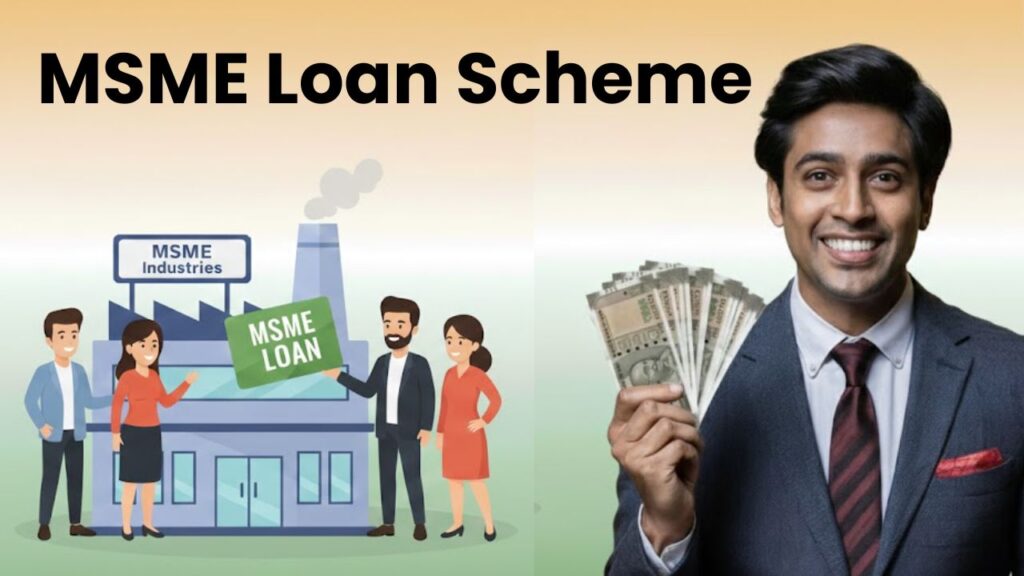
Micro, Small, and Medium Enterprises (MSMEs) are the backbone of India’s economy, creating jobs and driving innovation across manufacturing, trading, and service sectors. To support these businesses with timely and affordable finance, various MSME loan schemes are offered by banks, NBFCs, and the Government of India. In this detailed guide, you will find everything about MSME Loan Scheme 2026, including interest rates, eligibility conditions, loan types, government schemes, and step-by-step application methods. ⭐ What is an MSME Loan? An MSME loan is a business credit facility designed specifically for micro, small, and medium enterprises. These loans help businesses meet expenses related to working capital, business expansion, machinery purchase, technology upgrades, and operational needs. MSME loans are provided by public sector banks, private banks, NBFCs, and under government-backed schemes supported by the Government of India. Many MSME loans are available with low interest rates and without collateral, especially under credit guarantee schemes. ⭐ MSME Loan Scheme 2026 – Key Highlights ⭐ MSME Loan Interest Rates in 2026 MSME loan interest rates vary depending on the lender, business profile, credit score, and loan type. Bank / NBFC Interest Rate (p.a.) State Bank of India 8.00% onwards Canara Bank 9.20% onwards Punjab National Bank 9.60% onwards Indian Bank 8.80% onwards Union Bank of India 10.95% onwards Mahindra Finance 7.20% onwards Fullerton India 17% onwards Muthoot Fincorp 18% onwards Lendingkart 1.25% per month onwards 📌 Actual interest rates may differ based on borrower eligibility and risk profile. ⭐ How to Apply for an MSME Loan? 🖥️ Online Application Process 🏦 Offline Application Process ⭐ Eligibility Criteria for MSME Loans To qualify for an MSME loan, applicants generally must meet the following conditions: Eligible Business Structures ⭐ Documents Required for MSME Loan Identity & Address Proof Business Proof Financial Documents Other Documents ⭐ Types of MSME Loans 🔹 Working Capital Loan Short-term loans to manage daily business expenses like inventory purchase, salaries, and utility bills. 🔹 Term Loan Long-term loans for expansion, purchasing machinery, construction, or capital investment. ⭐ Popular Government MSME Loan Schemes ⭐ Pradhan Mantri Mudra Yojana (PMMY) Offers loans up to ₹20 lakh for micro and small businesses under: ⭐ Prime Minister’s Employment Generation Programme (PMEGP) Provides credit-linked subsidy for new micro-enterprises: ⭐ Credit Guarantee Scheme (CGTMSE) Offers collateral-free loans with credit guarantee coverage up to 85–90% for eligible MSMEs. ⭐ Interest Subsidy Eligibility Certificate (ISEC) Provides working capital loans at 4% interest for khadi institutions, with subsidy paid by the government. ⭐ SIDBI MSME Loans Loans for machinery, projects, and working capital ranging from ₹3 crore to ₹50 crore. ⭐ MSME Loan in 59 Minutes Fully digital loan processing for MSMEs with approval in under one hour for loans up to ₹5 crore. ⭐ Benefits of MSME Loans Conclusion The MSME Loan Scheme 2026 offers flexible, affordable, and fast financing options for businesses at every stage—from startups to expanding enterprises. With multiple government-backed schemes, low interest rates, and collateral-free options, MSMEs can easily access funds for growth, technology upgrades, and operational stability. For more easy-to-understand guides on business loans, government schemes, and finance-related topics, visit Sarkari Bakery.

Kisan Credit Card Scheme
Govt. Schemes

Kisan Credit Card (KCC) Scheme 2026: Interest Rate, Benefits, Credit Limit & Application Process

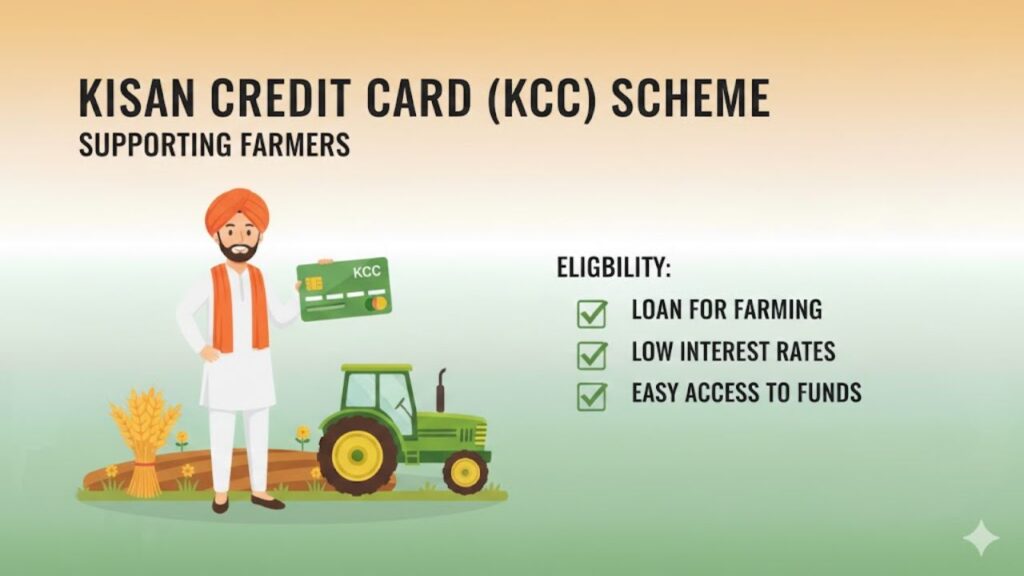
Indian agriculture depends heavily on timely access to credit. Farmers often need funds for seeds, fertilisers, irrigation, equipment, and allied activities like dairy or fisheries. To solve this problem, the Government of India introduced the Kisan Credit Card (KCC) Scheme, which ensures easy, flexible, and affordable credit for farmers. This guide explains the Kisan Credit Card Scheme 2026 in detail, including interest rates, benefits, credit limits, eligibility, and step-by-step application methods—so nothing important is missed. ⭐ What is the Kisan Credit Card Scheme? The Kisan Credit Card Scheme was launched in 1998 to provide short-term and long-term credit to farmers for agricultural and allied needs. Under this scheme, banks issue a Kisan Credit Card (KCC) that allows farmers to withdraw money as per their approved limit, similar to a revolving credit facility. Over time, the scheme has expanded beyond crop cultivation to include investment credit and allied activities such as dairy, animal husbandry, fisheries, poultry, and beekeeping. The scheme is implemented by the Government of India through banks and cooperative institutions. ⭐ Key Highlights of Kisan Credit Card Scheme 2026 ⭐ Purpose of Kisan Credit Card Scheme The credit available under KCC can be used for multiple farming-related needs: ⭐ Types of Kisan Credit Cards Issued by Banks Banks issue KCCs in modern digital formats to ensure easy access and secure transactions: These cards allow farmers to withdraw money, make payments to input dealers, and receive sale proceeds directly into their bank accounts. ⭐ Kisan Credit Card Delivery Channels Farmers can use KCC facilities through multiple channels: ⭐ Interest Rate Under Kisan Credit Card Scheme The interest rate structure is as follows: 📌 Aadhaar submission is mandatory to avail interest subvention benefits.📌 Actual rates may vary slightly between banks and can go up to 12–13% if benefits are not applicable. ⭐ How is the Kisan Credit Card Limit Calculated? The KCC limit is calculated based on crop pattern, landholding, and farming needs. 📍 For Crop Cultivation (First Year) 📍 For Subsequent Years 📍 For Multiple Crops 📍 For Investment Credit 📍 Maximum Permissible Limit (MPL) ⭐ Who is Eligible for Kisan Credit Card? The following categories can apply for KCC: ⭐ How to Apply for Kisan Credit Card Online The online application process generally works as follows: ⭐ Offline Application Process for Kisan Credit Card ⭐ Documents Required for Kisan Credit Card ⭐ Impact of Kisan Credit Card Scheme As of 31 December 2024, loans worth over ₹10.05 lakh crore have been sanctioned under the KCC scheme, benefiting more than 7.7 crore farmers across India. The scheme has become a backbone of agricultural financing by ensuring quick and affordable credit access. Conclusion The Kisan Credit Card Scheme plays a vital role in supporting Indian farmers by offering low-interest, flexible, and timely credit for farming and allied activities. With interest subvention, wide eligibility, and multiple usage options, KCC helps farmers manage both cultivation and investment needs efficiently. For more simple, step-by-step explanations of government schemes, banking, and farmer-focused initiatives, visit Sarkari Bakery.

Pradhan Mantri Ayushman Bharat Yojana
Govt. Schemes

Eligibility of Pradhan Mantri Ayushman Bharat Yojana: Who Can Get ₹5 Lakh Health Cover

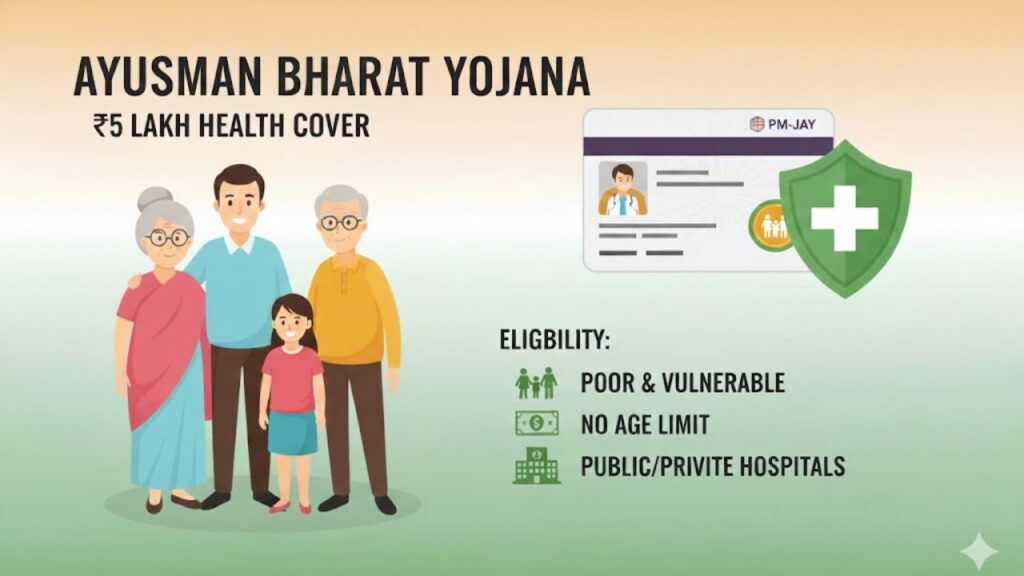
A strong nation is built on the health of its people. To make quality healthcare affordable and accessible for everyone, especially poor and vulnerable families, the Government of India launched a large-scale health insurance programme known as Pradhan Mantri Ayushman Bharat Yojana. This scheme focuses on providing cashless treatment for serious medical needs so that families do not fall into debt due to hospital expenses. Below is a complete and clearly explained guide covering eligibility, benefits, hospital criteria, senior citizen coverage, and the registration process. ⭐ What is Pradhan Mantri Ayushman Bharat Yojana (PM-JAY)? Pradhan Mantri Ayushman Bharat Yojana is a government-funded health insurance scheme that provides medical cover of up to ₹5 lakh per family per year. The coverage is offered on a family floater basis, meaning the entire family can use the insured amount. Earlier known as AB-NHPS, the scheme is now officially called Ayushman Bharat Pradhan Mantri Jan Arogya Yojana (PM-JAY). It has replaced earlier health schemes like Rashtriya Swasthya Bima Yojana and senior citizen health insurance programmes. ⭐ Key Features and Benefits of Ayushman Bharat Yojana ⭐ Eligibility for Ayushman Bharat Yojana – Rural Families Rural households are identified based on Socio-Economic Caste Census (SECC) 2011 data. A family is eligible if it falls under any of the following categories: Automatically Eligible Rural Categories ⭐ Eligibility for Ayushman Bharat Yojana – Urban Families Urban eligibility is based on occupation, not income. A family must belong to one of the following occupational groups: ⭐ Special Coverage for Senior Citizens (70+ Years) On 11 September 2024, the Union Cabinet approved universal coverage for all senior citizens aged 70 years and above, regardless of income or socio-economic status. Key Points for Senior Citizens If Already Covered Under Other Schemes ⭐ Eligibility Criteria for Hospitals Under PM-JAY Hospitals must meet strict requirements to be empanelled: ⭐ How to Register for Ayushman Bharat Yojana Online Follow these steps to check eligibility and register: If eligible, your name and family details will appear on the screen. ⭐ How to Claim Cashless Treatment Under PM-JAY Conclusion The Pradhan Mantri Ayushman Bharat Yojana is one of the world’s largest public health insurance schemes, offering ₹5 lakh annual coverage to millions of families. With wide eligibility, senior citizen inclusion, and cashless treatment facilities, it plays a major role in protecting families from financial stress caused by medical emergencies. For simple, step-by-step guidance on Ayushman Bharat, health cards, and other government schemes, visit Sarkari Bakery.

Atal Pension Yojana 2025
Savings, Govt. Schemes

Atal Pension Yojana (APY): Eligibility, Benefits, Contribution & Withdrawal Rules

Planning for old age is often ignored by people working in the unorganised and private sectors. To solve this problem, the Government of India introduced a pension scheme that guarantees a fixed monthly income after retirement. The Atal Pension Yojana (APY) is designed to give financial security to citizens who do not receive pension benefits from their employer. This scheme is especially useful for daily wage workers, small job holders, and self-employed individuals who want a safe and government-backed pension plan. ⭐ What is Atal Pension Yojana (APY)? Atal Pension Yojana is a social security pension scheme launched by the Government of India in 2015. It was announced in the Union Budget 2015–16 and replaced the earlier Swavalamban Yojana, which had limited reach. The scheme mainly targets people working in the unorganised sector such as helpers, delivery staff, drivers, gardeners, shop workers, and others who do not have access to employer-sponsored pension schemes. Under APY, subscribers receive a guaranteed monthly pension of ₹1,000, ₹2,000, ₹3,000, ₹4,000, or ₹5,000 after attaining the age of 60 years, depending on their contribution amount and entry age. ⭐ Key Features of Atal Pension Yojana ⭐ Pension Options Under APY Subscribers can choose any one of the following monthly pension amounts after the age of 60: The contribution amount depends on: Younger subscribers pay lower monthly contributions compared to older entrants. ⭐ Eligibility Criteria for Atal Pension Yojana To join the APY scheme, the applicant must fulfil the following conditions: People already enrolled under Swavalamban Yojana were automatically shifted to APY. ⭐ Government Co-Contribution (Special Period) The Government of India provided co-contribution benefits to eligible subscribers who joined APY between June 2015 and December 2015. ⭐ How to Apply for Atal Pension Yojana APY can be opened through online or offline methods. ⭐ Online Application Method ⚠️ Online facility is available only with selected banks. ⭐ Offline Application Method Once approved, confirmation is sent to the registered mobile number. ⭐ Monthly Contribution Details The contribution amount varies based on: For example: Payments are auto-debited monthly from the linked bank account. ⭐ Withdrawal and Exit Rules of APY On Attaining 60 Years On Death of Subscriber Early Exit (Before 60 Years) ⭐ Penalty for Default in Contributions If monthly contributions are missed, penalties are charged: Long-term default consequences: ⭐ Tax Benefits Under Atal Pension Yojana APY contributions are eligible for tax benefits under the Income Tax Act, 1961: ⭐ Important Things to Remember Conclusion Atal Pension Yojana is a reliable retirement solution for people who do not have access to formal pension benefits. With guaranteed returns, government backing, and tax advantages, it provides long-term financial stability after the age of 60. For more simplified explanations of government schemes and step-by-step guidance, visit Sarkari Bakery.

Scroll to Top