Author name: Nibha

Tatkal vs Premium Tatkal
Train

Difference Between Tatkal and Premium Tatkal Ticket (Complete Comparison)

When you need to book a train ticket at the last moment, Tatkal and Premium Tatkal are the two special quotas offered by Indian Railways through IRCTC.Although both are meant for urgent travel, their pricing, refund rules, booking conditions, and confirmation chances are very different. Below is a clear, point-by-point explanation so you don’t miss anything. ⭐ What Is Tatkal Ticket? Tatkal is a fixed-price emergency booking quota. Tickets are released one day before the journey at a fixed additional charge, on a first-come-first-served basis. Key idea:👉 Fixed fare + waiting list allowed + limited refund rules ⭐ What Is Premium Tatkal Ticket? Premium Tatkal (PT) is a dynamic pricing version of Tatkal. The fare increases automatically as demand rises, similar to flight ticket pricing. Key idea:👉 Dynamic fare + confirmed ticket only + no refund ⭐ Tatkal vs Premium Tatkal: Main Difference Table Feature Tatkal Premium Tatkal Fare type Fixed Tatkal charges Dynamic (increases with demand) Waiting list allowed ✅ Yes (TQWL possible) ❌ No waiting list Ticket status Confirmed / RAC / WL Only Confirmed Refund on cancellation ❌ Confirmed: No refund✅ RAC/WL: Partial refund ❌ No refund at all Tatkal charges Fixed by IRCTC Variable (can be very high) Agents booking Allowed (with restrictions) ❌ Not allowed Senior citizen concession ❌ Not allowed ❌ Not allowed Booking time Same as Tatkal timing Same as Tatkal timing Availability More seats compared to PT Very limited seats Best for Budget urgent travel Emergency confirmed travel ⭐ Booking Timing (Same for Both) Tatkal and Premium Tatkal follow the same booking schedule: ⏰ Booking is based on train’s originating station date, not your boarding station. ⭐ Fare Difference Explained (Important) Tatkal Fare Premium Tatkal Fare 👉 If many users book at the same time, Premium Tatkal fare can rise sharply within minutes. ⭐ Cancellation & Refund Rules (Biggest Difference) Tatkal Cancellation Premium Tatkal Cancellation 👉 Premium Tatkal = Book only if you are 100% sure of travel ⭐ Confirmation Chances ⭐ Which One Should You Choose? Choose Tatkal if: ✔ You want lower cost✔ You can accept RAC or WL risk✔ You may need partial refund✔ Budget matters Choose Premium Tatkal if: ✔ You need confirmed ticket only✔ Money is not a concern✔ Travel is unavoidable✔ You accept zero refund risk 🔚 Conclusion The difference between Tatkal and Premium Tatkal ticket lies mainly in price and refund rules. Tatkal is more affordable but risky due to waiting lists, while Premium Tatkal offers confirmed seats at a higher and variable price with no refund at all. Before booking, always check: For simple, honest, and step-by-step railway guides in easy language, visit Sarkari Bakery. ❓ FAQs – Tatkal vs Premium Tatkal
Normal Train Ticket Cancellation Charges
Train

Normal Train Ticket Cancellation Charges Explained (IRCTC Rules)

Train travel plans can change at the last moment, and knowing the normal train ticket cancellation charges helps you avoid confusion and financial loss. Indian Railways has fixed, time-based cancellation rules for confirmed, RAC, and waitlisted tickets. These rules apply to tickets booked online through IRCTC as well as counter tickets. Below is a clear, step-by-step explanation of cancellation charges, refund eligibility, chart preparation rules, and special cases—so nothing is missed. ⭐ What Is a Normal Train Ticket? A normal train ticket is a regular railway reservation booked under the General Quota (not Tatkal or Premium Tatkal). These tickets follow standard cancellation and refund rules set by Indian Railways. ⭐ Cancellation Charges for Confirmed Normal Tickets Cancellation charges depend on how early you cancel before the scheduled departure of the train. ✔ Cancellation Charges (Confirmed Tickets) Time of Cancellation Charges Deducted More than 48 hours before departure ₹240 (AC First/Executive), ₹200 (AC 2/3 Tier), ₹180 (Sleeper), ₹120 (2S) 48 to 12 hours before departure 25% of base fare (minimum clerkage applies) 12 to 4 hours before departure 50% of base fare After chart preparation ❌ No refund (except special cases) ⚠️ Cancellation is allowed up to 4 hours before departure for confirmed tickets. ⭐ Cancellation Charges for RAC Tickets If your ticket status is RAC (Reservation Against Cancellation): 👉 RAC tickets offer better refund flexibility compared to confirmed tickets. ⭐ Cancellation Charges for Waitlisted Tickets If your ticket is waitlisted (WL): ⭐ What Happens After Chart Preparation? Chart preparation usually happens 3–4 hours before departure. Ticket Status Refund After Chart? Confirmed ❌ No refund RAC ✅ Refund allowed Waitlisted ✅ Auto-cancel + refund ⭐ Refund Rules If Train Is Cancelled If Indian Railways cancels the train: ⭐ Refund If Train Is Running Late If the train is delayed by more than 3 hours at your boarding station: ⭐ Online vs Counter Ticket Cancellation Ticket Type How to Cancel Online ticket Through IRCTC website/app Counter ticket At PRS counter only Refund time 3–7 working days (online) ⭐ Important Points to Remember 🔚 Conclusion Understanding normal train ticket cancellation charges helps you plan better and avoid unnecessary losses. Confirmed tickets attract higher deductions as departure time approaches, while RAC and waitlisted tickets offer easier refunds. Always check your ticket status and cancellation timing before making a decision. For simple, reliable, and updated railway rules explained step by step, visit Sarkari Bakery. ❓ FAQs – Normal Train Ticket Cancellation

Tatkal Ticket Booking
Train

Tatkal Ticket Cancellation Rules – Is Refund Allowed?

Tatkal ticket booking is a popular option for passengers who need to travel urgently by train. However, many people are confused about Tatkal ticket cancellation rules, especially whether a refund is allowed or not. In this detailed guide, we explain every single rule related to Tatkal ticket cancellation, refunds, waitlisted tickets, RAC tickets, and TDR—so that nothing is missed. What Is a Tatkal Ticket? A Tatkal ticket is a last-minute train ticket booking facility provided by Indian Railways through IRCTC.It allows passengers to book tickets one day before the date of journey by paying extra Tatkal charges. Tatkal Ticket Cancellation Rules (Important Overview) Before going into details, here is the most important rule you should remember: ❌ No refund is allowed on confirmed Tatkal tickets if you cancel them. However, this rule changes depending on the ticket status (Confirmed, RAC, or Waitlisted). Let’s understand each case clearly. 1. Cancellation of Confirmed Tatkal Ticket If your Tatkal ticket is confirmed, then: 👉 Even if you cancel immediately after booking, refund = ₹0 Example: ➡️ After cancellation, refund amount = ₹0 2. Cancellation of RAC Tatkal Ticket If your Tatkal ticket status is RAC (Reservation Against Cancellation): Important Points: 3. Cancellation of Waitlisted Tatkal Ticket (TQWL) If your Tatkal ticket is waitlisted (TQWL – Tatkal Quota Waiting List): Auto-Cancellation Rule: 4. Tatkal Ticket Refund If Train Is Cancelled If the train itself is cancelled by Indian Railways: 5. Tatkal Refund If Train Is Running Late If the train is delayed by more than 3 hours at your boarding station: 👉 TDR must be filed before actual departure of the train 6. Tatkal Ticket Cancellation After Chart Preparation Ticket Status Refund Allowed? Confirmed Tatkal ❌ No RAC Tatkal ✅ Yes (with charges) Waitlisted Tatkal ✅ Yes Train Cancelled ✅ Full Refund Train Late > 3 hrs (TDR) ✅ Yes 7. Tatkal Cancellation Charges (Summary) Ticket Type Refund Confirmed Tatkal ❌ No refund RAC Tatkal ✅ Refund after deduction Waitlisted Tatkal ✅ Refund Cancelled Train ✅ Full refund TDR Filed (Delay / Cancellation) ✅ Refund ⚠️ Tatkal charges are non-refundable in normal cancellation cases. 8. Can Tatkal Ticket Be Cancelled Online? Yes, Tatkal tickets booked online can be cancelled through the IRCTC website or app, but: 9. Difference Between Tatkal and Premium Tatkal (Refund) Feature Tatkal Premium Tatkal Refund on cancellation RAC/WL only ❌ No refund Waitlist allowed Yes No Fare Fixed Dynamic Cancellation allowed Yes No Important Things to Remember Conclusion The Tatkal Ticket Cancellation Rules are strict, especially for confirmed tickets. If your Tatkal ticket is confirmed, do not expect any refund on cancellation. However, RAC and waitlisted Tatkal tickets are eligible for partial refunds, and special cases like train cancellation or long delays allow full or partial refunds through TDR. For more simple, accurate, and step-by-step guides on railway rules, tickets, and government schemes, visit 👉 Sarkari Bakery. FAQs – Tatkal Ticket Cancellation

MSME Loan Scheme
Govt. Schemes

MSME Loan Scheme 2026: Interest Rates, Eligibility, Types & Application Process Explained

Micro, Small, and Medium Enterprises (MSMEs) are the backbone of India’s economy, creating jobs and driving innovation across manufacturing, trading, and service sectors. To support these businesses with timely and affordable finance, various MSME loan schemes are offered by banks, NBFCs, and the Government of India. In this detailed guide, you will find everything about MSME Loan Scheme 2026, including interest rates, eligibility conditions, loan types, government schemes, and step-by-step application methods. ⭐ What is an MSME Loan? An MSME loan is a business credit facility designed specifically for micro, small, and medium enterprises. These loans help businesses meet expenses related to working capital, business expansion, machinery purchase, technology upgrades, and operational needs. MSME loans are provided by public sector banks, private banks, NBFCs, and under government-backed schemes supported by the Government of India. Many MSME loans are available with low interest rates and without collateral, especially under credit guarantee schemes. ⭐ MSME Loan Scheme 2026 – Key Highlights ⭐ MSME Loan Interest Rates in 2026 MSME loan interest rates vary depending on the lender, business profile, credit score, and loan type. Bank / NBFC Interest Rate (p.a.) State Bank of India 8.00% onwards Canara Bank 9.20% onwards Punjab National Bank 9.60% onwards Indian Bank 8.80% onwards Union Bank of India 10.95% onwards Mahindra Finance 7.20% onwards Fullerton India 17% onwards Muthoot Fincorp 18% onwards Lendingkart 1.25% per month onwards 📌 Actual interest rates may differ based on borrower eligibility and risk profile. ⭐ How to Apply for an MSME Loan? 🖥️ Online Application Process 🏦 Offline Application Process ⭐ Eligibility Criteria for MSME Loans To qualify for an MSME loan, applicants generally must meet the following conditions: Eligible Business Structures ⭐ Documents Required for MSME Loan Identity & Address Proof Business Proof Financial Documents Other Documents ⭐ Types of MSME Loans 🔹 Working Capital Loan Short-term loans to manage daily business expenses like inventory purchase, salaries, and utility bills. 🔹 Term Loan Long-term loans for expansion, purchasing machinery, construction, or capital investment. ⭐ Popular Government MSME Loan Schemes ⭐ Pradhan Mantri Mudra Yojana (PMMY) Offers loans up to ₹20 lakh for micro and small businesses under: ⭐ Prime Minister’s Employment Generation Programme (PMEGP) Provides credit-linked subsidy for new micro-enterprises: ⭐ Credit Guarantee Scheme (CGTMSE) Offers collateral-free loans with credit guarantee coverage up to 85–90% for eligible MSMEs. ⭐ Interest Subsidy Eligibility Certificate (ISEC) Provides working capital loans at 4% interest for khadi institutions, with subsidy paid by the government. ⭐ SIDBI MSME Loans Loans for machinery, projects, and working capital ranging from ₹3 crore to ₹50 crore. ⭐ MSME Loan in 59 Minutes Fully digital loan processing for MSMEs with approval in under one hour for loans up to ₹5 crore. ⭐ Benefits of MSME Loans Conclusion The MSME Loan Scheme 2026 offers flexible, affordable, and fast financing options for businesses at every stage—from startups to expanding enterprises. With multiple government-backed schemes, low interest rates, and collateral-free options, MSMEs can easily access funds for growth, technology upgrades, and operational stability. For more easy-to-understand guides on business loans, government schemes, and finance-related topics, visit Sarkari Bakery.

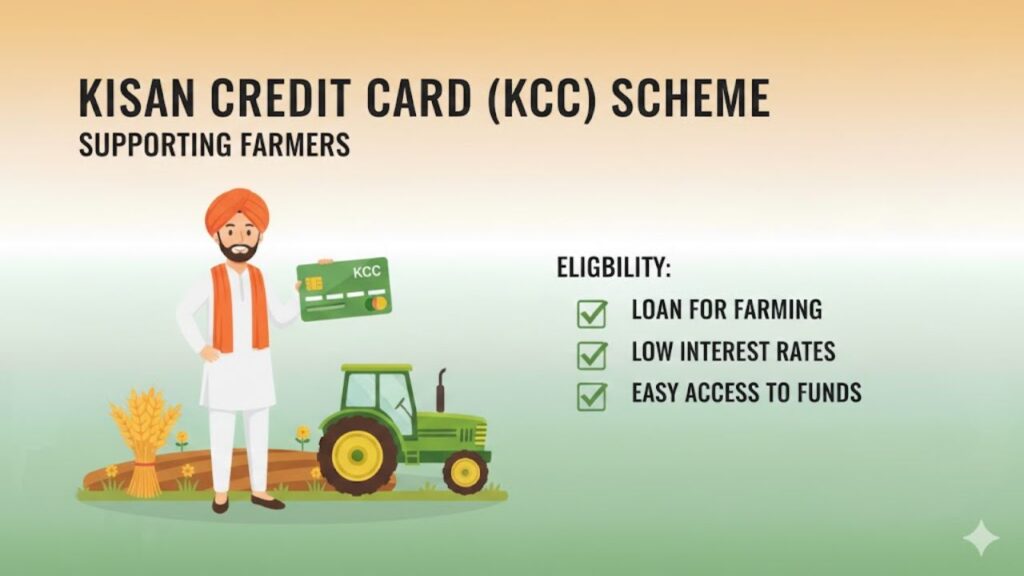
Kisan Credit Card Scheme
Govt. Schemes

Kisan Credit Card (KCC) Scheme 2026: Interest Rate, Benefits, Credit Limit & Application Process

Indian agriculture depends heavily on timely access to credit. Farmers often need funds for seeds, fertilisers, irrigation, equipment, and allied activities like dairy or fisheries. To solve this problem, the Government of India introduced the Kisan Credit Card (KCC) Scheme, which ensures easy, flexible, and affordable credit for farmers. This guide explains the Kisan Credit Card Scheme 2026 in detail, including interest rates, benefits, credit limits, eligibility, and step-by-step application methods—so nothing important is missed. ⭐ What is the Kisan Credit Card Scheme? The Kisan Credit Card Scheme was launched in 1998 to provide short-term and long-term credit to farmers for agricultural and allied needs. Under this scheme, banks issue a Kisan Credit Card (KCC) that allows farmers to withdraw money as per their approved limit, similar to a revolving credit facility. Over time, the scheme has expanded beyond crop cultivation to include investment credit and allied activities such as dairy, animal husbandry, fisheries, poultry, and beekeeping. The scheme is implemented by the Government of India through banks and cooperative institutions. ⭐ Key Highlights of Kisan Credit Card Scheme 2026 ⭐ Purpose of Kisan Credit Card Scheme The credit available under KCC can be used for multiple farming-related needs: ⭐ Types of Kisan Credit Cards Issued by Banks Banks issue KCCs in modern digital formats to ensure easy access and secure transactions: These cards allow farmers to withdraw money, make payments to input dealers, and receive sale proceeds directly into their bank accounts. ⭐ Kisan Credit Card Delivery Channels Farmers can use KCC facilities through multiple channels: ⭐ Interest Rate Under Kisan Credit Card Scheme The interest rate structure is as follows: 📌 Aadhaar submission is mandatory to avail interest subvention benefits.📌 Actual rates may vary slightly between banks and can go up to 12–13% if benefits are not applicable. ⭐ How is the Kisan Credit Card Limit Calculated? The KCC limit is calculated based on crop pattern, landholding, and farming needs. 📍 For Crop Cultivation (First Year) 📍 For Subsequent Years 📍 For Multiple Crops 📍 For Investment Credit 📍 Maximum Permissible Limit (MPL) ⭐ Who is Eligible for Kisan Credit Card? The following categories can apply for KCC: ⭐ How to Apply for Kisan Credit Card Online The online application process generally works as follows: ⭐ Offline Application Process for Kisan Credit Card ⭐ Documents Required for Kisan Credit Card ⭐ Impact of Kisan Credit Card Scheme As of 31 December 2024, loans worth over ₹10.05 lakh crore have been sanctioned under the KCC scheme, benefiting more than 7.7 crore farmers across India. The scheme has become a backbone of agricultural financing by ensuring quick and affordable credit access. Conclusion The Kisan Credit Card Scheme plays a vital role in supporting Indian farmers by offering low-interest, flexible, and timely credit for farming and allied activities. With interest subvention, wide eligibility, and multiple usage options, KCC helps farmers manage both cultivation and investment needs efficiently. For more simple, step-by-step explanations of government schemes, banking, and farmer-focused initiatives, visit Sarkari Bakery.

Sovereign Gold Bond
Savings

Sovereign Gold Bond (SGB) 2026: Issue Status, Interest Rate, Redemption Rules & Tax Benefits Explained

Gold has always been a preferred investment choice in India. However, buying physical gold comes with concerns like storage, safety, and making charges. To solve these issues, the Government of India introduced Sovereign Gold Bonds (SGBs)—a smart, paper-based way to invest in gold with additional benefits like fixed interest and tax exemption at maturity. This detailed guide explains everything you need to know about Sovereign Gold Bond 2026, including the latest issue status, interest rate, premature redemption rules, tax treatment, and whether SGBs are still a good investment option. ⭐ What is a Sovereign Gold Bond (SGB)? A Sovereign Gold Bond is a government-backed security linked to the price of gold. Instead of holding physical gold, investors hold gold in digital or certificate form. The bond value is calculated based on the price of 999-purity gold, and returns depend on gold price movement plus fixed interest. SGBs are issued by the Reserve Bank of India on behalf of the Government of India under the Gold Monetisation Scheme. ⭐ SGB 2026 – Current Status & Latest Update As per the most recent RBI and government updates: Details of the Last Issued SGB Particular Information Last Tranche SGB 2023–24 Series IV Subscription Period 12–16 February 2025 Issue Price (Offline) ₹6,263 per gram Issue Price (Online) ₹6,213 per gram New Issue Calendar Not announced for 2025–26 / 2026 ⭐ Key Features of Sovereign Gold Bonds ⭐ Interest Rate on SGBs (How You Earn) SGBs offer 2.5% fixed annual interest, calculated on the issue price—not on the market price of gold. This interest is additional to the appreciation in gold price, making SGBs more rewarding than physical gold. ⭐ Who Can Invest in Sovereign Gold Bonds? Eligible investors include: ❌ NRIs cannot invest in new SGBs, but they may continue holding bonds purchased earlier while they were residents. ⭐ How Do Sovereign Gold Bonds Work? ⭐ How to Invest in SGBs (When Issues Are Open) Primary Market (New Issues – When Announced) Secondary Market (Existing SGBs) Since no new issues are announced, investors can still buy SGBs from: ⭐ SGB vs Gold ETF – Quick Comparison Feature SGB Gold ETF Backing Government of India Market-traded fund Interest 2.5% p.a. No interest Maturity 8 years No fixed tenure Capital Gains Tax-free at maturity Taxable Risk Very low Market-linked Best For Long-term investors Short-term traders ⭐ How Are SGB Returns Calculated? Returns come from two sources: Example: Interest earned (8 years):2.5% × ₹6,263 × 8 ≈ ₹1,252 Capital appreciation:₹12,500 – ₹6,263 = ₹6,237 (tax-free) Total return per gram:≈ ₹7,489 ⭐ Sovereign Gold Bond Redemption Rules 🔓 Final Redemption (After 8 Years) ⏳ Premature Redemption (After 5 Years) 📌 Important Note If SGBs are sold on stock exchanges before maturity: ⭐ Tax Treatment of Sovereign Gold Bonds ⭐ Pros and Cons of Investing in SGBs ✅ Advantages ❌ Limitations Conclusion The Sovereign Gold Bond (SGB) remains one of the most efficient and tax-friendly ways to invest in gold. Even though no new SGB issues are planned for 2026 as of now, existing bonds continue to offer strong long-term value due to rising gold prices, fixed interest, and tax-free maturity benefits. For investors with a long-term horizon who want gold exposure without physical hassles, SGBs remain a solid choice. For more easy-to-understand guides on gold investment and government-backed schemes, visit Sarkari Bakery.

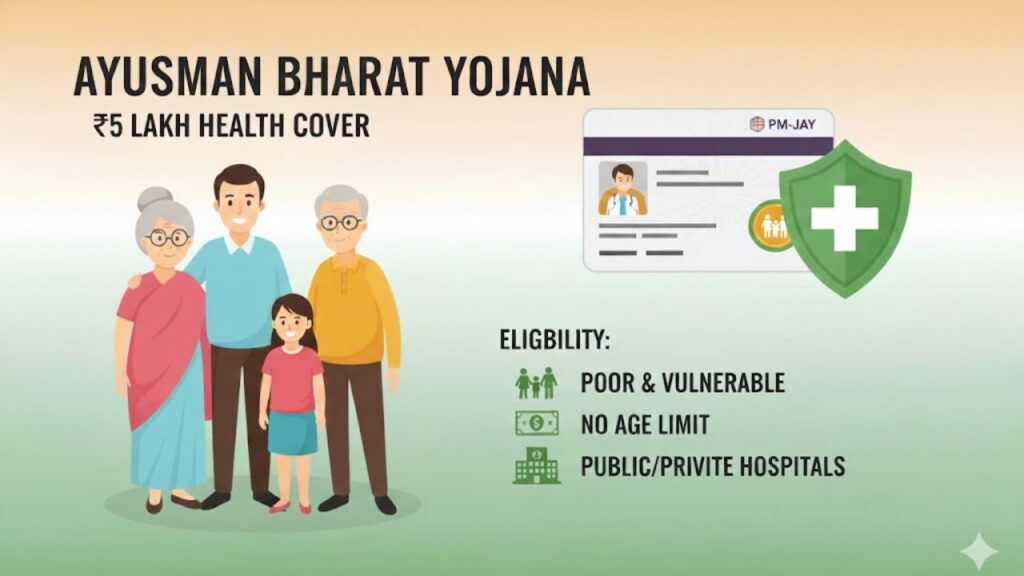
Pradhan Mantri Ayushman Bharat Yojana
Govt. Schemes

Eligibility of Pradhan Mantri Ayushman Bharat Yojana: Who Can Get ₹5 Lakh Health Cover

A strong nation is built on the health of its people. To make quality healthcare affordable and accessible for everyone, especially poor and vulnerable families, the Government of India launched a large-scale health insurance programme known as Pradhan Mantri Ayushman Bharat Yojana. This scheme focuses on providing cashless treatment for serious medical needs so that families do not fall into debt due to hospital expenses. Below is a complete and clearly explained guide covering eligibility, benefits, hospital criteria, senior citizen coverage, and the registration process. ⭐ What is Pradhan Mantri Ayushman Bharat Yojana (PM-JAY)? Pradhan Mantri Ayushman Bharat Yojana is a government-funded health insurance scheme that provides medical cover of up to ₹5 lakh per family per year. The coverage is offered on a family floater basis, meaning the entire family can use the insured amount. Earlier known as AB-NHPS, the scheme is now officially called Ayushman Bharat Pradhan Mantri Jan Arogya Yojana (PM-JAY). It has replaced earlier health schemes like Rashtriya Swasthya Bima Yojana and senior citizen health insurance programmes. ⭐ Key Features and Benefits of Ayushman Bharat Yojana ⭐ Eligibility for Ayushman Bharat Yojana – Rural Families Rural households are identified based on Socio-Economic Caste Census (SECC) 2011 data. A family is eligible if it falls under any of the following categories: Automatically Eligible Rural Categories ⭐ Eligibility for Ayushman Bharat Yojana – Urban Families Urban eligibility is based on occupation, not income. A family must belong to one of the following occupational groups: ⭐ Special Coverage for Senior Citizens (70+ Years) On 11 September 2024, the Union Cabinet approved universal coverage for all senior citizens aged 70 years and above, regardless of income or socio-economic status. Key Points for Senior Citizens If Already Covered Under Other Schemes ⭐ Eligibility Criteria for Hospitals Under PM-JAY Hospitals must meet strict requirements to be empanelled: ⭐ How to Register for Ayushman Bharat Yojana Online Follow these steps to check eligibility and register: If eligible, your name and family details will appear on the screen. ⭐ How to Claim Cashless Treatment Under PM-JAY Conclusion The Pradhan Mantri Ayushman Bharat Yojana is one of the world’s largest public health insurance schemes, offering ₹5 lakh annual coverage to millions of families. With wide eligibility, senior citizen inclusion, and cashless treatment facilities, it plays a major role in protecting families from financial stress caused by medical emergencies. For simple, step-by-step guidance on Ayushman Bharat, health cards, and other government schemes, visit Sarkari Bakery.

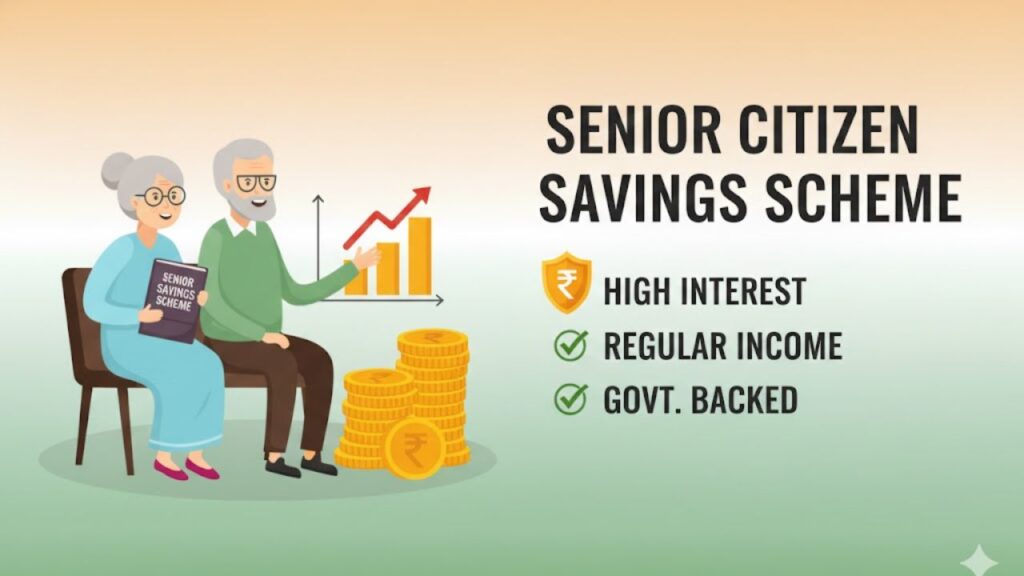
Senior Citizen Savings Scheme
Savings

Senior Citizen Savings Scheme (SCSS): Interest Rate, Tax Benefits, Deposit Limit & Full Details

After retirement, regular income and capital safety become the top priorities for senior citizens. To address this need, the Government of India offers the Senior Citizen Savings Scheme (SCSS), a trusted and low-risk investment option specially designed for people above a certain age. SCSS is one of the most popular post-retirement schemes because it provides stable quarterly income, tax benefits, and government-backed security. Below is a complete and detailed explanation of SCSS for 2026, covering eligibility, interest rate, tax rules, withdrawal conditions, and much more. ⭐ What is Senior Citizen Savings Scheme (SCSS)? The Senior Citizen Savings Scheme is a government-backed savings scheme available through post offices and selected banks. It is meant to provide senior citizens with a steady flow of interest income after retirement, along with safety of principal amount. The scheme is regulated by the Government of India and is considered one of the safest investment options for retirees. ⭐ Senior Citizen Savings Scheme – Key Highlights ⭐ Eligibility for Senior Citizen Savings Scheme The following individuals are eligible to open an SCSS account: ❌ Who Is Not Eligible? 📌 PAN and Aadhaar are mandatory for opening an SCSS account (applicable since 31 March 2023). ⭐ Features of Senior Citizen Savings Scheme 🔒 Safe and Secure Investment SCSS is fully backed by the Government of India, ensuring guaranteed returns and capital protection. 👥 Multiple & Joint Accounts 🧾 Nomination Facility 💰 Deposit Rules For retired employees, deposit amount should not exceed retirement benefits and must be deposited within one month of receiving them. ⭐ What Are Considered Retirement Benefits? If deposit exceeds the allowed limit, the excess amount is refunded immediately. ⭐ Transfer of Senior Citizen Savings Scheme Account An SCSS account can be: ⭐ Tax Benefits Under Senior Citizen Savings Scheme 📌 Withdrawals from SCSS accounts are tax-exempt from 29 August 2024 onwards. ⭐ Premature Closure & Withdrawal Rules SCSS allows premature closure, but with penalties: Period of Closure Penalty Before 1 year Entire interest paid is recovered 1–2 years 1.5% of principal After 2 years 1% of principal ⭐ Maturity & Extension ⭐ Senior Citizen Savings Scheme Interest Rate Particular Details Interest Rate 8.2% per annum Revision Every quarter Compounding Quarterly Payout Dates 1st April, July, October, January Interest is directly credited to the linked savings account. The image below shows how returns grow under the Senior Citizen Savings Scheme over a five-year period. ⭐ Banks & Institutions Offering SCSS SCSS is available through: ⭐ Documents Required to Open Senior Citizen Savings Scheme Account Conclusion The Senior Citizen Savings Scheme (SCSS) remains one of the best investment options for retirees who want safety, predictable income, and tax benefits. With a high interest rate of 8.2%, quarterly payouts, and government backing, SCSS is ideal for long-term financial stability after retirement. For more clear, reliable, and step-by-step guides on savings schemes, taxes, and government benefits, visit Sarkari Bakery.

Tatkal Ticket Booking
Train

Tatkal Ticket Booking Timing: Complete Guide with Rules, Cancellation, Charges & Tips

Tatkal ticket booking is the most useful option when you need to travel urgently by train. However, many passengers miss out on confirmed tickets because they do not fully understand the Tatkal ticket booking timing, rules, and cancellation conditions. A small mistake in timing or process can lead to a waiting list or payment failure. This detailed guide explains everything step by step, so that nothing is missed — from booking time and eligibility to cancellation rules, refunds, and practical tips. ⭐ What Is Tatkal Ticket Booking? Tatkal is a special quota introduced by Indian Railway Catering and Tourism Corporation (IRCTC) under Indian Railways.It is meant for last-minute travel needs and works on a first-come, first-served basis. Tatkal tickets are available: ⚠️ Seats under Tatkal quota are limited and usually sell out within minutes. ⭐ Tatkal Ticket Booking Timing (Most Important Part) Tatkal booking opens one day before the date of journey, excluding the journey date itself. 🕘 Exact Tatkal Booking Time (India Time) Class of Travel Tatkal Booking Time AC Classes (1A, 2A, 3A, 3E, CC, EC) 10:00 AM to 10:30 AM Non-AC Classes (Sleeper, 2S, FC) 11:00 AM to 11:30 AM 🔎 Example to Understand Timing Clearly ⛔ Tatkal booking is NOT available on the same day of journey. ⭐ Important Tatkal Booking Rules (Must Read) ⭐ Tatkal Ticket Charges (Extra Amount You Pay) Tatkal tickets cost more than normal tickets. Class Minimum Charge Maximum Charge Second Seating (2S) ₹10 ₹15 Sleeper (SL) ₹100 ₹200 AC Chair Car ₹125 ₹225 AC 3 Tier ₹300 ₹400 AC 2 Tier ₹400 ₹500 Executive Class ₹400 ₹500 📌 Charges are: ⭐ Tatkal Ticket Cancellation Rules (Very Important) This is where most people get confused. ❌ Confirmed Tatkal Ticket Cancellation ✅ RAC or Waiting List Tatkal Ticket 🔄 Automatic Cancellation 🧾 TDR (Ticket Deposit Receipt) Refund You can file TDR and claim refund if: ⭐ What Is TQWL in Tatkal? ⭐ Can You Book Tatkal on Mobile? Yes. Tatkal tickets can be booked via: ⚠️ Make sure: ⭐ Difference Between Tatkal and Premium Tatkal Tatkal Premium Tatkal Fixed charges Dynamic pricing RAC / WL allowed Only confirmed tickets Cancellation allowed No cancellation Agents allowed Agents not allowed Available online & counters Online only ⭐ Practical Tips to Get Tatkal Ticket Successfully Conclusion Understanding the Tatkal ticket booking timing and rules is the key to successful last-minute train travel. From exact booking hours to cancellation and refund rules, every detail matters. A confirmed Tatkal ticket cannot be cancelled for refund, so booking carefully is very important. If you plan properly and follow the correct timing, your chances of getting a seat increase significantly. For more detailed railway guides, booking rules, and travel-related updates, visit Sarkari Bakery.

PAN Card Aadhaar Link Last Date
PAN Card

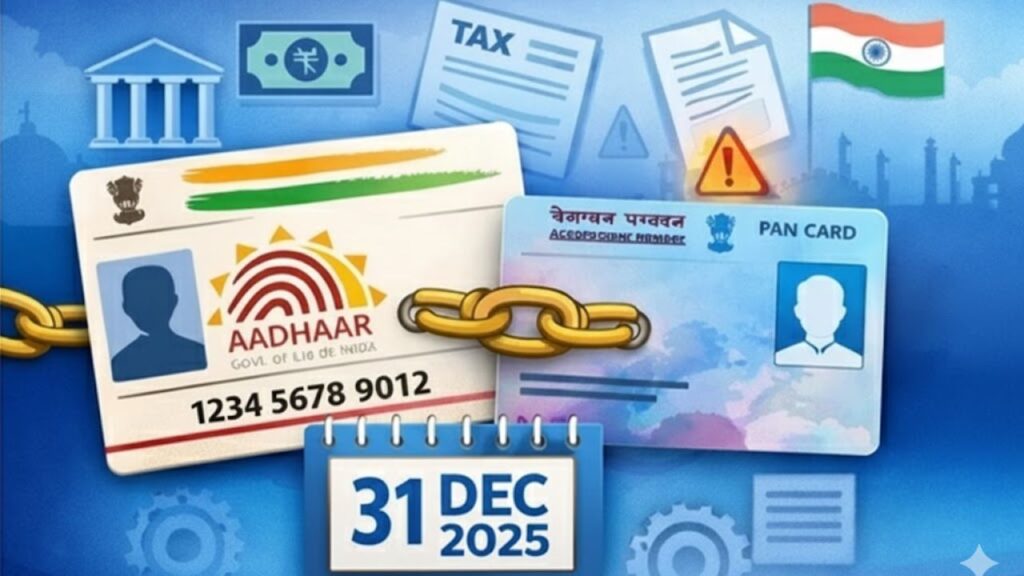
🪪 PAN Card Aadhaar Link Last Date: 31 December 2025 Is the Final Chance, PAN Will Become Inoperative If Not Linked

If your PAN card is still not linked with Aadhaar, this update is extremely important for you. The Income Tax Department has clearly stated that PAN–Aadhaar linking is mandatory for all eligible PAN holders. 👉 31 December 2025 is the final deadlineIf PAN is not linked with Aadhaar by this date, the PAN will become Inoperative, meaning it cannot be used for financial or tax-related work. ⭐ Why PAN–Aadhaar Linking Is Mandatory The government has made PAN–Aadhaar linking compulsory to: ⭐ PAN Aadhaar Link Last Date – Latest Official Update For Most PAN Holders Who Gets Fee Exemption? People who applied for PAN using Aadhaar Enrolment ID after 1 October 2024 can: ⚠️ All other PAN holders must pay the ₹1,000 penalty before linking. ⭐ What Happens If PAN Is Not Linked With Aadhaar? If PAN–Aadhaar is not linked before the deadline, the PAN becomes Inoperative and you may face these problems: ⭐ How to Link PAN With Aadhaar (Step-by-Step Guide) If you have not completed linking yet, follow these steps immediately. 🪜 Online PAN–Aadhaar Linking Process Step 1:Visit the Income Tax e-Filing portal Step 2:Go to Quick Links and click on Link Aadhaar Step 3:Enter your PAN number and Aadhaar number, then click Validate Step 4:If PAN is already linked, a confirmation message will appear Step 5:If not linked, the system will verify penalty payment (if applicable) Step 6:Click on Link Aadhaar Step 7:Enter the 6-digit OTP sent to your Aadhaar-linked mobile number Step 8:Submit the request – linking process will be completed ⏳ PAN–Aadhaar linking usually takes 4–5 working days. ⭐ PAN Aadhaar Linking Fee Details Situation Fee Linking after deadline ₹1,000 PAN made using Aadhaar Enrolment ID (after 1 Oct 2024) ₹0 ⭐ Important Points to Remember Conclusion The PAN Card Aadhaar Link last date is very close, and missing it can create serious tax and banking issues. If your PAN is still not linked, complete the process immediately to avoid your PAN becoming inoperative. Timely linking will ensure smooth income tax filing, refunds, and financial transactions. For simple, reliable, and step-by-step guidance on PAN, Aadhaar, and other government services, visit Sarkari Bakery.

Scroll to Top