
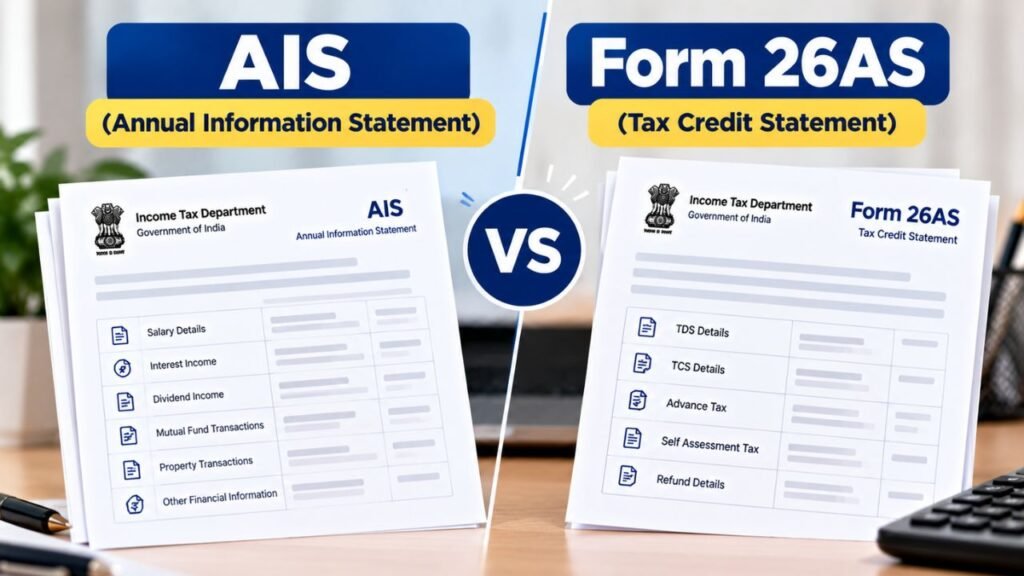
AIS vs Form 26AS is an important comparison for taxpayers preparing their Income Tax Return (ITR). Both are available through the Income Tax Department’s systems and can help taxpayers verify tax-related information before filing their return. However, they serve different purposes and contain different types of information.
From Assessment Year 2023-24 onwards, Form 26AS available through the TRACES system primarily displays TDS and TCS-related information, while broader information about the taxpayer is available through the Annual Information Statement (AIS). The Income Tax Department also provides a feedback facility in AIS for reported transactions.
This difference is important because many taxpayers still assume that Form 26AS and AIS contain exactly the same information. They do not.
For accurate ITR filing, it is better to understand what each statement contains and use them together with documents such as Form 16, Form 16A, bank statements and investment records.
What Is AIS?
AIS stands for Annual Information Statement.
It provides a comprehensive view of information presently available with the Income Tax Department for a taxpayer. The objective is to provide information before filing the income tax return, support voluntary compliance and facilitate pre-filling of the return.
AIS can contain information relating to:
- TDS
- TCS
- Specified Financial Transactions (SFT)
- Payment of taxes
- Refund and demand information
- Other information reported to the Income Tax Department
Depending on the taxpayer’s financial activities, AIS may therefore contain considerably more information than what a taxpayer normally checks in Form 26AS.
AIS also contains a Taxpayer Information Summary (TIS), which provides category-wise aggregated information.
What Is Form 26AS?
Form 26AS is the Annual Tax Statement associated with a taxpayer’s PAN.
Under the current system, from AY 2023-24 onwards, Form 26AS available through TRACES primarily displays TDS and TCS-related data.
It is particularly useful when checking whether tax deducted or collected against your PAN has been reported correctly.
For example, if your employer deducts TDS from your salary, you can use Form 26AS to check whether the corresponding TDS information has been reflected.
Similarly, TDS deducted from certain non-salary payments may also be relevant when reconciling your tax records.
You can learn more about the statement in our detailed guide on Form 26AS.
AIS vs Form 26AS: Main Difference
The simplest way to understand the difference is:
Form 26AS mainly focuses on TDS/TCS-related tax information, while AIS provides a broader view of information available with the Income Tax Department.
The Income Tax Department specifically states that from AY 2023-24 onwards, Form 26AS displays only TDS/TCS-related data, while other taxpayer-related information is available in AIS.
AIS vs Form 26AS Comparison Table
| Feature | AIS | Form 26AS |
|---|---|---|
| Full Name | Annual Information Statement | Annual Tax Statement |
| Main Purpose | Comprehensive taxpayer information | TDS/TCS tax information |
| TDS | Yes | Yes |
| TCS | Yes | Yes |
| SFT Information | Yes | No, not its primary scope |
| Tax Payments | Available in AIS | Not the primary scope |
| Demand/Refund Information | Available in AIS | Not the primary scope |
| Other Reported Information | Available | Limited compared with AIS |
| Taxpayer Feedback | Available | AIS provides the feedback facility |
| TIS | Available within AIS | Not applicable |
| Best Use | Broader financial reconciliation | Checking TDS/TCS |
| Access | Income Tax e-Filing portal | Income Tax e-Filing portal/TRACES route |
The Income Tax Department’s current taxpayer guidance lists TDS/TCS, SFT information, payment of taxes, demand/refund and other information under AIS, while Form 26AS is described as providing TDS/TCS information.
AIS vs Form 26AS: Information Available
Understanding the type of information in each statement makes the difference much clearer.
Information Available in AIS
AIS may include:
- TDS information
- TCS information
- SFT information
- Tax payments
- Demand information
- Refund information
- Other information received by the Income Tax Department
- Certain information related to GST
- Certain information received from foreign governments
- Other reported financial information
The exact information available depends on what has been reported to the Income Tax Department.
Information Available in Form 26AS
Under the current system, Form 26AS primarily contains:
- TDS information
- TCS information
Therefore, if your main objective is to verify whether tax deducted or collected has been reflected against your PAN, Form 26AS remains useful.
Why Did AIS Become Important?
AIS was introduced to provide taxpayers with a broader view of information available with the Income Tax Department before filing their returns.
Instead of relying only on tax-credit information, taxpayers can review additional financial information reported by different sources.
For example, a taxpayer may have:
- Salary income
- Bank interest
- Dividend income
- Investment transactions
- Property-related transactions
- TDS
- TCS
- Tax payments
A broader statement makes it easier to identify information that may need to be considered while preparing the ITR.
However, AIS is not a guarantee that every transaction of the taxpayer will appear there. The Income Tax Department clearly states that AIS contains information presently available with the department and that other transactions may not currently be displayed. Taxpayers are still expected to report complete and accurate information in the ITR.
Is AIS More Important Than Form 26AS?
It is better not to think of AIS as a replacement for Form 26AS.
Both can serve different purposes.
AIS is useful for broader information and reconciliation.
Form 26AS is particularly useful for checking TDS/TCS-related tax credit information.
For example, if your employer deducted ₹40,000 as TDS from your salary, you would want to confirm that the relevant TDS information has been reported correctly.
At the same time, if you have bank interest, dividends or other reportable transactions, AIS can provide additional information that may not be visible in the same way in Form 26AS.
Therefore, checking both can provide a stronger reconciliation process.
AIS vs Form 26AS for ITR Filing
Before filing your ITR, you should ideally compare your tax and financial records across multiple sources.
A practical sequence is:
Form 16 → Form 16A → Form 26AS → AIS → Bank Statements → Investment Records → ITR
For salaried taxpayers, Form 16 is particularly important because it provides salary and salary-TDS information.
For non-salary TDS, Form 16A may also be relevant.
The objective is not to copy every amount from AIS or Form 26AS blindly. Instead, use these statements to reconcile the information with your actual financial records.
Example: AIS vs Form 26AS for a Salaried Employee
Suppose Rahul works for a private company.
During the financial year:
- Salary income: ₹8,00,000
- Salary TDS: ₹42,000
- Bank interest: ₹18,000
- Dividend income: ₹5,000
His employer reports salary TDS.
The bank may report relevant financial information.
When Rahul checks his records:
Form 16:
Shows his salary and salary TDS.
Form 26AS:
Primarily helps him verify the TDS/TCS-related information.
AIS:
May provide a broader view of reported information, including TDS and other applicable information.
Rahul should then compare these records with his bank statements and other financial documents before filing the ITR.
What If AIS and Form 26AS Show Different Information?
A difference does not automatically mean that something is wrong.
AIS and Form 26AS have different scopes, and information can come from different reporting sources and compliance processes.
The Income Tax Department has also stated that information reflected in AIS and 26AS can be based on information received from different sources and tax-compliance actions by different stakeholders.
If you notice a difference, follow this process:
Step 1: Identify the Type of Difference
Determine whether the difference relates to:
- TDS
- TCS
- Income
- Transaction value
- Tax payment
- Another category
Step 2: Check Form 16 or Form 16A
If the difference relates to TDS, compare it with the relevant TDS certificate.
Step 3: Check Your Bank or Investment Records
For interest, dividends or investment transactions, check the original financial records.
Step 4: Check AIS Details
Look at the information source, transaction description and amount displayed in AIS.
Step 5: Submit AIS Feedback Where Appropriate
AIS provides taxpayers with a facility to submit feedback on reported information.
If your TDS credit is missing or incorrect, you can also refer to TDS Credit Not Showing.
Does AIS Show More Information Than Form 26AS?
Yes.
Under the current system, AIS provides broader information than Form 26AS.
The Income Tax Department states that Form 26AS from AY 2023-24 onwards displays only TDS/TCS-related data, while other taxpayer information is available in AIS.
AIS can include information such as:
- TDS/TCS
- SFT
- Tax payments
- Demand
- Refund
- Other reported information
This is why taxpayers should not assume that everything visible in AIS must also appear in Form 26AS.
Does Form 26AS Still Matter?
Yes.
Even though AIS provides broader information, Form 26AS remains useful for checking tax deducted and collected at source.
For example, if you are filing an ITR and claiming TDS credit, checking the relevant TDS information can help identify discrepancies before submitting the return.
A taxpayer should not simply assume that because the TDS amount appears in Form 16, the same credit has automatically been reflected correctly everywhere.
Checking Form 26AS and AIS provides an additional reconciliation step.
How to Check AIS Online
You can access AIS after logging into the Income Tax e-Filing portal.
The Income Tax Department’s FAQ provides the following basic route:
Login → Annual Information Statement (AIS) → Proceed → AIS
AIS can then be viewed for the relevant financial year.
You can also use the detailed AIS Check Online guide for the online checking process.
How to View Form 26AS
Form 26AS is available through the Income Tax e-Filing system using the relevant Form 26AS option.
The Income Tax Department currently describes the route as:
Login → e-File → Income Tax Return → View Form 26AS
You can also refer to Form 26AS Download for the download process.
Should You Check AIS or Form 26AS First?
There is no need to choose only one.
For ITR preparation, a better approach is to check both.
If you want to verify TDS/TCS, Form 26AS is especially useful.
If you want to review broader reported financial information, AIS is more comprehensive.
A practical order can be:
- Collect Form 16/Form 16A
- Check Form 26AS
- Check AIS
- Compare bank statements
- Compare investment records
- Check other income
- Resolve discrepancies
- Prepare and file ITR
You can also refer to ITR Filing Documents for a broader checklist of records to keep ready.
Common Mistakes to Avoid
Assuming AIS and 26AS Are the Same
They are not. Their current scope is different.
Checking Only Form 26AS
This may cause you to overlook information available in AIS.
Checking Only AIS
AIS is comprehensive, but it should not replace your own financial records or the use of Form 26AS for tax-credit reconciliation.
Treating Every AIS Transaction as Taxable Income
A transaction reported in AIS does not automatically mean that the entire transaction value represents taxable income.
The actual tax treatment depends on the nature of the transaction and applicable tax rules.
Ignoring a Mismatch
If Form 16, Form 26AS, AIS and your financial records do not agree, investigate the difference before filing.
Assuming Missing Information Means No Tax Liability
The Income Tax Department specifically states that AIS may not contain every transaction. Taxpayers remain responsible for reporting complete and accurate information.
AIS vs Form 26AS: Which One Should You Use?
The answer depends on what you are checking.
| Your Requirement | Better Reference |
|---|---|
| Check salary TDS | Form 26AS + Form 16 |
| Check non-salary TDS | Form 26AS + Form 16A |
| Review broader reported information | AIS |
| Check SFT information | AIS |
| Review tax payments | AIS |
| Review demand/refund information | AIS |
| Reconcile TDS/TCS | Form 26AS |
| Prepare for ITR filing | AIS + Form 26AS + supporting records |
The best approach is therefore not AIS vs Form 26AS, but AIS and Form 26AS together.
AIS vs Form 26AS: Quick Summary
The key differences can be remembered easily:
- AIS = broader information
- Form 26AS = primarily TDS/TCS information
- AIS contains TDS/TCS as well as other reported information.
- Form 26AS remains useful for checking tax credits.
- AIS provides a taxpayer feedback facility.
- AIS also contains TIS for aggregated information.
- Neither statement should replace your own financial records.
- AIS may not contain every transaction.
- Both should be checked when preparing an accurate ITR.
Conclusion
The difference between AIS vs Form 26AS is mainly about the scope of information they provide.
From AY 2023-24 onwards, Form 26AS available through TRACES primarily displays TDS and TCS-related data, while AIS provides a broader view of information available with the Income Tax Department. AIS also provides a feedback facility for reported transactions.
For accurate ITR filing, taxpayers should ideally check both AIS and Form 26AS and compare them with Form 16, Form 16A, bank statements, investment records and other financial documents.
Most importantly, do not assume that missing information in AIS or Form 26AS means that an income or transaction does not need to be reported. The taxpayer remains responsible for filing complete and accurate information.
For more practical Income Tax, ITR, PAN and government-service guides, visit Sarkari Bakery.
Frequently Asked Questions About AIS vs Form 26AS
id=”0ou9te”
Based on Google's Helpful Content System, this article emphasizes user value, transparency, and accuracy. It incorporates principles of E-E-A-T (Experience, Expertise, Authoritativeness, Trustworthiness).
Why Choose Sarkari Bakery?
Official Information
Government schemes & banking information based on official sources.
Step-by-Step Guides
Simple application process explained for every service.
Regular Updates
Content updated whenever official rules or services change.
People-First Content
Helpful, transparent and user-focused content.
Pingback: Freelancer ITR Documents: Complete List of Documents Required to File ITR - Sarkari Bakery