
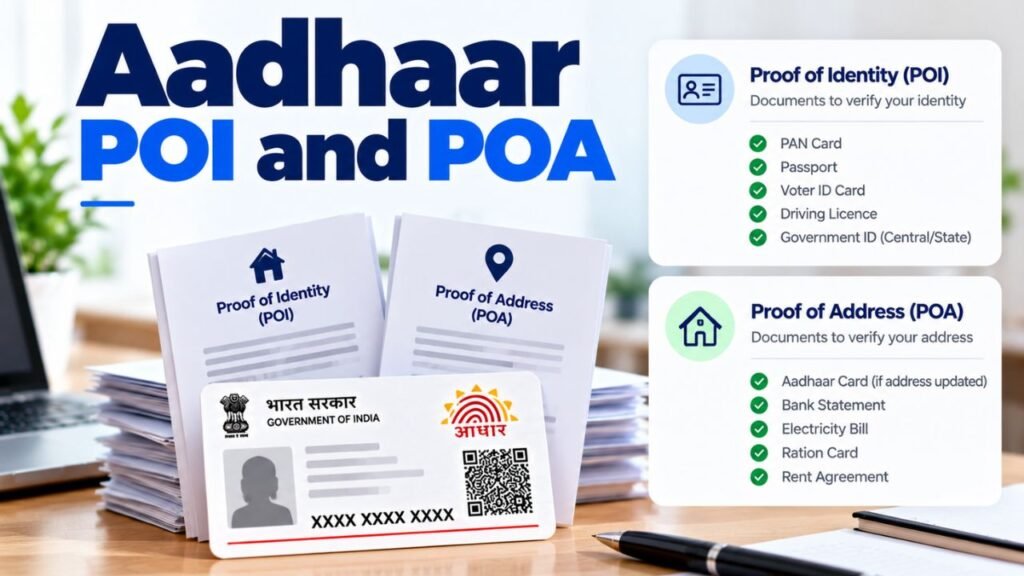
When you apply for Aadhaar or update your Aadhaar details, UIDAI requires supporting documents to verify the information you provide. Two of the most important document categories are POI and POA.
POI means Proof of Identity, while POA means Proof of Address. POI generally establishes your identity through details such as your name and photograph, whereas POA establishes your residential address.
UIDAI maintains an official list of acceptable supporting documents for Aadhaar enrolment and updates. The current 2026 Aadhaar Handbook lists documents separately under POI, POA, Proof of Relationship (POR) and Date of Birth (DOB) categories.
Understanding the difference between Aadhaar POI and POA is important because submitting the wrong document can lead to delays or rejection of an enrolment or update request.
What Is POI in Aadhaar?
POI stands for Proof of Identity.
A POI is a document used to establish the identity of the person applying for Aadhaar enrolment or an Aadhaar update.
UIDAI’s verification guidance states that a POI used for Aadhaar should contain the individual’s name and photograph. The verifier checks the identity details against the document submitted.
Common Aadhaar POI Documents
The current UIDAI Aadhaar Handbook lists several documents under Proof of Identity, including:
- Passport
- PAN Card
- Ration/PDS Photo Card
- Voter ID
- Driving Licence
- Government photo ID card
- Service photo identity card issued by a PSU
- NREGS Job Card
- Photo ID issued by a recognised educational institution
- Arms Licence
- Photo Bank ATM Card
- Photo Credit Card
- Pensioner Photo Card
- Freedom Fighter Photo Card
- Kisan Passbook
- CGHS/ECHS Photo Card
- Address card containing name and photograph issued by the Department of Posts
- Disability ID Card
- Certain UIDAI-standard certificates issued by authorised officials
The exact list can change, so applicants should use the current UIDAI list of acceptable documents rather than relying on an old list found online.
What Is POA in Aadhaar?
POA stands for Proof of Address.
A POA is a document used to establish the address of the Aadhaar applicant.
The document should contain the information required to establish the applicant’s residential address and must be among the documents accepted by UIDAI for Aadhaar enrolment or update.
Common Aadhaar POA Documents
The current UIDAI Handbook lists several POA documents, including:
- Passport
- Bank Statement or Passbook
- Post Office Account Statement or Passbook
- Ration Card
- Voter ID
- Driving Licence
- Government photo ID card or PSU service photo identity card
- Electricity Bill
- Water Bill
- Telephone Landline Bill
- Property Tax Receipt
- Credit Card Statement
- Insurance Policy
- Certain bank-issued address documents
- Certain company-issued address certificates
- Recognised educational institution documents
- NREGS Job Card
- Pensioner Card
- Freedom Fighter Card
- Kisan Passbook
- CGHS/ECHS Card
- Certain UIDAI-standard address certificates
Some documents have specific age or validity requirements. For example, the current UIDAI Handbook lists electricity, water and telephone landline bills as POA documents when they meet the specified recency requirement.
Difference Between POI and POA
The easiest way to remember the difference is:
POI = Who you are
POA = Where you live
| Feature | POI | POA |
|---|---|---|
| Full form | Proof of Identity | Proof of Address |
| Main purpose | Establishes identity | Establishes residential address |
| Main information | Name and photograph | Name and address |
| Used for | Identity verification | Address verification |
| Example | PAN Card | Electricity Bill |
| Example | Voter ID | Bank Passbook |
| Example | Passport | Ration Card |
| Example | Driving Licence | Property Tax Receipt |
Some documents can serve as both POI and POA, depending on UIDAI’s current accepted-document list.
For example, the current UIDAI Handbook lists documents such as a passport, voter ID and driving licence in both the POI and POA categories.
Which Documents Are Accepted as Both POI and POA?
This is one of the most useful things to understand when preparing for an Aadhaar update.
Some documents contain both identity and address information. Where UIDAI accepts them in both categories, one document may satisfy both requirements.
Examples include:
- Passport
- Voter ID
- Driving Licence
- Certain government-issued photo ID documents
- Certain ration/PDS documents
- Certain employment or government-issued cards
However, acceptance depends on the current UIDAI document list and the specific Aadhaar service.
Do not assume that every document containing an address automatically qualifies as POI and POA.
POI and POA for Aadhaar Enrolment
For standard document-based Aadhaar enrolment, UIDAI requires applicable supporting documents for identity and address.
UIDAI’s current enrolment information describes the document-based approach as submission of valid POI and POA documents. It also provides an HoF-based route for eligible people who cannot provide the required individual documents.
The applicant should carry the original supporting documents to the enrolment centre for verification.
UIDAI specifically states that original documents are required for Aadhaar enrolment and are returned after the process along with the acknowledgement slip.
POI and POA for Aadhaar Update
POI and POA are also relevant when updating Aadhaar demographic information.
For example, if you need to update your:
- Name
- Address
- Other eligible demographic details
you may need to submit the appropriate supporting documents.
UIDAI states that demographic updates can be supported by POI and POA documents, depending on the information being updated.
If you are specifically updating documents rather than changing the underlying Aadhaar information, see the guide on Aadhaar Document Update.
Do POI and POA Need to Be in the Same Name?
For normal document-based verification, the supporting document should belong to the person whose Aadhaar information is being enrolled or updated.
UIDAI’s verification guidance specifically instructs the verifier to confirm that the applicant is providing their own documents and to verify the relevant name, address and other details against the supporting documents.
For example, if an electricity bill is in your father’s name, you should not simply submit it as your own POA through the normal document-based process.
If you do not have an address document in your own name, UIDAI has an Head of Family (HoF)-based mechanism for eligible situations.
What If You Do Not Have POA in Your Own Name?
This is a common problem for people who live with their parents, spouse or another family member.
UIDAI provides an HoF-based mechanism in eligible cases where the individual does not have the required POI and/or POA documents.
Under the applicable HoF process, the relationship with the Head of Family is established through an accepted Proof of Relationship (POR) document, and the HoF’s Aadhaar information can be used according to the applicable rules.
This is particularly relevant for:
- Family members living together
- Children
- People without individual address documents
- People whose household documents are in another family member’s name
For more details, you can read Aadhaar Address Update Without Proof.
What Is POR in Aadhaar?
Although this guide focuses on POI and POA, POR is also important when using the Head of Family route.
POR means Proof of Relationship.
A POR document establishes the relationship between the applicant and the Head of Family.
The current UIDAI Handbook identifies POR documents as documents containing the name of the applicant and the name of the HoF. Its listed examples include PDS cards and MNREGA Job Cards, among other applicable documents.
POI, POA, POR and DOB: What Is the Difference?
These four categories are often confused.
| Document Type | Full Form | Purpose |
|---|---|---|
| POI | Proof of Identity | Establishes identity |
| POA | Proof of Address | Establishes address |
| POR | Proof of Relationship | Establishes relationship with HoF |
| DOB/PDB | Proof of Date of Birth | Establishes date of birth |
For example:
- PAN Card → commonly used as POI
- Electricity Bill → commonly used as POA
- PDS Card → may establish relationship where accepted
- Birth Certificate → used as a date-of-birth document
The applicable document list should always be checked before submission.
Can PAN Card Be Used as POI?
Yes. The current UIDAI Aadhaar Handbook lists PAN Card among the POI documents.
However, PAN Card should not automatically be treated as a POA simply because you want to update your address. The document category accepted for the particular purpose matters.
Can Electricity Bill Be Used as POA?
Yes, an electricity bill can be used as a POA when it satisfies UIDAI’s applicable requirements.
The current UIDAI Handbook lists an electricity bill not older than three months among the POA documents.
The bill should also meet the applicable identity/name requirements for the Aadhaar service.
If the electricity bill belongs to another family member, do not simply treat it as your own POA. Consider whether the HoF-based route is applicable.
Can Bank Passbook Be Used as POA?
Yes. The current UIDAI Handbook lists Bank Statement/Passbook and Post Office Account Statement/Passbook among POA documents.
Make sure the document satisfies the current UIDAI requirements and contains the necessary information.
Can Voter ID Be Used as POI and POA?
Yes. Voter ID is listed in the current UIDAI Handbook under both POI and POA categories.
This makes it a useful document for applicants who need to establish both identity and address.
Can Driving Licence Be Used as POI and POA?
Yes. A driving licence appears in the current UIDAI Handbook under both POI and POA.
However, always use the current document list applicable to your Aadhaar service.
Can Passport Be Used as Both POI and POA?
Yes. A valid Indian passport is listed as both POI and POA in the current UIDAI documentation. The 2026 Aadhaar regulations also specifically identify a valid Indian passport as POI and POA in document-based enrolment/update examples.
How to Choose the Right POI and POA
Before submitting your Aadhaar request, follow these steps.
Step 1: Identify What You Need to Update
First determine whether you are:
- Applying for new Aadhaar
- Updating address
- Updating name
- Updating demographic information
- Updating supporting documents
Step 2: Check UIDAI’s Current Document List
Do not rely only on a list from an old article or social media post.
UIDAI currently publishes a dedicated list of acceptable documents for Aadhaar enrolment and update.
Step 3: Select the Appropriate POI
Choose a valid identity document containing the required identity information.
Step 4: Select the Appropriate POA
Choose a valid address document containing the required address information.
Step 5: Check the Name
Make sure the document belongs to the person whose Aadhaar is being updated, unless an applicable HoF process is being used.
Step 6: Check Document Validity
Some documents have specific validity or age requirements.
For example, certain utility bills must be recent.
Step 7: Carry Original Documents
If visiting an Aadhaar centre, carry the original documents for verification. UIDAI states that original supporting documents are required for enrolment and are returned after the process.
What Happens If You Submit the Wrong POI or POA?
Submitting an incorrect, invalid or unsuitable document can result in the Aadhaar request being rejected.
Common problems include:
- Document is not on the accepted list
- Document does not belong to the applicant
- Name does not match
- Address does not support the requested update
- Document is expired or outside the permitted validity period
- Document image is unclear
- Incorrect document type is selected
- Required information is missing
UIDAI’s verification guidance requires the verifier to check the authenticity and relevant details of the documents submitted.
If your request has already been rejected, you can review Aadhaar Update Rejected for the next steps.
Does POI and POA Need to Have the Same Address?
For an address update, the address-related information should be supported by the applicable POA.
A POI primarily establishes identity, while POA establishes address.
Therefore, do not assume that an identity document automatically proves your current address unless UIDAI specifically accepts that document in the POA category.
This is why documents such as passports, voter IDs and driving licences can sometimes serve both purposes, while documents such as PAN Card are primarily useful as POI.
Can One Document Be Used for Both POI and POA?
Yes.
Where UIDAI lists a document under both categories, the same document can potentially satisfy both requirements.
Examples include:
- Passport
- Voter ID
- Driving Licence
- Certain government-issued photo identity documents
- Other documents listed in both categories
Always check the current UIDAI list before submitting the document.
Important Mistakes to Avoid
Using Another Person’s Document
Do not submit your parent’s or spouse’s address document as your own POA through the normal process.
Using an Old Document List
UIDAI updates its supporting-document rules. Use the current list.
Ignoring Validity Requirements
A document may be accepted only if it meets a specific age or validity condition.
Uploading Poor-Quality Copies
If the service requires an online upload, make sure the document is clear and complete.
Confusing POI With POA
A PAN Card can establish identity but should not automatically be treated as proof of address.
Forgetting Original Documents at the Centre
For centre-based enrolment/update, carry the original documents required for verification.
POI and POA for Address Update
If your goal is specifically to change your Aadhaar address, the POA is particularly important.
UIDAI’s current update guidance states that address updates require appropriate supporting documentation where the document-based route is used. Online address update is available through the applicable myAadhaar process, subject to the service requirements.
If you need a detailed guide on changing the actual address, you can also read Aadhaar Card Address Update.
POI and POA for Document Update
UIDAI also provides a facility to update the POI and POA documents associated with Aadhaar.
The current 2026 Aadhaar regulations specifically identify “Update of POI and POA documents” as an Aadhaar update category.
This is different from changing the actual demographic information.
For example:
Document update:
You submit current POI/POA documents.
Address update:
You request a change to the address recorded in Aadhaar.
Understanding this difference can help you select the correct service.
Practical Example
Suppose your Aadhaar contains:
Name: Rahul Kumar
Address: Delhi
You have a valid passport containing your name and current address.
The passport may serve as both POI and POA because UIDAI lists a valid passport in both categories.
Now consider another situation:
Your PAN Card contains your name but does not provide the address information needed for your address update.
In that situation, the PAN Card can be useful as POI, but you would need an accepted POA for the address-related requirement.
This is why choosing the correct document category matters.
Final Checklist for Aadhaar POI and POA
Before visiting an Aadhaar centre or submitting an update request, check:
- Is the document accepted by UIDAI?
- Does the POI contain the required identity information?
- Does the POA contain the required address information?
- Is the document in your name where required?
- Is the document still valid?
- Does the document meet any age/recency requirement?
- Is the document clear and readable?
- Are you carrying the original document for centre-based verification?
- Are you using the correct Aadhaar service?
- Have you saved the acknowledgement/SRN after submission?
Frequently Asked Questions
Conclusion
Understanding Aadhaar POI and POA is essential when applying for Aadhaar or updating Aadhaar details.
POI means Proof of Identity, while POA means Proof of Address. Some documents, such as a valid passport, voter ID and driving licence, may be accepted in both categories, while other documents are intended mainly for one category.
Always check the latest UIDAI list before submitting your documents. Make sure the document is valid, belongs to the appropriate person, contains the required information and meets any applicable validity or recency requirements.
If you do not have your own address proof, do not simply use another person’s document as your POA. Check whether the applicable Head of Family route is available for your situation.
For more practical guides on Aadhaar, government documents and citizen services, visit Sarkari Bakery.
Based on Google's Helpful Content System, this article emphasizes user value, transparency, and accuracy. It incorporates principles of E-E-A-T (Experience, Expertise, Authoritativeness, Trustworthiness).
Why Choose Sarkari Bakery?
Official Information
Government schemes & banking information based on official sources.
Step-by-Step Guides
Simple application process explained for every service.
Regular Updates
Content updated whenever official rules or services change.
People-First Content
Helpful, transparent and user-focused content.