
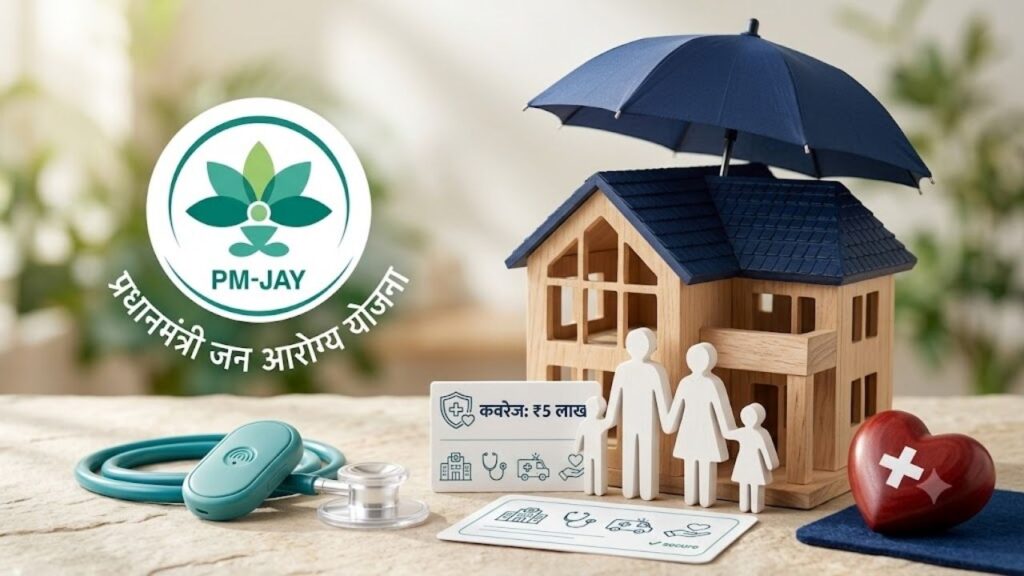
Healthcare expenses can place a significant financial burden on families, especially during emergencies or serious illnesses. To ensure that economically weaker sections receive quality medical treatment without worrying about hospital bills, the Government of India launched the Pradhan Mantri Jan Arogya Yojana (PM-JAY) under the Ayushman Bharat Mission.
Popularly known as the Ayushman Bharat Health Insurance Scheme, PM-JAY provides eligible families with cashless health insurance coverage of up to ₹5 lakh per family every year for hospitalization at empanelled government and private hospitals across India.
This detailed guide explains everything about PM-JAY, including eligibility, benefits, Ayushman Card registration, required documents, hospital list, claim process, and frequently asked questions.
What is Pradhan Mantri Jan Arogya Yojana (PM-JAY)?
Pradhan Mantri Jan Arogya Yojana (PM-JAY) is one of the world’s largest government-funded health insurance schemes. It was launched under the Ayushman Bharat Programme to provide free cashless treatment to eligible families for secondary and tertiary healthcare services.
Under this scheme, eligible beneficiaries receive health insurance coverage of up to ₹5 lakh per family per year without paying any premium.
The scheme aims to reduce out-of-pocket medical expenses and improve access to quality healthcare for economically weaker families.
Key Highlights of PM-JAY
| Particular | Details |
|---|---|
| Scheme Name | Pradhan Mantri Jan Arogya Yojana (PM-JAY) |
| Popular Name | Ayushman Bharat Yojana |
| Launched By | Government of India |
| Launch Year | 2018 |
| Coverage Amount | Up to ₹5 Lakh per family per year |
| Premium | No premium for eligible beneficiaries |
| Treatment Type | Cashless hospitalization |
| Hospitals | Government & Empanelled Private Hospitals |
| Beneficiaries | Eligible economically weaker families |
Objectives of PM-JAY
The primary objective of PM-JAY is to provide affordable healthcare services to vulnerable families.
The scheme aims to:
- Reduce financial burden due to medical emergencies.
- Provide quality healthcare facilities.
- Increase access to private hospitals.
- Promote cashless treatment.
- Improve healthcare infrastructure.
- Prevent families from falling into poverty due to medical expenses.
Benefits of Pradhan Mantri Jan Arogya Yojana
PM-JAY provides comprehensive healthcare benefits.
Major benefits include:
Cashless Hospitalization
Eligible families can receive completely cashless treatment at empanelled hospitals.
Health Coverage up to ₹5 Lakh
Each eligible family receives annual health insurance coverage of up to ₹5 lakh.
Pre-Hospitalization Expenses
Medical expenses incurred before hospitalization are covered for eligible treatments.
Post-Hospitalization Expenses
Expenses after discharge, including medicines and follow-up care for covered procedures, are also included as per scheme provisions.
No Family Size Limit
There is generally no restriction on the number of family members eligible under PM-JAY.
No Age Limit
Eligible beneficiaries of all age groups can receive benefits under the scheme.
Treatment Across India
Beneficiaries can receive treatment at empanelled hospitals across India through the portability feature.
Treatments Covered Under PM-JAY
The scheme covers numerous medical specialties, including:
- General Surgery
- Cardiology
- Oncology
- Orthopaedics
- Neurology
- Nephrology
- Urology
- ENT
- Ophthalmology
- Maternity Care
- Pediatric Care
- Burns Management
- Trauma Care
- Intensive Care Services
Coverage depends on the approved treatment packages under the scheme.
Who is Eligible for PM-JAY?
PM-JAY primarily covers eligible families identified under the Socio-Economic Caste Census (SECC) database and other approved beneficiary categories.
Eligible beneficiaries may include:
- Economically weaker families
- Rural households meeting eligibility criteria
- Urban workers in eligible occupations
- Informal sector workers
- Small and marginal farmers
- Construction workers
- Street vendors
- Domestic workers
- Sanitation workers
- Mine workers
- Other notified beneficiary categories
Eligibility can be verified through the official Ayushman Bharat beneficiary portal.
Documents Required
Applicants should keep the following documents ready:
- Aadhaar Card
- Ration Card (where applicable)
- Registered Mobile Number
- Family Identification Documents (if required)
- Government-issued Identity Proof
Additional documents may be required depending on state-specific implementation.
How to Check PM-JAY Eligibility
Before applying, check whether your family is eligible.
The process is simple.
Visit the official Ayushman Bharat beneficiary portal.
Choose the eligibility checking option.
Enter:
- Mobile Number
- OTP
- State
- Name or Family Details
If your family is listed, you can proceed with Ayushman Card generation.
How to Register for PM-JAY
Eligible beneficiaries can register through various channels.
These include:
- Official Ayushman Bharat Portal
- Common Service Centres (CSC)
- Empanelled Hospitals
- Ayushman Mitra Help Desk
- State Health Agencies
Online Registration Process
If online registration is available in your state, follow these steps.
Visit the official PM-JAY portal.
Verify your eligibility.
Authenticate using Aadhaar OTP.
Provide required beneficiary details.
Upload necessary documents if requested.
Submit the application.
After successful verification, your Ayushman Card will be generated.
How to Get an Ayushman Card
Once your eligibility is confirmed:
- Complete identity verification.
- Verify Aadhaar details.
- Capture photograph if required.
- Generate the Ayushman Bharat Card.
- Download or print the card.
The Ayushman Card can be used at empanelled hospitals.
How to Find PM-JAY Hospitals
Beneficiaries can search for empanelled hospitals by:
- State
- District
- Hospital Name
- Specialty
- Hospital Type
Only empanelled hospitals provide cashless treatment under the scheme.
How to Avail Cashless Treatment
When visiting an empanelled hospital:
Carry:
- Ayushman Card
- Aadhaar Card
- Identity Proof (if required)
The hospital verifies beneficiary details.
Eligible treatment is approved.
Cashless hospitalization is provided.
Hospital bills are settled directly under the scheme.
How Does the Claim Process Work?
One of the biggest advantages of PM-JAY is that beneficiaries usually do not need to submit reimbursement claims themselves.
The hospital handles:
- Patient verification
- Treatment approval
- Claim submission
- Settlement with the implementing authority
This makes the process simple for beneficiaries.
Major Advantages of PM-JAY
Some important advantages include:
- Cashless hospitalization
- No premium payment
- Nationwide portability
- Large network of hospitals
- No restriction on family size
- Coverage for major surgeries
- Reduced financial burden
- Better access to quality healthcare
Things to Remember
Before visiting a hospital:
- Verify that the hospital is empanelled.
- Carry your Ayushman Card.
- Keep Aadhaar available for verification.
- Confirm that your treatment is covered.
- Preserve discharge summaries and medical records.
Conclusion
The Pradhan Mantri Jan Arogya Yojana (PM-JAY) has significantly improved access to affordable healthcare for millions of eligible families across India. With cashless hospitalization up to ₹5 lakh per family every year, the scheme helps protect beneficiaries from high medical expenses while ensuring timely treatment at empanelled hospitals.
Eligible families should verify their beneficiary status, obtain an Ayushman Card, and make full use of the healthcare benefits available under the scheme.
Frequently Asked Questions (FAQs)
[su_accordion]

[su_spoiler title="What is Pradhan Mantri Jan Arogya Yojana (PM-JAY)?" open="no" style="default" icon="plus"]
PM-JAY is a government-funded health insurance scheme that provides eligible families with cashless hospitalization benefits of up to ₹5 lakh per family per year at empanelled hospitals.
[/su_spoiler]

[su_spoiler title="Who is eligible for PM-JAY?" open="no" style="default" icon="plus"]
Eligibility is generally based on the Socio-Economic Caste Census (SECC) database and other approved beneficiary categories notified under the scheme.
[/su_spoiler]

[su_spoiler title="How can I check whether I am eligible for PM-JAY?" open="no" style="default" icon="plus"]
You can verify your eligibility through the official Ayushman Bharat beneficiary portal by entering your registered mobile number and other required details.
[/su_spoiler]

[su_spoiler title="How much health insurance coverage is available under PM-JAY?" open="no" style="default" icon="plus"]
Eligible families receive health insurance coverage of up to ₹5 lakh per family per year for covered hospitalization expenses.
[/su_spoiler]

[su_spoiler title="Can I receive treatment in any state under PM-JAY?" open="no" style="default" icon="plus"]
Yes. Eligible beneficiaries can generally receive cashless treatment at empanelled hospitals across India through the portability feature.
[/su_spoiler]

[su_spoiler title="Is there any premium to be paid under PM-JAY?" open="no" style="default" icon="plus"]
No. Eligible beneficiaries are not required to pay any premium for coverage under the scheme.
[/su_spoiler]

[su_spoiler title="What documents are required for PM-JAY registration?" open="no" style="default" icon="plus"]
Applicants generally require Aadhaar Card, Ration Card (where applicable), registered mobile number, and other identity documents as required for verification.
[/su_spoiler]

[su_spoiler title="How can I obtain my Ayushman Card?" open="no" style="default" icon="plus"]
After successful eligibility verification and Aadhaar authentication, eligible beneficiaries can generate and download their Ayushman Card through authorized channels.
[/su_spoiler]

[/su_accordion]Based on Google's Helpful Content System, this article emphasizes user value, transparency, and accuracy. It incorporates principles of E-E-A-T (Experience, Expertise, Authoritativeness, Trustworthiness).
Why Choose Sarkari Bakery?
Official Information
Government schemes & banking information based on official sources.
Step-by-Step Guides
Simple application process explained for every service.
Regular Updates
Content updated whenever official rules or services change.
People-First Content
Helpful, transparent and user-focused content.